Salalah · CountriesSalalah’s monsoon tourism, container port, frankincense trade and banana farms follow one calendar.
Salalah is the largest city of Dhofar in southern Oman. Between June and September the khareef monsoon turns the hills green and brings visitors from across the Gulf. A deepwater container port and free zone handle ships all year. Frankincense, coconuts and bananas are old local products. Hotels, car hire and shipping firms keep very different schedules.
The khareef is the busiest tourist season. Families drive in from neighbouring states, hotels and guesthouses fill, and car rental firms run short of vehicles. Outside those months the city is far quieter, so businesses plan cash for the slow period.
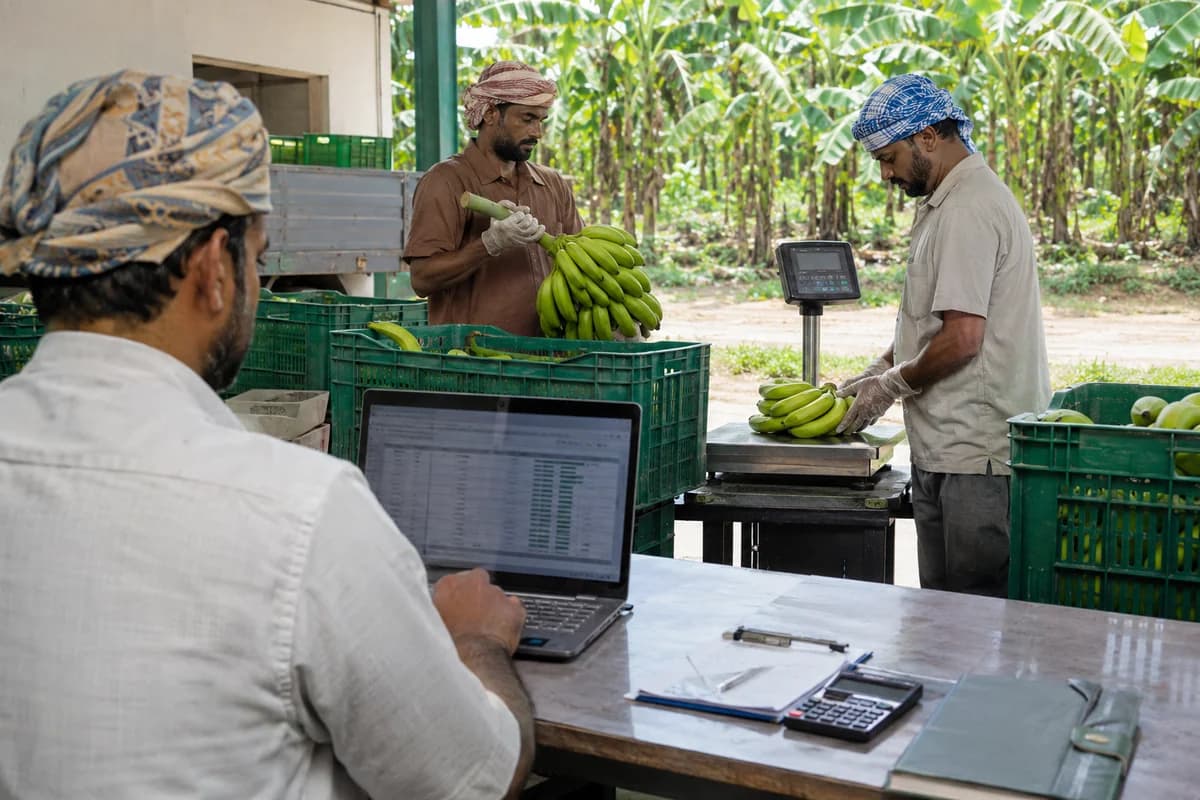
The port is the second trade. Shipping agents, freight forwarders, truckers and warehouse operators serve ships that call all year, and customs paperwork follows every box. Farms on the plain grow coconuts and bananas for local markets, and shops in the old souq sell frankincense and perfume oils. Oman is about an hour and a half behind Bengaluru. Working days overlap almost fully.
The districts, business parks and markets that matter in Salalah.
How Salalah businesses pick and use software.
Freight forwarders want one file per shipment holding documents, charges and delivery, so a customer’s status call can be answered in a minute without opening five inboxes.
Guesthouse owners need seasonal rates, bookings and deposits that match across channels, because the khareef weeks bring a rush of bookings and little time to correct a mistake.
Farm owners want harvest and sales recorded by plot and buyer.
Where Salalah businesses lose time and money.
Shipment papers sit in different inboxes
Bills, packing lists and invoices arrive by email, and one file per shipment lets anyone in the office find the right paper.
Rates are changed in a notebook
Peak and off-peak prices differ by week. A rate calendar applies the right price to each booking.
Rental cars come back with unrecorded damage
Photos at pickup and return settle disputes over scratches and deposits.
Farm sales are remembered, not recorded
Sales to repeat buyers are noted loosely. A simple ledger shows who has paid.
What we would build for Salalah businesses.
Usually in this order, starting with whatever the audit ranks first.
Web and Mobile Application Development
Web and mobile apps for customers, field staff and dealers, built to work on ordinary phones.
Learn moreBusiness Process Automation
Approvals, reminders and reports triggered by agreed rules, with exceptions assigned to a responsible person.
Learn moreERP, CRM and Business Software Implementation
One record of stock, orders, customers and accounts, set up so your team opens it every day.
Learn moreSoftware Maintenance, Support and Rescue
Taking over the system your last vendor stopped answering for: fixing it, documenting it and keeping it running.
Learn moreReady products that fit Salalah businesses.
Each one is adapted to how your business works before it goes live, and anything your trade needs that it lacks is added then. You are not paying to build the basics again.
Freight Forwarder Management Software
Rate sheets, quotations, job files, house bill drafts, milestones, buying and selling charges, vendor bills and agent statements for freight forwarders.
Learn moreHomestays and Guesthouse Management Software
Room and bed calendar, enquiries, guest register, deposits, meals, extras, housekeeping and bills for homestays and guesthouses.
Learn moreCrop Farm Management Software
Field plans, input stores, spray logs, machine hours, harvest weighbridge tickets, bin stock and grain contracts for arable crop farms.
Learn moreHow the work runs from Bengaluru for Salalah.
- 1
The audit, by call
A screen-share and a look at the sheets, accounting reports and WhatsApp groups your team uses. No travel needed.
- 2
A written proposal
Scope, what we build first and the cost, agreed in writing before anything starts.
- 3
Build in short rounds
Working screens shared every few weeks. Your team tests them from your own office.
- 4
Go-live, in person when it helps
For data migration and training we can come to Salalah. Travel is agreed in advance.
- 5
Support online
Fixes, changes and hosting handled remotely by the same team that built it.
The work we have published.
We don’t claim Salalah clients we don’t have. These are systems our team built; the way we work is the same wherever you are.
PetSeva: matching owners to the right vet, at any hour
A two-sided veterinary platform where vets are searchable by specialisation and bookable outside clinic hours. It now carries more than 2,000 veterinary doctors.
Read the case study Paying guest accommodationSAM Atithi Pavathi: bed-level occupancy as the source of truth
PG management software where allocation, rates and invoices are derived from bed-level occupancy and not maintained in parallel spreadsheets.
Read the case study School transport servicesSAM Tours: school transport on a single ledger
Registration, fee collection, routing and finance write to the same records, closing the gap between journeys run and fees collected.
Read the case study Microfinance and Self Help GroupsVikasa RDO: making SHG loan recovery auditable
Loan proposals, recoveries and commissions sit on one record, with a person attached to every state change, so a business handling a bank’s money can show where each rupee went.
Read the case studyMake the scope specific to your business.
Work through a real example from your operation and agree the handoffs, controls and support the project needs.
Shipment papers sit in different inboxes
Can a partial delivery be distinguished from a completed order?
For “Shipment papers sit in different inboxes”, follow an example that leaves in more than one trip. Compare the quantity handed over with the quantity still owed before closing the order.
Background reading: ERPNext: delivery notes
Rates are changed in a notebook
Which rule wins when two rates or offers apply?
Use “Rates are changed in a notebook” to check an ordinary sale and one that meets two pricing conditions. Ask for the calculation behind each final amount, rather than only the total.
Background reading: ERPNext: pricing conditions
Questions Salalah owners ask before they call.
Can the booking system handle different prices for the khareef weeks?
Yes, it can. You set a rate calendar by date range and room type, and the system applies it to every booking made on your website or entered by staff.
Can shipment files be shared with a customer without giving full access?
Yes, safely. A customer gets a link that shows status and documents for their own shipments only, and you can switch that link off whenever the job closes.
What happens after I share my requirements?
We review your brief and clarify the work with you. We then look at the software, spreadsheets and WhatsApp groups your business runs on today and write down what works, what slows your team down and what is missing. A demo login, a screen-share or a few screenshots are enough. You get a short written summary ordered by priority, with no obligation to hire us afterwards.
How much will the software cost?
We don’t publish a price, because it depends on what the system has to do. That first review settles the scope, and the cost goes into a written proposal before any work starts.
Industries we build for in Salalah.
Elsewhere in Oman.
Tell us what your Salalah business runs on today.
Send a short note on the spreadsheets, software or WhatsApp groups your team depends on. We reply the same working day.
What happens after you share your requirements
- We review your brief and the systems you already use.
- We clarify the workflow, missing information and the work to consider first.
- The proposed scope sets out the deliverables, responsibilities and dependencies.
- Review the scope and commercial terms before deciding whether to proceed.
Start with your requirements
Describe your current process, the people involved and the change you need. Start with the details you know; we can clarify the rest together.
Share your requirements