Lund · CountriesLund pairs a university of the seventeenth century with two large research facilities and a science park.
Lund is a small cathedral city whose economy is research. The university dates to the seventeenth century, a synchrotron and a neutron research facility sit on the northern edge, and science parks house medtech, sensor and software companies. Malmö is close by train. Student nations organise much of the social life. A carnival held every few years floods the town with visitors, and shops, cafes and caterers prepare for it long in advance.
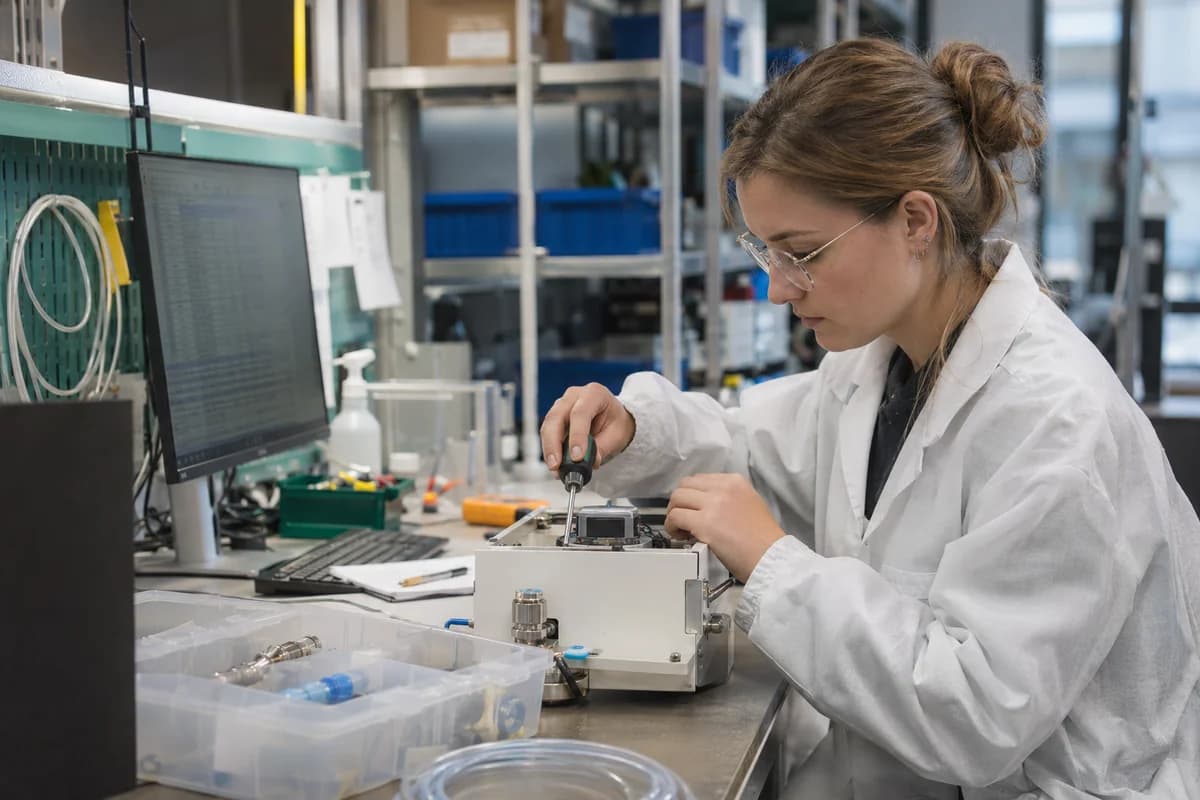
Research facilities buy instruments, vacuum parts and software in small, specialised lots. Each item is booked to a project. Sales cycles are slow, and universities buy under public procurement rules that favour clear, complete quotes with every specification written out in full.
Companies in Lund grow from a lab bench into a team of twenty, and the tools that served the first five hires stop working somewhere around the tenth. Our team is in Bengaluru, and we write for firms at that stage. We do no scientific work.
The districts, business parks and markets that matter in Lund.
How Lund businesses pick and use software.
Start-ups in medtech, sensors and software that must manage first customers, component orders and investor reports.
Suppliers to research facilities, who sell specialised parts in small lots against project budgets.
Where Lund businesses lose time and money.
Prototype units without a parts list
A medtech start-up builds ten units, each slightly different from the last. When a regulator or customer asks what is inside unit seven, nobody knows. A parts list per build answers it.
Orders tied to project budgets
A research group buys against a grant line and cannot pay an invoice that lacks the project code. Suppliers who record the project code on quotes, orders and invoices avoid payment delays.
A small team and one overloaded founder
The founder answers support, sales and invoices, and has no time left to design the product. A shared inbox with ticket status and a basic customer record gives the first hires a place to start.
What we would build for Lund businesses.
Usually in this order, starting with whatever the audit ranks first.
MVP Product Development
A first working version of a new product, small enough to launch and learn from.
Learn moreSaaS Product Development
Turning a system that works for one business into a product other businesses can subscribe to.
Learn moreUI/UX Design and Prototyping
Prototypes tested with the people doing the work, including corrections, missing information and everyday devices.
Learn moreCybersecurity and Application Security
Access, data exposure and recovery reviewed, including what happens when someone leaves or loses a device.
Learn moreReady products that fit Lund businesses.
Each one is adapted to how your business works before it goes live, and anything your trade needs that it lacks is added then. You are not paying to build the basics again.
Sensor Manufacturer Management Software
Variant codes, element lots, chamber calibration runs, master gauge register, certificates, OEM orders and drift returns for makers of pressure, temperature and level sensors.
Learn moreMedical Device Manufacturer Management Software
Bills of materials, production orders, lot and serial records, inspections, supplier approvals, complaints and shipments for medical device manufacturers.
Learn moreSoftware Development Company Management Software
Statements of work, project plans, timesheets, bench allocation, change requests, milestone and time-and-materials invoices and margin for software development companies.
Learn moreHow the work runs from Bengaluru for Lund.
- 1
The audit, by call
A screen-share and a look at the sheets, accounting reports and WhatsApp groups your team uses. No travel needed.
- 2
A written proposal
Scope, what we build first and the cost, agreed in writing before anything starts.
- 3
Build in short rounds
Working screens shared every few weeks. Your team tests them from your own office.
- 4
Go-live, in person when it helps
For data migration and training we can come to Lund. Travel is agreed in advance.
- 5
Support online
Fixes, changes and hosting handled remotely by the same team that built it.
The work we have published.
We don’t claim Lund clients we don’t have. These are systems our team built; the way we work is the same wherever you are.
PetSeva: matching owners to the right vet, at any hour
A two-sided veterinary platform where vets are searchable by specialisation and bookable outside clinic hours. It now carries more than 2,000 veterinary doctors.
Read the case study Paying guest accommodationSAM Atithi Pavathi: bed-level occupancy as the source of truth
PG management software where allocation, rates and invoices are derived from bed-level occupancy and not maintained in parallel spreadsheets.
Read the case study School transport servicesSAM Tours: school transport on a single ledger
Registration, fee collection, routing and finance write to the same records, closing the gap between journeys run and fees collected.
Read the case study Microfinance and Self Help GroupsVikasa RDO: making SHG loan recovery auditable
Loan proposals, recoveries and commissions sit on one record, with a person attached to every state change, so a business handling a bank’s money can show where each rupee went.
Read the case studyMake the scope specific to your business.
Work through a real example from your operation and agree the handoffs, controls and support the project needs.
The northern research facilities
Which observation would change the proposed scope?
For “The northern research facilities”, observe someone completing the task with a representative example. Record where they stop, ask another person or re-enter information, then choose the smallest change whose result the team can verify.
Background reading: GOV.UK: researching user needs
Prototype units without a parts list
Can someone correct a mistake without losing their earlier work?
Use “Prototype units without a parts list” to test an incomplete submission with keyboard-only input. Check the error wording and retained values before signing off the screen.
Background reading: W3C: usable form validation
Questions Lund owners ask before they call.
Can a start-up keep a parts list for each build?
Yes. Each build number lists its parts, supplier lots and test results, so any unit can be traced later when a customer, a regulator or an investor asks. Filings remain your own work.
Do you build early product versions for research spin-offs?
Yes. The first working version is a web or mobile app, delivered with documentation your own engineers can take over.
What happens after I share my requirements?
We review your brief and clarify the work with you. We then look at the software, spreadsheets and WhatsApp groups your business runs on today and write down what works, what slows your team down and what is missing. A demo login, a screen-share or a few screenshots are enough. You get a short written summary ordered by priority, with no obligation to hire us afterwards.
How much will the software cost?
We don’t publish a price, because it depends on what the system has to do. That first review settles the scope, and the cost goes into a written proposal before any work starts.
Industries we build for in Lund.
Elsewhere in Sweden.
Tell us what your Lund business runs on today.
Send a short note on the spreadsheets, software or WhatsApp groups your team depends on. We reply the same working day.
What happens after you share your requirements
- We review your brief and the systems you already use.
- We clarify the workflow, missing information and the work to consider first.
- The proposed scope sets out the deliverables, responsibilities and dependencies.
- Review the scope and commercial terms before deciding whether to proceed.
Start with your requirements
Describe your current process, the people involved and the change you need. Start with the details you know; we can clarify the rest together.
Share your requirements