Delft · CountriesDelft’s engineers, university spin offs, pottery painters and architects work in Dutch and English.
Delft is a small canal city between The Hague and Rotterdam, known for blue and white pottery and for its technical university. Engineers, designers and architects train here, and graduates start their own firms in space technology, water engineering or software, selling advice and products to clients far from the Netherlands.
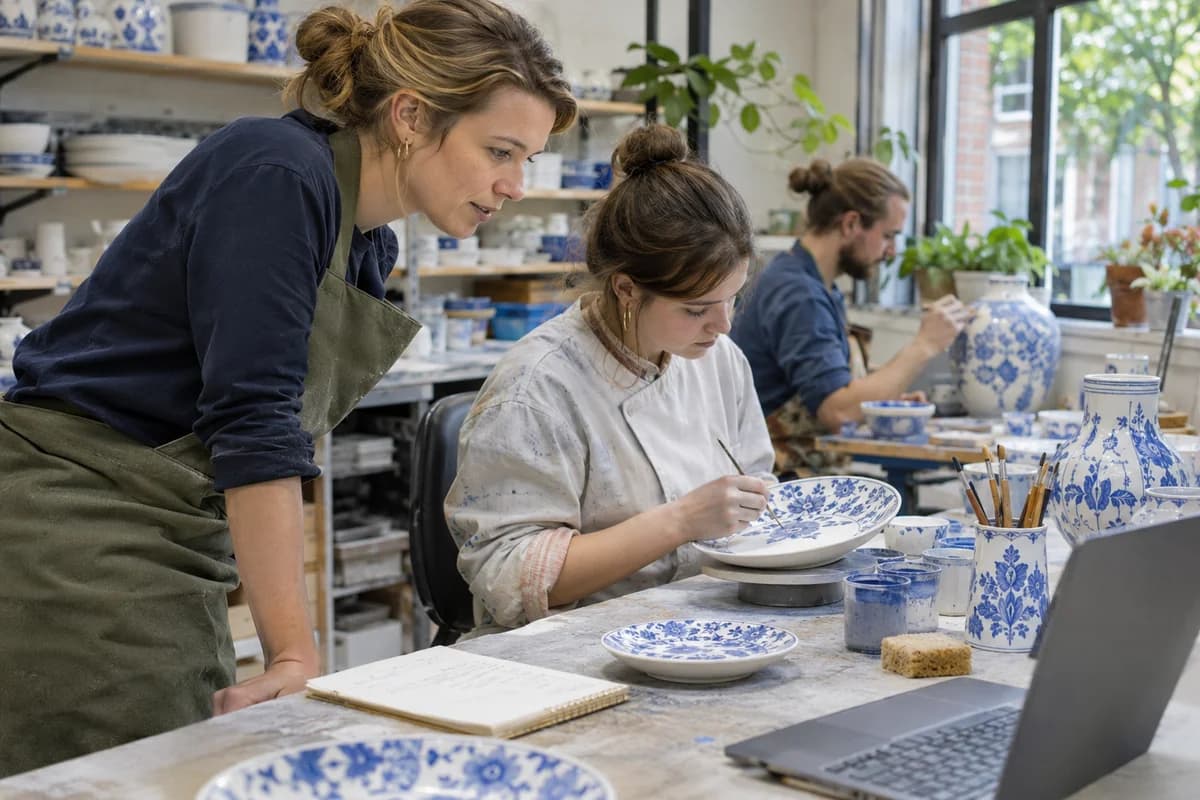
Painted tiles and plates made Delft famous centuries ago, and a pottery works still paints them by hand. The town’s other claim is a technical university, whose graduates design bridges, satellites and flood defences.
Those who stay start small firms in converted buildings near the campus, selling software, sensors and engineering advice to clients abroad. The centre is compact. Tourists come for the canals.
The districts, business parks and markets that matter in Delft.
How Delft businesses pick and use software.
Founders of university spin offs who build hardware or software and need to manage grants, quotes and project hours in one place.
Partners in architecture and engineering offices who bill clients by project hours and need drawings, change notes and approvals tied to every job.
Where Delft businesses lose time and money.
Research grants require careful hour records
Funders ask for hours by person and task, and reconstructing them at year end is painful. Daily time logs fix that.
Design offices lose track of drawing versions
A client may approve version four while the team builds from version three. One current list avoids rework.
Handmade goods sell through gift shops and online
A workshop that paints each piece takes orders by email, in person and through a web shop. Stock counts drift. One shared order list fixes it.
What we would build for Delft businesses.
Usually in this order, starting with whatever the audit ranks first.
MVP Product Development
A first working version of a new product, small enough to launch and learn from.
Learn moreUI/UX Design and Prototyping
Prototypes tested with the people doing the work, including corrections, missing information and everyday devices.
Learn moreTechnology Strategy and Product Consulting
A plain answer to what to build, what to buy and what to leave alone, before money is spent.
Learn moreDevOps & Automation Services
Releases with agreed checks, planned service windows and a tested route back to a working version.
Learn moreReady products that fit Delft businesses.
Each one is adapted to how your business works before it goes live, and anything your trade needs that it lacks is added then. You are not paying to build the basics again.
Machine Vision Company Management Software
Feasibility studies, camera and lens lists, image sets and model versions, line trials, retraining jobs and support contracts for machine vision companies.
Learn moreArchitecture Firm Management Software
Projects, design stages, drawing revisions, approval submissions, site visit reports, consultant coordination, stage billing and fee recovery for architecture firms.
Learn moreBranding and Design Studio Management Software
Briefs, stage quotes, proof rounds, approver sign-off, change requests, brand asset library and stage invoices for branding and design studios.
Learn moreHow the work runs from Bengaluru for Delft.
- 1
The audit, by call
A screen-share and a look at the sheets, accounting reports and WhatsApp groups your team uses. No travel needed.
- 2
A written proposal
Scope, what we build first and the cost, agreed in writing before anything starts.
- 3
Build in short rounds
Working screens shared every few weeks. Your team tests them from your own office.
- 4
Go-live, in person when it helps
For data migration and training we can come to Delft. Travel is agreed in advance.
- 5
Support online
Fixes, changes and hosting handled remotely by the same team that built it.
The work we have published.
We don’t claim Delft clients we don’t have. These are systems our team built; the way we work is the same wherever you are.
PetSeva: matching owners to the right vet, at any hour
A two-sided veterinary platform where vets are searchable by specialisation and bookable outside clinic hours. It now carries more than 2,000 veterinary doctors.
Read the case study Paying guest accommodationSAM Atithi Pavathi: bed-level occupancy as the source of truth
PG management software where allocation, rates and invoices are derived from bed-level occupancy and not maintained in parallel spreadsheets.
Read the case study School transport servicesSAM Tours: school transport on a single ledger
Registration, fee collection, routing and finance write to the same records, closing the gap between journeys run and fees collected.
Read the case study Microfinance and Self Help GroupsVikasa RDO: making SHG loan recovery auditable
Loan proposals, recoveries and commissions sit on one record, with a person attached to every state change, so a business handling a bank’s money can show where each rupee went.
Read the case studyMake the scope specific to your business.
Work through a real example from your operation and agree the handoffs, controls and support the project needs.
Research grants require careful hour records
Does each receipt retain its agreed purpose?
For “Research grants require careful hour records”, compare an unrestricted receipt with one assigned to a named purpose. Ask the trustees to confirm the reporting category before combining the totals.
Background reading: ERPNext: nonprofit operations
Questions Delft owners ask before they call.
Can project hours be tracked for grant reports?
Yes. Staff log hours against projects and tasks, and a report groups them by person and funder. Funders set the format.
Can a small team start small?
Yes. A first version can cover one process, such as quotes or time logging, and grow when the team is ready. Scope is written down first.
What happens after I share my requirements?
We review your brief and clarify the work with you. We then look at the software, spreadsheets and WhatsApp groups your business runs on today and write down what works, what slows your team down and what is missing. A demo login, a screen-share or a few screenshots are enough. You get a short written summary ordered by priority, with no obligation to hire us afterwards.
How much will the software cost?
We don’t publish a price, because it depends on what the system has to do. That first review settles the scope, and the cost goes into a written proposal before any work starts.
Industries we build for in Delft.
Elsewhere in Netherlands.
Tell us what your Delft business runs on today.
Send a short note on the spreadsheets, software or WhatsApp groups your team depends on. We reply the same working day.
What happens after you share your requirements
- We review your brief and the systems you already use.
- We clarify the workflow, missing information and the work to consider first.
- The proposed scope sets out the deliverables, responsibilities and dependencies.
- Review the scope and commercial terms before deciding whether to proceed.
Start with your requirements
Describe your current process, the people involved and the change you need. Start with the details you know; we can clarify the rest together.
Share your requirements