Home Collection Visits for Pathology Labs
Home collection is booked by area and slot. Each visit goes to a phlebotomist, and the lab can see which samples are still on the road. Fasting patients want an early slot, and the lab wants each phlebotomist’s round to stay within one part of town, so both are recorded at booking.
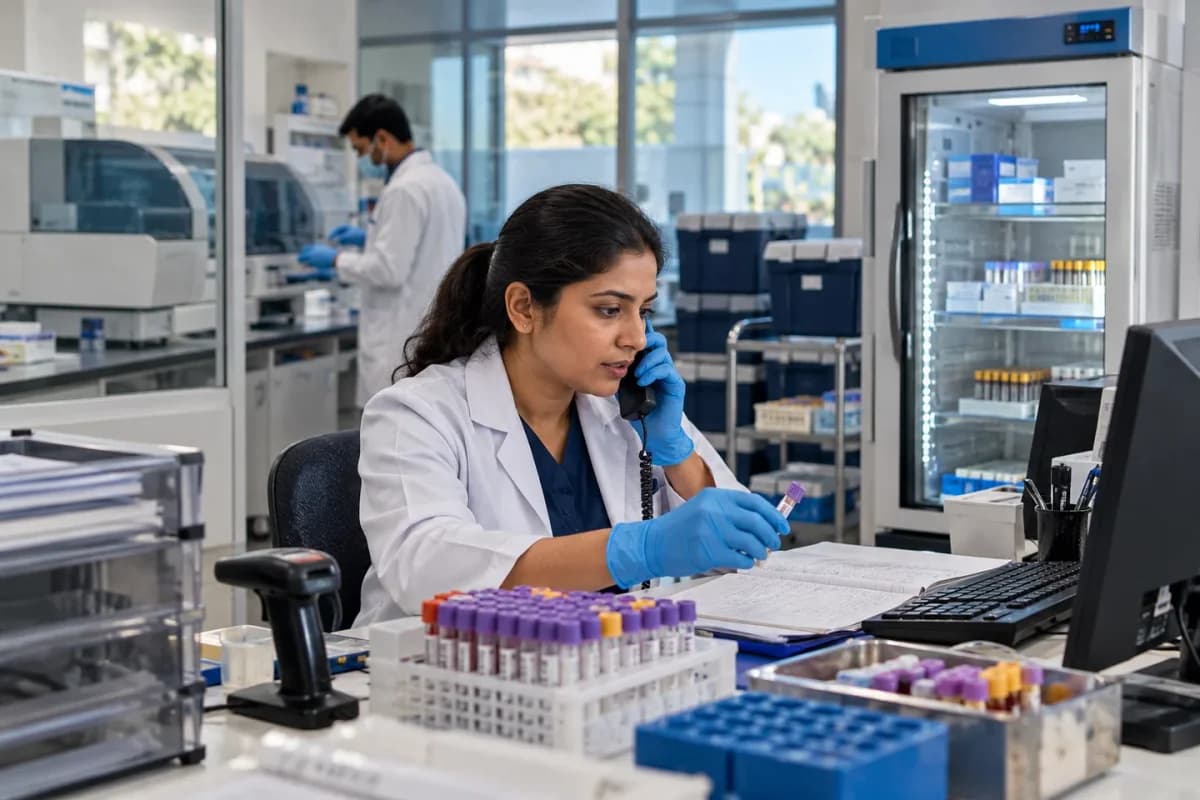
Booking a visit
A patient books by phone or message, and the desk records the address, area, preferred slot and tests. Fasting tests are booked early in the morning. Booking through the desk keeps one source of truth, so two staff members do not promise the same slot to different patients.
The phlebotomist’s day
Each phlebotomist sees the day’s visits in order, with addresses and phone numbers. A visit is marked collected, postponed or cancelled. When the samples reach the lab they are scanned in, and the round is closed. A visit that cannot be completed is not simply dropped. It is marked postponed or cancelled, and the desk sees it and can call the patient back before the slot is lost.
Fasting, slots and the early morning rush
Most home bookings cluster before nine, because fasting patients want to eat afterwards. Lab guidance commonly asks for eight to twelve hours of fasting, so a patient who finishes dinner at ten expects a draw the next morning. The desk therefore sees a crowd of requests at the same hour, in the same few areas. Spreading slots across a round, and noting fasting at booking, keeps the busiest hour manageable.
- Mark fasting tests at booking so the slot is early
- Cap the visits per slot per phlebotomist
- Note a landmark and a second phone number
- Record special preparation, such as a timed test
From the doorstep back to the bench
Time in the carrier bag matters. Training material for sample handling asks for tubes kept upright, protected from shaking and light, and delivered within a limit the lab fixes. Rough handling and delay both raise haemolysis and spoil some analytes. Ammonia, for example, needs ice at once. The lab’s own rules decide the cut-off, and the system makes the collection time and the receiving time visible so a long gap is easy to spot.
What stays outside the lab system
Route planning is not included. Live location tracking is not part of this module either. The lab assigns visits by area, and phlebotomists use their own maps. If the lab wants maps or live tracking, that is a separate request to be scoped on its own, and nothing in the visit record depends on it.
Questions to settle before home collection starts
Home service touches the patient’s door, so the lab should decide the rules in advance.
A home collection round from booking to bench
A home visit starts as a phone call and ends at the analyser. The booking desk, the phlebotomist and the bench each hold a piece. Four moments follow a single early-morning visit from slot to sample received. Timing is everything here.
Agree the evidence before signing off this part.
Use a representative scenario to decide what this part of the system must show and where review is still needed.
Booking a visit
What becomes available when a booking is moved or cancelled?
Use “Booking a visit” to move a booking, then cancel a second example. Check the released slot, the person or resource still assigned, and any amount left to settle before accepting the revised schedule.
Background reading: ERPNext: appointment records
Payment at the door
Can the same receipt be allocated without counting the money twice?
Take an unallocated amount in “Payment at the door” and apply it to the intended balance. Review the remaining amount and the original receipt reference together.
Background reading: ERPNext: payment allocation
Frequently asked questions
Can patients book a home visit online?
Only if a booking form is added during implementation. By default the desk books visits from calls and messages.
Does it track the phlebotomist’s location?
No. It records which visits were completed and when samples were received at the lab.
Can one phlebotomist be given a fixed area?
Yes, visits are grouped by area, so a phlebotomist can be given the same part of town each day.
What if the patient cancels at the door?
The phlebotomist marks the visit cancelled or postponed, and the booking remains on the day’s list for the desk to follow up.
Can the bill be paid on the visit?
Yes. Cash or UPI taken at the door is entered on the bill, and the collection appears in the day’s totals.
How do we know a sample has not been lost?
Collected samples stay on a not-yet-received list until the lab scans them in. A long wait on that list prompts a call.
How this feature fits the system.
Pathology Lab Management Software: the parts that work with this feature, the trades that use it and the ways to put it in place.
Sample collection and barcodes
A barcode prints for every container at collection, recording sample type and time, and the lab marks any rejected sample with a reason.
Barcodes and LabelsHome collection visits
Home collections are booked by area and time slot and assigned to a phlebotomist, and the front desk sees which samples have reached the lab.
Appointment SchedulingQuality control records
Technologists record daily control runs by test and machine, plot them against limits the lab sets, and note the action taken on a failed run.
Quality ControlTell us what you need.
Tell us what your team does today, where work gets stuck and what you want to change.
What happens after you share your requirements
- We review your brief and the systems you already use.
- We clarify the workflow, missing information and the work to consider first.
- The proposed scope sets out the deliverables, responsibilities and dependencies.
- Review the scope and commercial terms before deciding whether to proceed.
Start with your requirements
Describe your current process, the people involved and the change you need. Start with the details you know; we can clarify the rest together.
Share your requirements