Azamgarh · LocationsBlack pottery orders, handloom stock and remittance-driven shops for Azamgarh’s artisans and traders.
Azamgarh’s best known craft is the black pottery of nearby Nizamabad, glazed, fired in a smoky kiln and decorated with silver patterns. Handloom weavers around Mubarakpur supply sarees to wholesalers across the country. Money from relatives working abroad keeps the retail markets busy. Orders, stock and weaver accounts run on software built in Bengaluru.
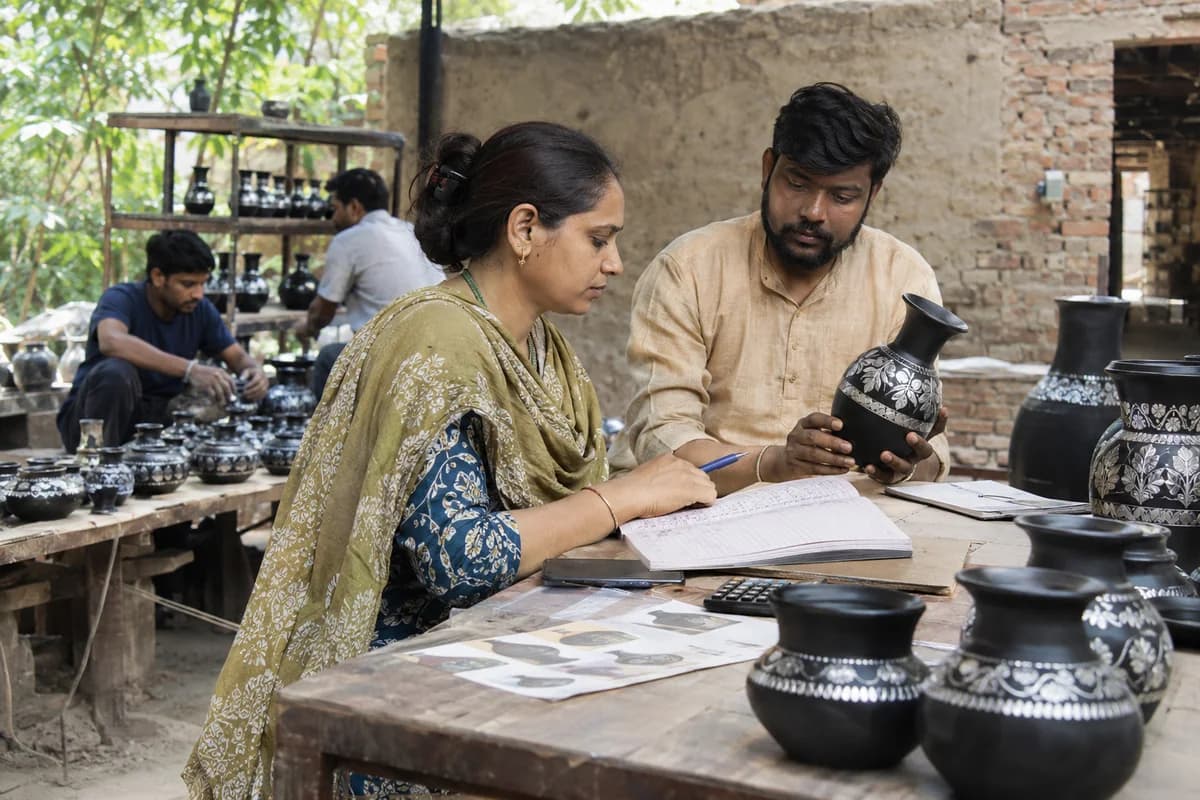
Nizamabad potters work in family units and take orders for lamps, vases and decorative pieces from gift shops and exhibitions. Breakage in firing and transit makes it hard to say what any piece truly cost. Sellers go through traders who pay late. One notebook holds every amount owed.
Mubarakpur’s weavers sell to saree wholesalers who give yarn and take finished pieces, while Azamgarh town’s shops selling electronics, clothes and gold depend on families with someone in the Gulf. Shibli National College and the district courts bring a steady daytime crowd.
The areas, estates and markets that matter in Azamgarh.
How Azamgarh businesses pick and use software.
Pottery workshop owners sell by phone and WhatsApp photographs. They want a catalogue and an order sheet more than a full ERP.
Saree wholesalers and shop owners keep credit books for dozens of customers. A shared ledger with reminders matters more than new screens. Simple wins.
Where Azamgarh businesses lose time and money.
Firing losses hide what a piece really costs
A kiln load may lose several pieces to cracks, yet the price quoted to the buyer rarely reflects that, so profit on a large order stays unclear until the very end. Nobody checks sooner.
Yarn given to weavers is hard to follow
Each weaver holds yarn for a saree due in some weeks. A wholesaler with forty weavers cannot say quickly who holds what, or who is late, without phoning round the village one by one.
Credit to remittance families runs on memory
A shopkeeper lets a family take goods until money arrives from abroad. The promised date is remembered, not recorded, so reminders go out by hand when someone happens to recall the account.
What we would build for Azamgarh businesses.
Usually in this order, starting with whatever the audit ranks first.
E-Commerce and Digital Commerce
An online store or B2B order portal wired to your stock, billing and dispatch.
Learn moreBusiness Process Automation
Approvals, reminders and reports triggered by agreed rules, with exceptions assigned to a responsible person.
Learn moreWeb and Mobile Application Development
Web and mobile apps for customers, field staff and dealers, built to work on ordinary phones.
Learn moreData Engineering and Business Intelligence
Dashboards that answer the owner’s Monday questions without anyone building an Excel sheet first.
Learn moreHow the work runs from Bengaluru for Azamgarh.
- 1
The audit, by call
A screen-share and a look at the sheets, accounting reports and WhatsApp groups your team uses. No travel needed.
- 2
A written proposal
Scope, what we build first and the cost, agreed in writing before anything starts.
- 3
Build in short rounds
Working screens shared every few weeks. Your team tests them from your own office.
- 4
Go-live, in person when it helps
For data migration and training we can come to Azamgarh. Travel is agreed in advance.
- 5
Support online
Fixes, changes and hosting handled remotely by the same team that built it.
The work we have published.
We don’t claim Azamgarh clients we don’t have. These are systems our team built; the way we work is the same wherever you are.
PetSeva: matching owners to the right vet, at any hour
A two-sided veterinary platform where vets are searchable by specialisation and bookable outside clinic hours. It now carries more than 2,000 veterinary doctors.
Read the case study Paying guest accommodationSAM Atithi Pavathi: bed-level occupancy as the source of truth
PG management software where allocation, rates and invoices are derived from bed-level occupancy and not maintained in parallel spreadsheets.
Read the case study School transport servicesSAM Tours: school transport on a single ledger
Registration, fee collection, routing and finance write to the same records, closing the gap between journeys run and fees collected.
Read the case study Microfinance and Self Help GroupsVikasa RDO: making SHG loan recovery auditable
Loan proposals, recoveries and commissions sit on one record, with a person attached to every state change, so a business handling a bank’s money can show where each rupee went.
Read the case studyMake the scope specific to your business.
Work through a real example from your operation and agree the handoffs, controls and support the project needs.
Firing losses hide what a piece really costs
Which observation would change the proposed scope?
For “Firing losses hide what a piece really costs”, observe someone completing the task with a representative example. Record where they stop, ask another person or re-enter information, then choose the smallest change whose result the team can verify.
Background reading: GOV.UK: researching user needs
Questions Azamgarh owners ask before they call.
Can a pottery workshop take orders from gift shops and exhibitions on one sheet?
Yes. Orders can be logged by design, size and due date, with firing losses noted against each batch, and photographs sit beside each item. A simple catalogue link goes out on WhatsApp.
Can we send credit reminders to customers waiting for remittances?
Yes. Each customer has a balance and a promised date, and a WhatsApp message goes out once the date passes. You decide the wording. It stays polite.
What happens after I share my requirements?
We review your brief and clarify the work with you. We then look at the software, spreadsheets and WhatsApp groups your business runs on today and write down what works, what slows your team down and what is missing. A demo login, a screen-share or a few screenshots are enough. You get a short written summary ordered by priority, with no obligation to hire us afterwards.
How much will the software cost?
We don’t publish a price, because it depends on what the system has to do. That first review settles the scope, and the cost goes into a written proposal before any work starts.
Industries we build for in Azamgarh.
Elsewhere in Uttar Pradesh.
Tell us what your Azamgarh business runs on today.
Send a short note on the spreadsheets, software or WhatsApp groups your team depends on. We reply the same working day.
What happens after you share your requirements
- We review your brief and the systems you already use.
- We clarify the workflow, missing information and the work to consider first.
- The proposed scope sets out the deliverables, responsibilities and dependencies.
- Review the scope and commercial terms before deciding whether to proceed.
Start with your requirements
Describe your current process, the people involved and the change you need. Start with the details you know; we can clarify the rest together.
Share your requirements