Kovilpatti · LocationsKovilpatti’s kadalai mittai makers, match units and onion traders work to festival and harvest calendars.
Peanut brittle from Kovilpatti carries a geographical indication, and the town also has match units and trade in onions, groundnut and pulses from dry black soil farms. Sweet makers, packers and wholesalers sell by weight and by season. GullySystem works remotely from Nagarbhavi, Bengaluru, on batch production, packing, stock and credit sales for food makers and traders.
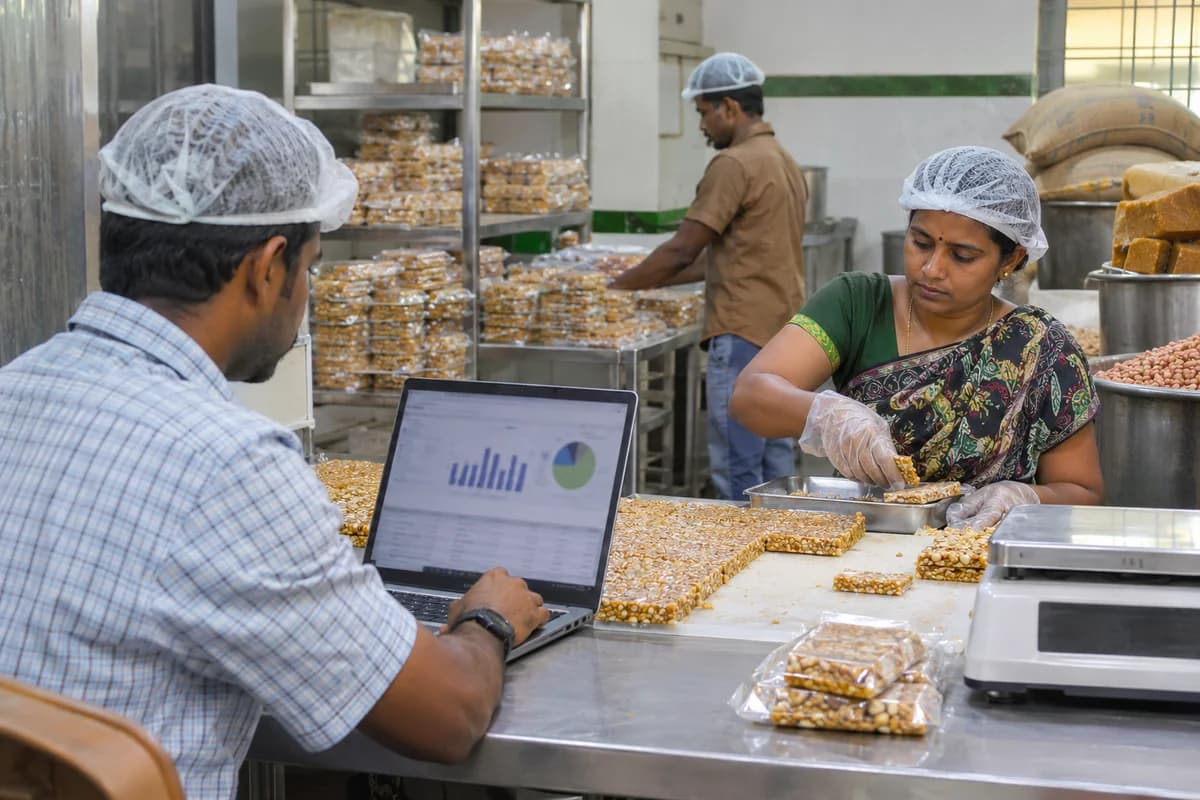
Kovilpatti’s kadalai mittai is made of groundnut and jaggery, cooked in large pans, then cut and packed by hand in small units where the same family has stirred the pot for generations. Small family units and larger sweet houses produce it, and sales go to local shops, to travellers on the highway and to relatives abroad who ask for a parcel at every festival.
The farms around are rain fed. Groundnut, millets, pulses and onions depend on the northeast monsoon, and traders buy from the farmers in the market and store lots. Match and printing units in and near the town add steady industrial work.
The areas, estates and markets that matter in Kovilpatti.
How Kovilpatti businesses pick and use software.
Family sweet makers hold their recipes close and prefer a system that does not ask them to change how they cook. Raw material and output are the two numbers they will share.
Grain and onion traders care about stock and advances. They ask first about the daily rate and the stock in each godown.
Where Kovilpatti businesses lose time and money.
Jaggery and groundnut prices are tracked in the head
The owner buys when the rate looks good. Nobody writes it down. Without a record of cost per batch, the price on the shop shelf is set by feel and corrected only when a season ends badly.
Wedding and festival orders arrive by call
Bulk orders for functions are taken over the phone and noted on scraps of paper that travel between the counter, the kitchen and the owner’s pocket. A missed order is found only on delivery day. By then it is too late.
Onion storage loses value silently
Lots wait in godowns for a better price while moisture and sprouting cut the weight. Nobody has a clear view of what a lot has lost.
Label and carton orders come in late
Match makers need cartons printed before packing, but approvals arrive at the last minute. Production halts while the printer waits for a design sign off. Idle lines cost money.
What we would build for Kovilpatti businesses.
Usually in this order, starting with whatever the audit ranks first.
ERP, CRM and Business Software Implementation
One record of stock, orders, customers and accounts, set up so your team opens it every day.
Learn moreBusiness Process Automation
Approvals, reminders and reports triggered by agreed rules, with exceptions assigned to a responsible person.
Learn moreWeb and Mobile Application Development
Web and mobile apps for customers, field staff and dealers, built to work on ordinary phones.
Learn moreE-Commerce and Digital Commerce
An online store or B2B order portal wired to your stock, billing and dispatch.
Learn moreReady products that fit Kovilpatti businesses.
Each one is adapted to how your business works before it goes live, and anything your trade needs that it lacks is added then. You are not paying to build the basics again.
Sweet Shop Management Software
Weighing and billing, festival advance orders, gift boxes, kitchen production plans, shelf life and branch stock for sweet and confectionery shops.
Learn moreSnack Manufacturer Management Software
Potato, flour and oil lots, fryer batches, seasoning recipes, yield, bag weight checks, flavour changeovers and distributor dispatch for snack makers.
Learn morePackaged Food Manufacturer Management Software
Ingredient lots, recipes, batch records, line checks, allergen data, pack coding, shelf life and customer dispatch for packaged food makers.
Learn moreHow the work runs from Bengaluru for Kovilpatti.
- 1
The audit, by call
A screen-share and a look at the sheets, accounting reports and WhatsApp groups your team uses. No travel needed.
- 2
A written proposal
Scope, what we build first and the cost, agreed in writing before anything starts.
- 3
Build in short rounds
Working screens shared every few weeks. Your team tests them from your own office.
- 4
Go-live, in person when it helps
For data migration and training we can come to Kovilpatti. Travel is agreed in advance.
- 5
Support online
Fixes, changes and hosting handled remotely by the same team that built it.
The work we have published.
We don’t claim Kovilpatti clients we don’t have. These are systems our team built; the way we work is the same wherever you are.
PetSeva: matching owners to the right vet, at any hour
A two-sided veterinary platform where vets are searchable by specialisation and bookable outside clinic hours. It now carries more than 2,000 veterinary doctors.
Read the case study Paying guest accommodationSAM Atithi Pavathi: bed-level occupancy as the source of truth
PG management software where allocation, rates and invoices are derived from bed-level occupancy and not maintained in parallel spreadsheets.
Read the case study School transport servicesSAM Tours: school transport on a single ledger
Registration, fee collection, routing and finance write to the same records, closing the gap between journeys run and fees collected.
Read the case study Microfinance and Self Help GroupsVikasa RDO: making SHG loan recovery auditable
Loan proposals, recoveries and commissions sit on one record, with a person attached to every state change, so a business handling a bank’s money can show where each rupee went.
Read the case studyMake the scope specific to your business.
Work through a real example from your operation and agree the handoffs, controls and support the project needs.
Jaggery and groundnut prices are tracked in the head
Which observation would change the proposed scope?
For “Jaggery and groundnut prices are tracked in the head”, observe someone completing the task with a representative example. Record where they stop, ask another person or re-enter information, then choose the smallest change whose result the team can verify.
Background reading: GOV.UK: researching user needs
Questions Kovilpatti owners ask before they call.
Can the cost of each batch of sweets be worked out?
Yes. The raw material issued to a batch is recorded, and the packed output is counted. The cost per kilo appears for that batch, so prices can follow the market for groundnut and jaggery.
Can orders for a wedding be taken with a delivery date?
Yes. The order notes the items, the quantity, the advance and the date. A list of the next days’ orders goes to the kitchen, so production planning is clear.
What happens after I share my requirements?
We review your brief and clarify the work with you. We then look at the software, spreadsheets and WhatsApp groups your business runs on today and write down what works, what slows your team down and what is missing. A demo login, a screen-share or a few screenshots are enough. You get a short written summary ordered by priority, with no obligation to hire us afterwards.
How much will the software cost?
We don’t publish a price, because it depends on what the system has to do. That first review settles the scope, and the cost goes into a written proposal before any work starts.
Industries we build for in Kovilpatti.
Elsewhere in Tamil Nadu.
- Ariyalur
- Chennai
- Coimbatore
- Cuddalore
- Dharmapuri
- Dindigul
- Erode
- Hosur
- Kanchipuram
- Karaikudi
- Karur
- Krishnagiri
- Kumbakonam
- Madurai
- Nagercoil
- Namakkal
- Pollachi
- Pudukkottai
- Ramanathapuram
- Salem
- Sivakasi
- Thanjavur
- Theni
- Thoothukudi
- Tiruchirappalli
- Tirunelveli
- Tiruppur
- Vellore
- Ambur
- Tiruvannamalai
- Villupuram
- Virudhunagar
- Rajapalayam
- Ooty
- Gobichettipalayam
- Palani
- Tiruchengode
- Avadi
- Tambaram
- Ranipet
- Nagapattinam
- Mayiladuthurai
Tell us what your Kovilpatti business runs on today.
Send a short note on the spreadsheets, software or WhatsApp groups your team depends on. We reply the same working day.
What happens after you share your requirements
- We review your brief and the systems you already use.
- We clarify the workflow, missing information and the work to consider first.
- The proposed scope sets out the deliverables, responsibilities and dependencies.
- Review the scope and commercial terms before deciding whether to proceed.
Start with your requirements
Describe your current process, the people involved and the change you need. Start with the details you know; we can clarify the rest together.
Share your requirements