Kolar · LocationsKolar’s tomato mandi, mango growers and milk unions feed Bengaluru and keep thin margins.
Kolar lies about 70 km east of Bengaluru. Its produce market sends tomatoes and vegetables to the big cities. Srinivaspur is known for mango, the old gold fields have closed, and a milk union collects from many villages. The team is in Bengaluru, so Kolar clients get calls and chat rather than a branch office.
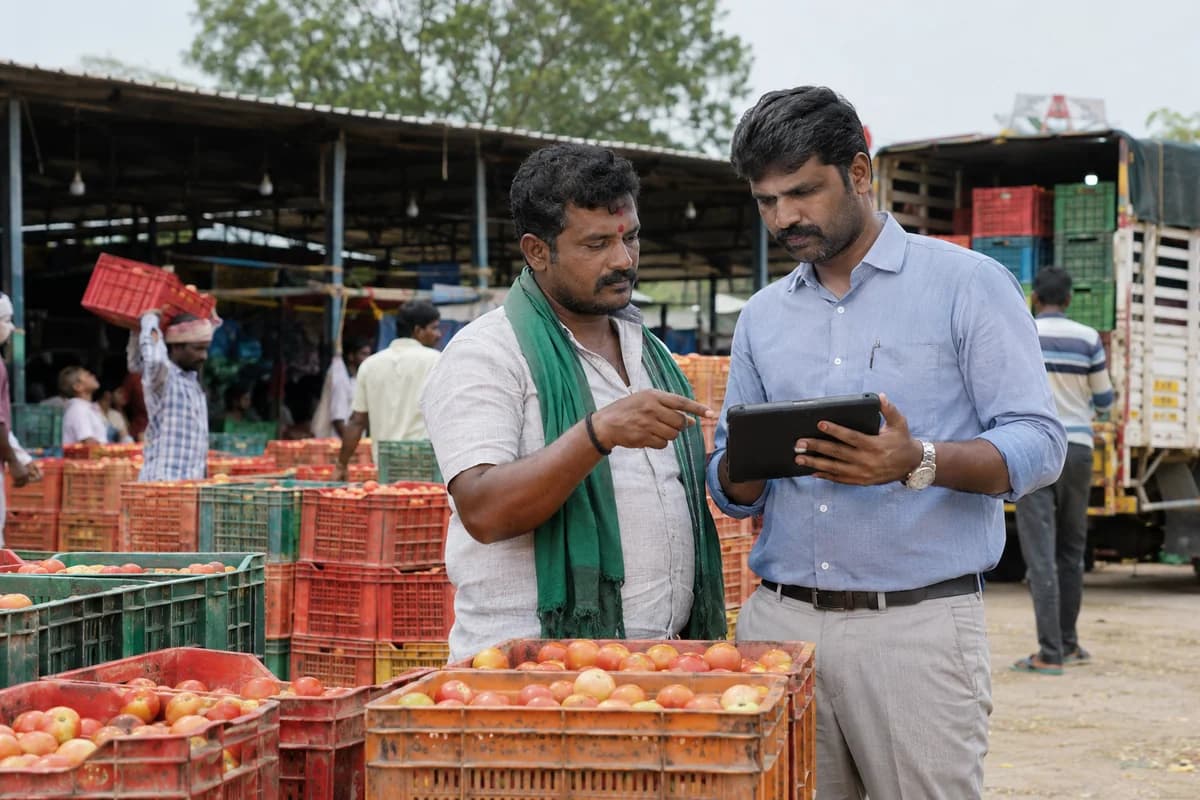
Tomatoes move fast. Growers pick at dawn, commission agents auction the lots, and trucks leave for Bengaluru, Chennai and further. Prices can change sharply in a few days. Growers and agents both want proof of what was sold.
Milk is another daily business. Village societies measure fat and quantity twice a day and pay farmers by cycle, so one farmer can have two readings and a payment line to check each cycle. The Kolar Gold Fields closed years ago, but the township and its families remain.
The areas, estates and markets that matter in Kolar.
How Kolar businesses pick and use software.
A commission agent holds money for many growers at once, so every crate, deduction and payout needs an entry that a grower can read without asking for the book.
Mango pulp units need lots tracked by orchard and by day, with quality differing by orchard.
Where Kolar businesses lose time and money.
Crate counts are disputed
The grower counts crates going out and the agent counts those that were sold, and when the two numbers differ there is no third record to settle which is right. Spoilage makes it worse.
Milk society ledgers pile up
Fat readings and payments are written in books for each farmer. A farmer asking for a statement waits.
Mango lots lose their trail
Fruit from many orchards arrives in a day. Later, no one can name the best orchard.
What we would build for Kolar businesses.
Usually in this order, starting with whatever the audit ranks first.
Web and Mobile Application Development
Web and mobile apps for customers, field staff and dealers, built to work on ordinary phones.
Learn moreBusiness Process Automation
Approvals, reminders and reports triggered by agreed rules, with exceptions assigned to a responsible person.
Learn moreERP, CRM and Business Software Implementation
One record of stock, orders, customers and accounts, set up so your team opens it every day.
Learn moreData Engineering and Business Intelligence
Dashboards that answer the owner’s Monday questions without anyone building an Excel sheet first.
Learn moreReady products that fit Kolar businesses.
Each one is adapted to how your business works before it goes live, and anything your trade needs that it lacks is added then. You are not paying to build the basics again.
Dairy Cooperative Management Software
Member register, shift milk entry, fat and solids readings, rate charts, pay cycles, feed credit, share capital and union dispatch for dairy cooperatives.
Learn moreCrop Farm Management Software
Field plans, input stores, spray logs, machine hours, harvest weighbridge tickets, bin stock and grain contracts for arable crop farms.
Learn moreLogistics and Transport Management Software
Consignment booking, trip sheets, lorry and driver records, attached vehicle hire, delivery proof, freight billing and to-pay collection for road haulage companies.
Learn moreHow the work runs from Bengaluru for Kolar.
- 1
The audit, by call
A screen-share and a look at the sheets, accounting reports and WhatsApp groups your team uses. No travel needed.
- 2
A written proposal
Scope, what we build first and the cost, agreed in writing before anything starts.
- 3
Build in short rounds
Working screens shared every few weeks. Your team tests them from your own office.
- 4
Go-live, in person when it helps
For data migration and training we can come to Kolar. Travel is agreed in advance.
- 5
Support online
Fixes, changes and hosting handled remotely by the same team that built it.
The work we have published.
We don’t claim Kolar clients we don’t have. These are systems our team built; the way we work is the same wherever you are.
PetSeva: matching owners to the right vet, at any hour
A two-sided veterinary platform where vets are searchable by specialisation and bookable outside clinic hours. It now carries more than 2,000 veterinary doctors.
Read the case study Paying guest accommodationSAM Atithi Pavathi: bed-level occupancy as the source of truth
PG management software where allocation, rates and invoices are derived from bed-level occupancy and not maintained in parallel spreadsheets.
Read the case study School transport servicesSAM Tours: school transport on a single ledger
Registration, fee collection, routing and finance write to the same records, closing the gap between journeys run and fees collected.
Read the case study Microfinance and Self Help GroupsVikasa RDO: making SHG loan recovery auditable
Loan proposals, recoveries and commissions sit on one record, with a person attached to every state change, so a business handling a bank’s money can show where each rupee went.
Read the case studyMake the scope specific to your business.
Work through a real example from your operation and agree the handoffs, controls and support the project needs.
Crate counts are disputed
Which observation would change the proposed scope?
For “Crate counts are disputed”, observe someone completing the task with a representative example. Record where they stop, ask another person or re-enter information, then choose the smallest change whose result the team can verify.
Background reading: GOV.UK: researching user needs
Questions Kolar owners ask before they call.
Can a commission agent give each grower a clear statement?
Yes. Each lot records crates, rate, deductions and payout, and growers get a statement in Kannada. The agent’s own cash position is shown separately.
Can twice daily milk collection be recorded on a phone?
Yes. Quantity and fat are entered at the society, and the farmer’s payment is worked out from them. Entries save offline and sync when the signal is back.
What happens after I share my requirements?
We review your brief and clarify the work with you. We then look at the software, spreadsheets and WhatsApp groups your business runs on today and write down what works, what slows your team down and what is missing. A demo login, a screen-share or a few screenshots are enough. You get a short written summary ordered by priority, with no obligation to hire us afterwards.
How much will the software cost?
We don’t publish a price, because it depends on what the system has to do. That first review settles the scope, and the cost goes into a written proposal before any work starts.
Industries we build for in Kolar.
Tell us what your Kolar business runs on today.
Send a short note on the spreadsheets, software or WhatsApp groups your team depends on. We reply the same working day.
What happens after you share your requirements
- We review your brief and the systems you already use.
- We clarify the workflow, missing information and the work to consider first.
- The proposed scope sets out the deliverables, responsibilities and dependencies.
- Review the scope and commercial terms before deciding whether to proceed.
Start with your requirements
Describe your current process, the people involved and the change you need. Start with the details you know; we can clarify the rest together.
Share your requirements