Travel and transport · Software for cold chain companiesSee chamber and reefer temperatures beside each client’s lots, trips and storage bills.
Cold chain companies store and move goods that spoil outside a set range, such as dairy, frozen food, fruit and pharma. A firm runs chambers, reefer trucks or both. Clients ask for a temperature record with every lot and every delivery. GullySystem reads chamber sensors into alerts and history, runs reefer trips and freight bills in a transport system, and builds storage rent to your contract.
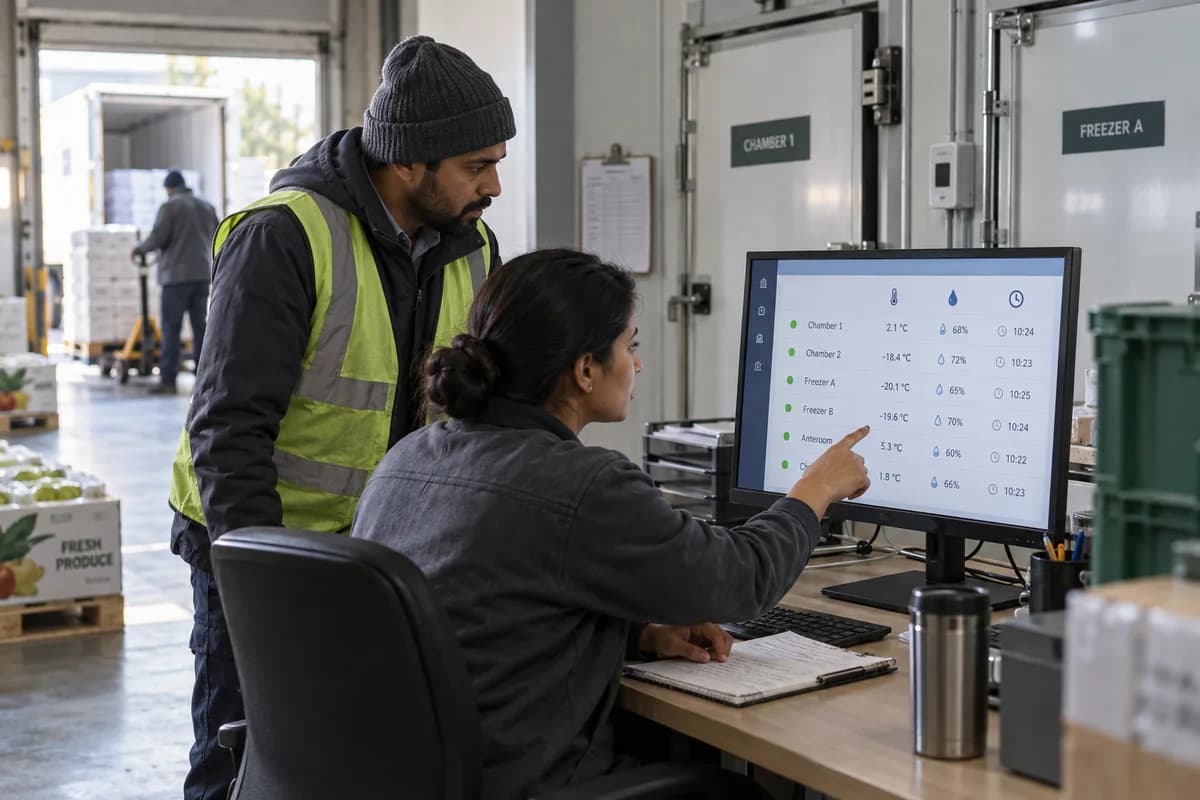
A cold chain business sells a temperature as well as a space or a trip. Clients want proof of it for every hour the goods were with you.
That proof sits in a logger, the lot register sits in a ledger and the rent bill sits in a spreadsheet, and the three are rarely read together. Excursions get explained after the fact.
Produce or cartons arrive at the dock and are checked for product temperature before they go in. Each lot is given a number, a chamber and a rack or floor position, and the client receives an inward receipt.
Chamber readings are written in a register twice a shift, or held on a standalone logger that someone downloads when a client asks. Reefer trucks carry their own unit, and the driver is rung when something looks wrong.
Releases go out against a gate pass, part of a lot at a time. Rent is charged per bag, pallet or tonne for the period stored. Handling, pre-cooling and loading are added to the bill.
What goes wrong for cold chain companies without a proper system.
What cold chain companies gain from one system.
Not a feature list. These are the moments in the working day that go differently once the records sit together.
What we would build for cold chain companies.
Named the way your team already talks about the work. We start with whichever part the audit shows is costing you most.
A requirements checklist for cold chain companies.
What to cover, which reports to ask for and what to put to every vendor, ready to print or save as a PDF.
Ready products we start from for cold chain companies.
Each one is adapted to how your business works before it goes live, and anything your trade needs that it lacks is added then. You are not paying to build the basics again.
IoT Monitoring Dashboard
Live values, thresholds and alerts, downtime and run hours, and the history behind every reading from your machines, meters and sensors.
Learn moreLogistics and Transport Management Software
Consignment booking, trip sheets, lorry and driver records, attached vehicle hire, delivery proof, freight billing and to-pay collection for road haulage companies.
Learn moreOther products in the same sector as cold chain companies.
- Aircraft Dealer Management Software
- Delivery Company Management Software
- Freight Forwarder Management Software
- Limousine Company Management Software
- Packers and Movers Management Software
- Storage Facility Management Software
- Third-Party Logistics Company Management Software
- Tour Operator Management Software
- Travel Agency Management Software
- Warehousing Company Management Software
- All industry products
The business modules cold chain companies use most.
Each one is also available on its own, or inside a system built for you.
Service Reminders
Compressor servicing, sensor calibration and reefer unit checks are scheduled with reminders to the maintenance supervisor. A sensor past its calibration date is listed. Truck refrigeration services follow the trip log.
Learn moreDashboards and KPIs
The operations head sees current temperature by chamber, open alerts and pallets stored against capacity. Reefer trucks on the road show with their last reading. Clients see their own lots only.
Learn moreWhatsApp, SMS and Email Notifications
A chamber drifting above its band sends a text and a call to the duty engineer. If nobody acknowledges, the next person is alerted. Clients are told when their goods are affected.
Learn moreRoles and Permissions
Dock clerks, chamber supervisors, drivers and client users see different screens. Only authorised staff can change a threshold or release a lot. Clients view only their own pallets.
Learn moreReport Builder
A client asking for the temperature history of one lot gets a printout from chamber readings between inward and release. Dairy and pharma clients can have different layouts. Saved layouts are reused.
Learn moreWorkflow and Approvals
A part release of a lot needs a gate pass request, a client approval and a supervisor check. Every step is signed. Releases against unpaid rent need a manager’s approval.
Learn moreVehicle and Trip Management
A reefer trip holds the truck, the driver, the set temperature and the delivery drops. Readings en route attach to the trip. A delivery slip shows the temperature on arrival.
Learn moreFuel and Driver Records
Diesel for the truck and for the refrigeration unit is logged separately by trip. Driver hours and licence dates are held. Fuel use outside the norm is flagged.
Learn more- Invoice Management
- Expense Tracking
- Estimate/Quotation Management
- Collections and Payment Follow-Up
- All business solutions
All solutions by area
- Applicant Tracking (5)
- CRM (8)
- Finance & Accounting (10)
- Helpdesk (4)
- Human Resources (13)
- Inventory Management (5)
- Project Management (7)
- Manufacturing (6)
- Procurement (4)
- Sales and Distribution (6)
- Field Service (5)
- Statutory and Compliance (4)
- Retail and POS (4)
- Bookings and Appointments (3)
- Subscriptions (2)
- Assets and Fleet (4)
- Platform (6)
- Analytics (2)
- Documents (1)
Where AI can help cold chain companies.
Each one reads records you already keep, and a person approves every decision.
Where we work with cold chain companies.
The services behind it.
IoT and Edge Computing
Chamber sensors, pallet probes and reefer unit readings would feed alerts and history into the system. A door left open or a compressor drifting warm sends an alert to the shift supervisor with the chamber and lots affected.
Learn moreCustom Software and Product Engineering
Storage rent rules, handling charges, lot and rack tracking and client temperature reports would be built to match your contracts. Dairy, frozen and pharma clients each get the record format they expect.
Learn moreAPI and System Integration
Chamber sensors, reefer telematics, the transport system and the accounting package would exchange data. A temperature reading, a trip and a rent line meet on the same lot record without anyone re-keying.
Learn moreWeb and Mobile Application Development
Clients could log in to see their lots, chamber readings and delivery records, and drivers could confirm drops and temperatures from a phone. Dock staff would record product temperature and rack position at inward receipt.
Learn moreAll our other services
- Business Process Automation
- Software Maintenance, Support and Rescue
- AI and Intelligent Automation
- ERP, CRM and Business Software Implementation
- Data Engineering and Business Intelligence
- UI/UX Design and Prototyping
- Cloud Engineering and Managed Infrastructure
- DevOps & Automation Services
- QA and Software Testing
- Performance Engineering
- Cybersecurity and Application Security
- Technology Strategy and Product Consulting
- E-Commerce and Digital Commerce
- MVP Product Development
- SaaS Product Development
- WhatsApp Business API and Chatbots
- Data Migration and Moving Off Spreadsheets
- Training and Adoption
- Data Protection and Privacy Readiness
- Tax and e-Invoice Engineering
- Managed IT Support
- Dedicated Team and Staff Augmentation
- Business Intelligence and Reporting Tools
- Cloud Cost Optimisation
- Global Compliance and Localisation
Written for cold chain companies.
Practical notes on running the business, not product marketing.
How the work runs from Bengaluru for your city.
- 1
The audit, by call
A screen-share and a look at the sheets, accounting reports and WhatsApp groups your team uses. No travel needed.
- 2
A written proposal
Scope, what we build first and the cost, agreed in writing before anything starts.
- 3
Build in short rounds
Working screens shared every few weeks. Your team tests them from your own office.
- 4
Go-live, in person when it helps
For data migration and training we can come to your city. Travel is agreed in advance.
- 5
Support online
Fixes, changes and hosting handled remotely by the same team that built it.
The work we have published.
We only name clients whose work is published. None of them is in this trade; they show how the team works, not that it has built for this trade.
PetSeva: matching owners to the right vet, at any hour
A two-sided veterinary platform where vets are searchable by specialisation and bookable outside clinic hours. It now carries more than 2,000 veterinary doctors.
Read the case study Paying guest accommodationSAM Atithi Pavathi: bed-level occupancy as the source of truth
PG management software where allocation, rates and invoices are derived from bed-level occupancy and not maintained in parallel spreadsheets.
Read the case study School transport servicesSAM Tours: school transport on a single ledger
Registration, fee collection, routing and finance write to the same records, closing the gap between journeys run and fees collected.
Read the case study Microfinance and Self Help GroupsVikasa RDO: making SHG loan recovery auditable
Loan proposals, recoveries and commissions sit on one record, with a person attached to every state change, so a business handling a bank’s money can show where each rupee went.
Read the case studyCheck the difficult cases before choosing software.
Use examples from your own records to test the workflows that matter in your business.
Recording through network drops
Which actions still need a connection, even if the screen opens offline?
For “Recording through network drops”, interrupt a save on a test device and reconnect it. Agree how pending work and conflicting edits should be shown before promising offline operation.
Background reading: Android: offline data handling
Rent periods are argued at billing
Can you explain the balance from its original documents?
Select a partly settled example in “Rent periods are argued at billing”. Ask for the invoice, allocated receipts and remaining balance to be shown together before agreeing the opening figures.
Background reading: ERPNext: outstanding invoices
Questions cold chain companies ask before they call.
Do you supply the sensors, loggers or reefer units?
No. Sensors and gateways are chosen with you or your vendor and bought in your name. A reefer unit that already logs can be read only where its maker allows it, which is confirmed during scoping.
Will the temperature record satisfy our auditor or licence?
Not on its own. The software keeps readings, alerts and who acknowledged each one. Whether that meets the records your licence or auditor asks for is for your adviser to judge.
Does it keep recording when the internet fails?
Yes, at the site. The gateway buffers readings and uploads them in order when the link returns. A reefer on the highway depends on its own device and mobile coverage.
Will rent and freight bills reach our accounts?
Not built in. A file of rent and freight bills for your accountant can be added when the system is first configured, with its own quote.
How is a cold store system quoted?
Chambers, the dock and reefer trips in scope, and the sensors or loggers that must feed the screen all matter. The rent and handling bill rules add more. Sensor hardware is not part of the figure unless it is named. Each part gets a figure once the chamber screens have been seen.
What should a cold store assemble before work starts?
Bring the chamber register, temperature log sheets, a sample inward receipt, a gate pass and the rent rate list. Reefer trip notes help. The chamber supervisor and a billing clerk check the dock and rent screens.
Who holds chamber readings when the cold store stops using the system?
You hold the chamber readings, lot movements, rent bills and reefer trip records. Spreadsheet exports cover every one of these. The cold store owns the code, and its writers keep supporting it.
What happens after I share my requirements?
We review your brief and clarify the work with you. We then look at the software, spreadsheets and WhatsApp groups your business runs on today and write down what works, what slows your team down and what is missing. A demo login, a screen-share or a few screenshots are enough. You get a short written summary ordered by priority, with no obligation to hire us afterwards.
How much will the software cost?
We don’t publish a price, because it depends on what the system has to do. That first review settles the scope, and the cost goes into a written proposal before any work starts.
Cities where cold chain companies are common.
Part of a wider group.
Also sell online?
The e-commerce pages cover the online side of this trade: storefronts, dealer ordering and the link to your stock.
Tell us how your business runs today.
A few lines on your spreadsheets, software and WhatsApp groups is enough. We reply the same working day.
What happens after you share your requirements
- We review your brief and the systems you already use.
- We clarify the workflow, missing information and the work to consider first.
- The proposed scope sets out the deliverables, responsibilities and dependencies.
- Review the scope and commercial terms before deciding whether to proceed.
Start with your requirements
Describe your current process, the people involved and the change you need. Start with the details you know; we can clarify the rest together.
Share your requirements