Hold every subscriber plan, installation, device and fault ticket on one account record.
Regional telecom providers sell broadband, fibre, fixed wireless and voice plans to homes and businesses. The telecom product keeps the subscriber, the plan, the line or port, the router and the open faults on one record. Installation crews, support desks and billing read the same account.
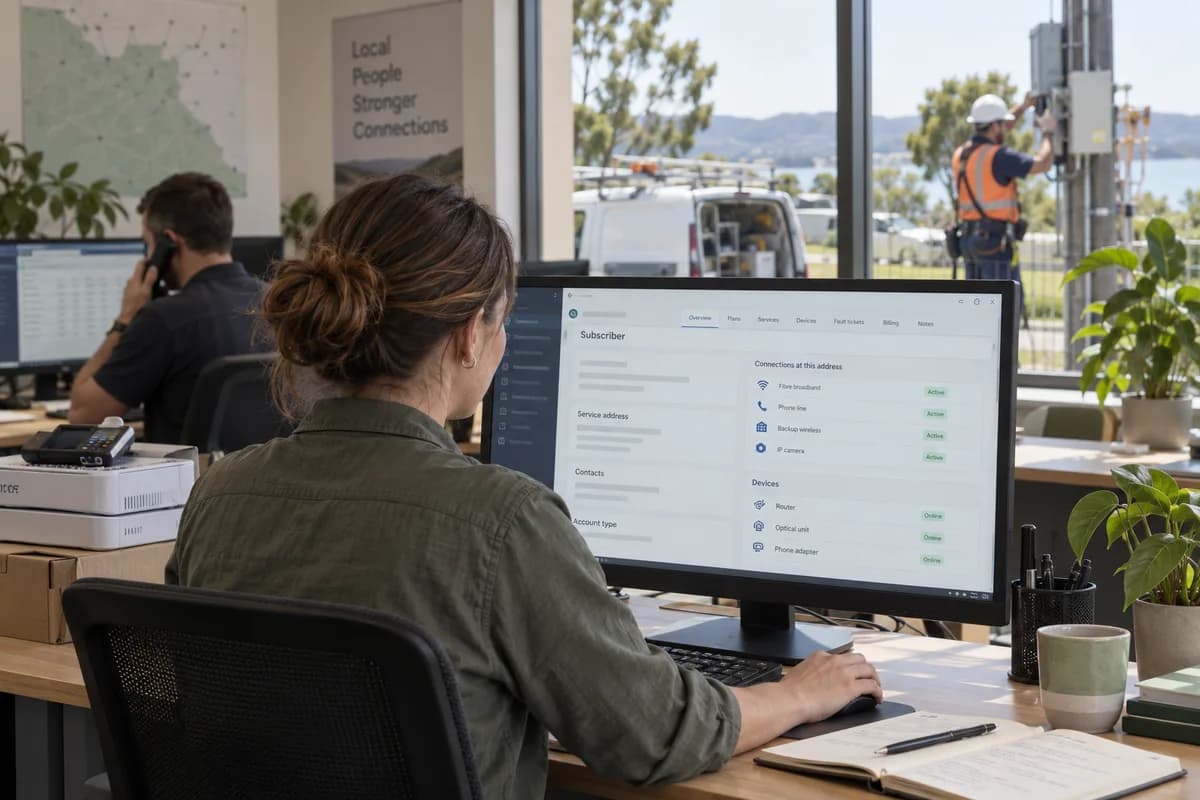
A regional telecom provider sells connectivity by plan and keeps it running by hand. Each subscriber has a plan, a connection point, a device and a billing cycle. Those four facts usually live in four different tools, kept by four different people, and none of them is the subscriber’s own record.
Software for this trade joins them at the subscriber. A first walkthrough can follow one installation from sign-up to first bill. Your network management and subscriber authentication tools stay where they are.
Sales staff take sign-ups from homes, shops and offices and check whether the address can be served from a cabinet, a mast or a fibre splitter. The answer often sits in one engineer’s head. A survey visit confirms the route and drop cable length. The subscriber then picks a plan, a static address option or a voice bundle, and a business account signs an agreement naming its restore target and term.
An installation crew fits the drop, the termination box and the router, then records the device serial, the port used, the signal level at the socket and any extra cabling. Billing runs each cycle against the plan, adds any installation fee or add-on, and chases late payers. Support takes calls. Slow speeds, dropped links and billing questions all arrive on the same line.
Faults come by phone and chat. A technician finds a cut cable, a faulty optical unit or a misaligned dish. Enterprise customers expect a restore target in the contract. Outages touch many accounts at once. Each needs a message.
What goes wrong for telecommunications companies without a proper system.
What we would build for telecommunications companies.
Named the way your team already talks about the work. We start with whichever part the audit shows is costing you most.
A requirements checklist for telecommunications companies.
What to cover, which reports to ask for and what to put to every vendor, ready to print or save as a PDF.
A product already built for telecommunications companies.
It is adapted to how your business works before it goes live, and anything your trade needs that it lacks is added then.
Telecom Service Provider Management Software
Subscriber accounts, plans, installation jobs, device stock, fault tickets, outage notices and recurring billing for regional telecom and broadband providers.
The business modules telecommunications companies use most.
Each one is also available on its own, or inside a system built for you.
The services behind it.
Business Process Automation
Approvals, reminders, follow-ups and reports that run on their own instead of on someone remembering.
Learn moreAPI and System Integration
Accounting software, WhatsApp, payment gateways, tax portals and your own apps sharing one set of numbers.
Learn moreERP, CRM and Business Software Implementation
One record of stock, orders, customers and accounts, set up so your team opens it every day.
Learn moreData Engineering and Business Intelligence
Dashboards that answer the owner’s Monday questions without anyone building an Excel sheet first.
Learn moreHow the work runs from Bengaluru for your city.
- 1
The audit, by call
A screen-share and a look at the sheets, accounting reports and WhatsApp groups your team uses. No travel needed.
- 2
A written proposal
Scope, what we build first and the cost, agreed in writing before anything starts.
- 3
Build in short rounds
Working screens shared every few weeks. Your team tests them from your own office.
- 4
Go-live, in person when it helps
For data migration and training we can come to your city. Travel is agreed in advance.
- 5
Support online
Fixes, changes and hosting handled remotely by the same team that built it.
Software we have built and run.
We only name clients whose work is published. These are systems our team designed, built and supports.
PetSeva: matching owners to the right vet, at any hour
A two-sided veterinary platform where vets are searchable by specialisation and bookable outside clinic hours. It now carries more than 2,000 veterinary doctors.
Read the case study Paying guest accommodationSAM Atithi Pavathi: bed-level occupancy as the source of truth
PG management software where allocation, rates and invoices are derived from bed-level occupancy and not maintained in parallel spreadsheets.
Read the case study School transport servicesSAM Tours: school transport on a single ledger
Registration, fee collection, routing and finance write to the same records, closing the gap between journeys run and fees collected.
Read the case studyQuestions telecommunications companies ask before they call.
Does the software control the network itself?
No. It does not configure routers or manage subscriber logins on the network. It holds the subscriber, plan, device and ticket records, and a link to your network tools is scoped during implementation.
Is this for a small broadband provider?
Yes. A local fibre or wireless provider with a few thousand subscribers is the usual fit. Large carriers with their own billing platforms are a different case.
Can it handle monthly plans and usage-based charges?
Plans bill on a cycle with add-ons and one-off fees. Usage-based charges need a usage file from your network, and that feed is agreed with you at the start.
Can agents collect payments in cash at a counter?
Yes. A payment taken at an agent counter is posted against the subscriber and shown on the next statement. Agent commission rules are set with you.
What happens after I share my requirements?
An engineer reads what you send and replies within one business day. We then look at the software, spreadsheets and WhatsApp groups your business runs on today and write down what works, what slows your team down and what is missing. A demo login, a screen-share or a few screenshots are enough. You get a short written summary ordered by priority, with no obligation to hire us afterwards.
How much will the software cost?
We don’t publish a price, because it depends on what the system has to do. That first review settles the scope, and the cost goes into a written proposal before any work starts.
Part of these wider groups.
Tell us how your business runs today.
A few lines on your spreadsheets, software and WhatsApp groups is enough. We reply the same working day.
- No obligation
- A reply within one business day
- Your details stay private
Start with your requirements
Seven short steps that tell us what you need. An engineer reads them before getting in touch.
Share your requirements