Heavy equipment and mining · Software for equipment rental companiesKnow where every machine is, who has it and what it is owed.
Equipment rental software holds each machine as one record with its hire history. Contracts, hour-meter readings, off-hire inspections and the service interval sit against the same unit, so the yard, the workshop and the accounts clerk stop quoting three different histories for one telehandler. Billing follows the hire period and the hours run. Damage found on return is tied to the contract that caused it.
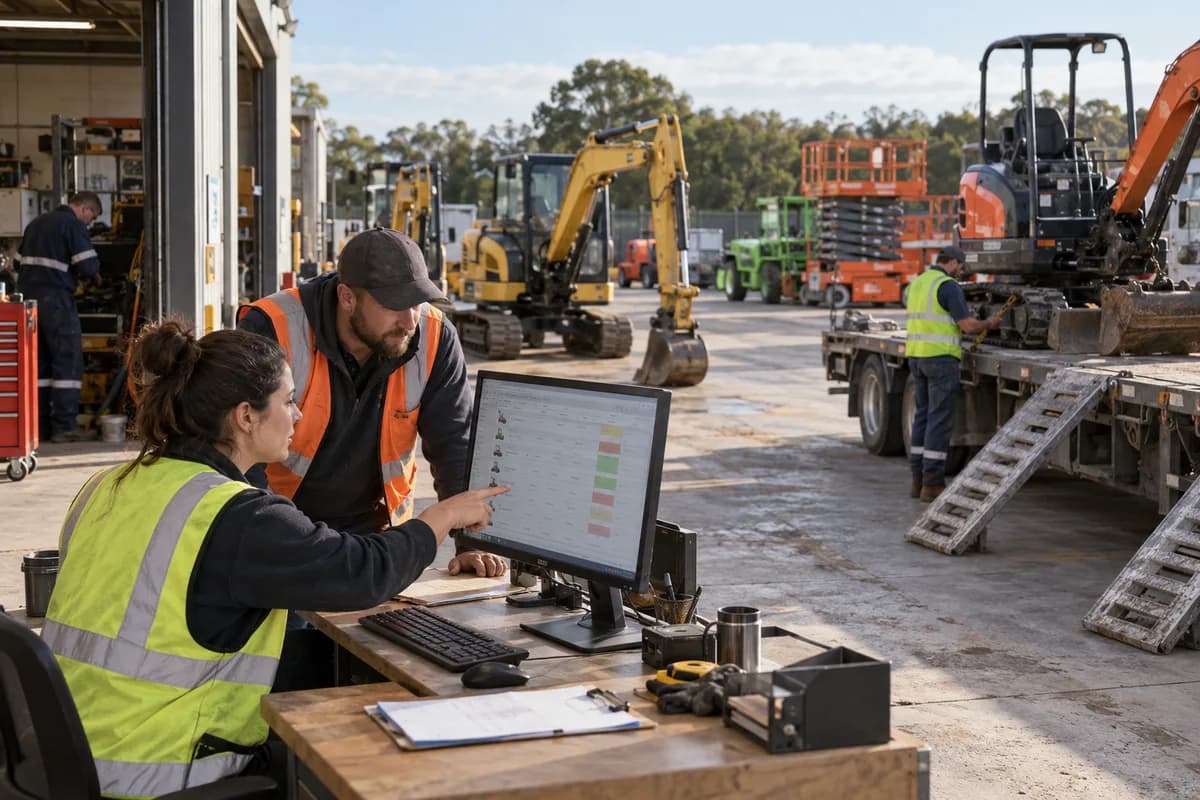
A rental company earns only while its machines are on hire and working. Between one site and the next, a unit has to be collected, washed, inspected, greased and made ready again. Each idle day costs money. Nobody sees it.
Most firms track this in a booking diary, a workshop notebook and a billing sheet that never quite agree. The software joins them.
A customer rings for a 3-tonne excavator, a scissor lift, a diesel generator, a plate compactor or a set of scaffold towers. The counter checks what is free for the dates asked, quotes a daily, weekly or monthly rate and takes a bond. Operators, fuel, low-loader transport and insurance may be added on top. Terms vary by customer. Each contract names the site, the person responsible and the period, and lists the machines and attachments that leave the yard.
The customer signs for the condition, and a photograph is taken of the machine, its bucket or forks and its attachments before it leaves for site. Hours or kilometres are read from the meter at hand-over. On return, the yard checks for damage, missing pins and fuel, and the workshop takes over. Invoices follow the contract, with extensions, standby days, damage charges and the bond settled at the end. Late returns are chased by the office. Fuel is charged at the rate on the contract.
What goes wrong for equipment rental companies without a proper system.
What equipment rental companies gain from one system.
Not a feature list. These are the moments in the working day that go differently once the records sit together.
What we would build for equipment rental companies.
Named the way your team already talks about the work. We start with whichever part the audit shows is costing you most.
A requirements checklist for equipment rental companies.
What to cover, which reports to ask for and what to put to every vendor, ready to print or save as a PDF.
A product already built for equipment rental companies.
It is adapted to how your business works before it goes live, and anything your trade needs that it lacks is added then.
Equipment Rental Management Software
Machine register, availability, rental contracts, delivery and return checks, workshop jobs, deposits and invoices for equipment rental companies running excavators, lifts, dumpers and generators.
What Equipment Rental Management Software covers, feature by feature
- Enquiries and customer files for equipment hire
- Equipment register for a plant hire yard
- Availability calendar for an equipment hire yard
- Quotations and rate cards for hire fleets
- Rental contracts for equipment hire firms
- Delivery and collection for a plant hire yard
- Condition checks and hour meter readings for hire
- Workshop jobs and servicing for hire machines
- Invoices, deposits and dues for hire firms
- Branches and yards for a multi-yard hire firm
Other products in the same sector as equipment rental companies.
- Excavation Company Management Software
- Farm Equipment Dealer Management Software
- Forklift Dealer Management Software
- Heavy Equipment Dealer Management Software
- Mining Company Management Software
- Oil and Gas Company Management Software
- Paving and Road Construction Management Software
- Well Drilling Company Management Software
- All industry products
The business modules equipment rental companies use most.
Each one is also available on its own, or inside a system built for you.
Lead Management
Enquiries arrive for cranes, excavators, generators and scaffolding for a named site and duration. Every one is logged with the machine type needed. Follow-up calls are scheduled for the sales desk.
Learn moreFixed Asset Register
Every machine is a record with purchase cost, depreciation and book value. Hire earnings are set against it. Management sees which units pay back and which are idle.
Learn moreQuote & Proposal Management
A rental quote lists machine, rate per day or hour, operator, transport and minimum hire. Customers receive options for different hire durations on one page. Accepted quotes become contracts.
Learn moreContract Management
Every hire has a contract with period, rate, deposit, insurance terms and site address. Extensions are added as dated amendments. Off-hire closes the contract and starts the final bill.
Learn moreVehicle and Trip Management
Low-loaders carry machines to and from sites, with driver, route and delivery time logged. The yard sees where each unit is. Collection runs are planned from off-hire dates.
Learn moreJob Cards
A repair or service on a machine is a job card with parts, labour and hours. The workshop sees which units are due before the next hire. Cards link to the asset record.
Learn moreService Reminders
Hour-meter readings and service intervals trigger reminders for oil changes, greasing and safety inspections. Planning follows the booking diary closely. Overdue machines are held back from the next hire.
Learn moreInvoice Management
Invoices bill hire by period from the contract, with extensions, transport, damage and fuel on separate lines. Deposits are adjusted at the end. Long hires bill in stages.
Learn moreAll solutions by area
- Applicant Tracking (5)
- CRM (8)
- Finance & Accounting (10)
- Helpdesk (4)
- Human Resources (13)
- Inventory Management (5)
- Project Management (7)
- Manufacturing (6)
- Procurement (4)
- Sales and Distribution (6)
- Field Service (5)
- Statutory and Compliance (4)
- Retail and POS (4)
- Bookings and Appointments (3)
- Subscriptions (2)
- Assets and Fleet (4)
- Platform (6)
- Analytics (2)
- Documents (1)
Where AI can help equipment rental companies.
Each one reads records you already keep, and a person approves every decision.
Where we work with equipment rental companies.
The services behind it.
Business Process Automation
Quote to contract, issue inspection, return inspection and invoice follow rules. A service-due alert holds a machine back from the next hire until the workshop releases it. Damage found at return goes to the contract.
Learn moreWeb and Mobile Application Development
A yard app captures photos, hour-meter readings and customer signatures at issue and return. Customers book and extend hires from a portal, with machine availability shown by date. Hire extensions are requested online.
Learn moreData Migration and Moving Off Spreadsheets
Machine lists, hire registers and service logs move from spreadsheets into unit records. Past hires and repairs stay attached to each excavator, lift and generator for the next quote. Hour-meter history carries over.
Learn moreAll our other services
- Custom Software and Product Engineering
- Software Maintenance, Support and Rescue
- AI and Intelligent Automation
- API and System Integration
- ERP, CRM and Business Software Implementation
- Data Engineering and Business Intelligence
- UI/UX Design and Prototyping
- Cloud Engineering and Managed Infrastructure
- DevOps & Automation Services
- QA and Software Testing
- Performance Engineering
- Cybersecurity and Application Security
- IoT and Edge Computing
- Technology Strategy and Product Consulting
- E-Commerce and Digital Commerce
- MVP Product Development
- SaaS Product Development
- WhatsApp Business API and Chatbots
- Training and Adoption
- Data Protection and Privacy Readiness
- Tax and e-Invoice Engineering
- Managed IT Support
- Dedicated Team and Staff Augmentation
- Business Intelligence and Reporting Tools
- Cloud Cost Optimisation
- Global Compliance and Localisation
How the work runs from Bengaluru for your city.
- 1
The audit, by call
A screen-share and a look at the sheets, accounting reports and WhatsApp groups your team uses. No travel needed.
- 2
A written proposal
Scope, what we build first and the cost, agreed in writing before anything starts.
- 3
Build in short rounds
Working screens shared every few weeks. Your team tests them from your own office.
- 4
Go-live, in person when it helps
For data migration and training we can come to your city. Travel is agreed in advance.
- 5
Support online
Fixes, changes and hosting handled remotely by the same team that built it.
The work we have published.
We only name clients whose work is published. None of them is in this trade; they show how the team works, not that it has built for this trade.
PetSeva: matching owners to the right vet, at any hour
A two-sided veterinary platform where vets are searchable by specialisation and bookable outside clinic hours. It now carries more than 2,000 veterinary doctors.
Read the case study Paying guest accommodationSAM Atithi Pavathi: bed-level occupancy as the source of truth
PG management software where allocation, rates and invoices are derived from bed-level occupancy and not maintained in parallel spreadsheets.
Read the case study School transport servicesSAM Tours: school transport on a single ledger
Registration, fee collection, routing and finance write to the same records, closing the gap between journeys run and fees collected.
Read the case study Microfinance and Self Help GroupsVikasa RDO: making SHG loan recovery auditable
Loan proposals, recoveries and commissions sit on one record, with a person attached to every state change, so a business handling a bank’s money can show where each rupee went.
Read the case studyCheck the difficult cases before choosing software.
Use examples from your own records to test the workflows that matter in your business.
Extensions slip past the invoice
Can you explain the balance from its original documents?
Select a partly settled example in “Extensions slip past the invoice”. Ask for the invoice, allocated receipts and remaining balance to be shown together before agreeing the opening figures.
Background reading: ERPNext: outstanding invoices
Quotations and rental contracts
Which assumptions stop being valid when the quotation changes?
For “Quotations and rental contracts”, compare an accepted version with a later revision. Identify changed quantities, exclusions and validity dates before the revised amount is used downstream.
Background reading: ERPNext: quotation terms
Questions equipment rental companies ask before they call.
Can we rent by day, week, month and hour meter?
Yes. Rate cards can be set per machine class for each basis. A contract picks the basis agreed with the customer, and extra hours or days are added when the machine returns.
Does it handle machines with operators?
Yes. An operator can be added to a contract as a line, with the shift or day rate. Operator rosters and overtime are set up with you during implementation.
Can we see which machines earn the least?
Yes. Reports show days on hire, idle days and billing for each machine, set beside servicing and repair cost. That gives a fair view of what to keep, sell or replace.
Do drivers and yard staff use phones?
Yes. Drivers and yard staff open their own deliveries and returns in a phone browser, add photographs and readings, and take the customer’s signature there.
How is a hire fleet system quoted?
Machines on the register, yards and workshops using it, and the staff who quote, dispatch and bill all drive the scope. Telematics, hour-meter feeds or an accounts package to connect add work. Every part is costed individually in the quotation.
What should a rental firm prepare ahead of the build?
Prepare your machine list with service intervals, a few signed contracts, condition check photos, the rate card and the deposit ledger. Ask the counter lead, the workshop head and the accounts clerk to be available. They can verify screens against real hires.
If the rental firm walks away, what stays with it?
All of it. Machine histories, contracts, inspections and invoices belong to the firm, and the code does too, so plain files hand them back on demand. Its builders keep supporting it, with hosting handled by GullySystem or elsewhere.
What happens after I share my requirements?
We review your brief and clarify the work with you. We then look at the software, spreadsheets and WhatsApp groups your business runs on today and write down what works, what slows your team down and what is missing. A demo login, a screen-share or a few screenshots are enough. You get a short written summary ordered by priority, with no obligation to hire us afterwards.
How much will the software cost?
We don’t publish a price, because it depends on what the system has to do. That first review settles the scope, and the cost goes into a written proposal before any work starts.
Part of a wider group.
Tell us how your business runs today.
A few lines on your spreadsheets, software and WhatsApp groups is enough. We reply the same working day.
What happens after you share your requirements
- We review your brief and the systems you already use.
- We clarify the workflow, missing information and the work to consider first.
- The proposed scope sets out the deliverables, responsibilities and dependencies.
- Review the scope and commercial terms before deciding whether to proceed.
Start with your requirements
Describe your current process, the people involved and the change you need. Start with the details you know; we can clarify the rest together.
Share your requirements