Follow each project from offer to commissioning, sign-off and retention.
An automation company sells offers, builds panels, and spends weeks commissioning at a customer’s plant, with retention money held long after the job. The project side is built for you during implementation. It follows each project from priced offer to final sign-off, holds panel material against it and logs service visits against warranty or a maintenance contract. The IoT monitoring dashboard covers machine readings.
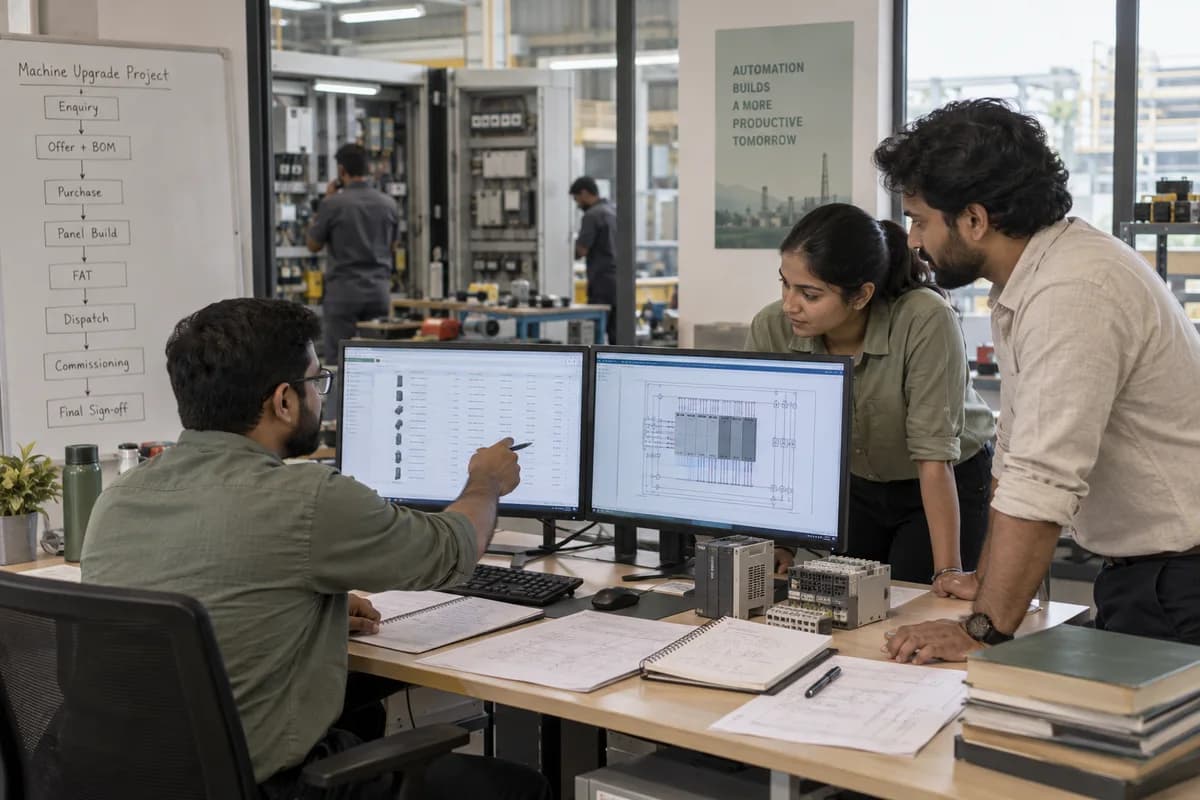
Automation projects rarely end when the panel ships. Commissioning, punch points, operator training and retention held until final acceptance all follow, often without a purchase order of their own.
Project and service tracking is what integrators and panel builders ask for, since the offer stage is usually fine and the stages after it are not. Share your requirements first.
A plant sends an enquiry for a machine upgrade, a SCADA supervisory system or a new motor control panel. An engineer counts every signal into an I/O list, then prices the PLCs, VFDs, HMIs, sensors and cabling that list demands. Every revision to that list moves the quoted figure. After the purchase order, parts are ordered from distributors, some with long lead times, and the panel is wired in your workshop.
The customer attends the factory acceptance test (FAT) in your workshop. Dispatch goes out with its transport document, and an engineer then spends days at the plant commissioning and sitting through the site acceptance test (SAT). Payments come against milestones, a share is held until final sign-off, and breakdown calls then arrive on an engineer’s personal phone.
What goes wrong for industrial automation companies without a proper system.
What we would build for industrial automation companies.
Named the way your team already talks about the work. We start with whichever part the audit shows is costing you most.
A requirements checklist for industrial automation companies.
What to cover, which reports to ask for and what to put to every vendor, ready to print or save as a PDF.
A product already built for industrial automation companies.
It is adapted to how your business works before it goes live, and anything your trade needs that it lacks is added then.
IoT Monitoring Dashboard
Live values, thresholds and alerts, downtime and run hours, and the history behind every reading from your machines, meters and sensors.
Other products in the same sector as industrial automation companies.
The business modules industrial automation companies use most.
Each one is also available on its own, or inside a system built for you.
- Dashboards and KPIs
- WhatsApp, SMS and Email Notifications
- Roles and Permissions
- Service Reminders
- Report Builder
- Workflow and Approvals
- Project Management Reports
- Project Timelines with Gantt Charts
- All business solutions
All solutions by area
- Applicant Tracking (5)
- CRM (8)
- Finance & Accounting (10)
- Helpdesk (4)
- Human Resources (13)
- Inventory Management (5)
- Project Management (7)
- Manufacturing (6)
- Procurement (4)
- Sales and Distribution (6)
- Field Service (5)
- Statutory and Compliance (4)
- Retail and POS (4)
- Bookings and Appointments (3)
- Subscriptions (2)
- Assets and Fleet (4)
- Platform (6)
- Analytics (2)
- Documents (1)
Where AI can help industrial automation companies.
Each one reads records you already keep, and a person approves every decision.
The services behind it.
ERP, CRM and Business Software Implementation
One record of stock, orders, customers and accounts, set up so your team opens it every day.
Learn moreIoT and Edge Computing
Machines, meters and sensors feeding the same system your office uses, even when the network drops.
Learn moreCustom Software and Product Engineering
Software built around how your business actually runs, when nothing off the shelf fits without workarounds.
Learn moreBusiness Process Automation
Approvals, reminders, follow-ups and reports that run on their own instead of on someone remembering.
Learn moreData Engineering and Business Intelligence
Dashboards that answer the owner’s Monday questions without anyone building an Excel sheet first.
Learn moreAll our other services
- Software Maintenance, Support and Rescue
- AI and Intelligent Automation
- API and System Integration
- UI/UX Design and Prototyping
- Cloud Engineering and Managed Infrastructure
- DevOps & Automation Services
- QA and Software Testing
- Performance Engineering
- Cybersecurity and Application Security
- Technology Strategy and Product Consulting
- E-Commerce and Digital Commerce
- MVP Product Development
- Web and Mobile Application Development
- SaaS Product Development
- WhatsApp Business API and Chatbots
- Data Migration and Moving Off Spreadsheets
- Training and Adoption
- Data Protection and Privacy Readiness
- Tax and e-Invoice Engineering
- Managed IT Support
- Dedicated Team and Staff Augmentation
- Business Intelligence and Reporting Tools
- Cloud Cost Optimisation
- Global Compliance and Localisation
Written for industrial automation companies.
Practical notes on running the business, not product marketing.
How the work runs from Bengaluru for your city.
- 1
The audit, by call
A screen-share and a look at the sheets, accounting reports and WhatsApp groups your team uses. No travel needed.
- 2
A written proposal
Scope, what we build first and the cost, agreed in writing before anything starts.
- 3
Build in short rounds
Working screens shared every few weeks. Your team tests them from your own office.
- 4
Go-live, in person when it helps
For data migration and training we can come to your city. Travel is agreed in advance.
- 5
Support online
Fixes, changes and hosting handled remotely by the same team that built it.
The work we have published.
We only name clients whose work is published. None of them is in this trade; they show how the team works, not that it has built for this trade.
PetSeva: matching owners to the right vet, at any hour
A two-sided veterinary platform where vets are searchable by specialisation and bookable outside clinic hours. It now carries more than 2,000 veterinary doctors.
Read the case study Paying guest accommodationSAM Atithi Pavathi: bed-level occupancy as the source of truth
PG management software where allocation, rates and invoices are derived from bed-level occupancy and not maintained in parallel spreadsheets.
Read the case study School transport servicesSAM Tours: school transport on a single ledger
Registration, fee collection, routing and finance write to the same records, closing the gap between journeys run and fees collected.
Read the case study Microfinance and Self Help GroupsVikasa RDO: making SHG loan recovery auditable
Loan proposals, recoveries and commissions sit on one record, with a person attached to every state change, so a business handling a bank’s money can show where each rupee went.
Read the case studyQuestions industrial automation companies ask before they call.
Does it work alongside our bookkeeping tool?
Yes, it runs beside your accounting software without a built-in link. We can add an export of purchases, milestone invoices and transport document details during configuration, priced as its own item. Accounts stay in your ledger software.
Can you also build SCADA dashboards?
Yes. The IoT monitoring dashboard reads PLCs, drives and meters and raises alerts, once your machine data is reachable. It is quoted separately from the project side.
Should we buy a standard ERP instead?
If you build repeat panels to the same design, a standard ERP may be enough. Integrators who commission on site usually find punch lists and retention missing from it.
Can it track imported parts?
Yes, in the project side we build. Each part on order shows its promised date against the project waiting for it, and a late item flags the FAT date at risk. Freight and duty can be added to the part’s cost.
Which parts of a panel and controls shop move the quotation?
Engineers quoting, the number of projects live at once, and the drawing and revision flow all weigh in. Imported part tracking and billing links add more. Each module is costed once the BOM builder has run on a past enquiry.
What should an automation firm prepare to begin?
Bring an I/O list, a quotation with its BOM, a FAT checklist, a milestone billing schedule, a service call record and a program backup folder. Name a project lead and a service engineer for checks. Real paperwork helps industrial automation companies most.
Who keeps project files and program backups if the panel shop moves on?
Offers, material control, checklists, billing and the program archive stay with the panel shop, with an open-format export on request. The panel shop holds title to the source, and the builders carry on repairing it. Industrial automation companies data stays with them.
What happens after I share my requirements?
An engineer reads what you send and replies within one business day. We then look at the software, spreadsheets and WhatsApp groups your business runs on today and write down what works, what slows your team down and what is missing. A demo login, a screen-share or a few screenshots are enough. You get a short written summary ordered by priority, with no obligation to hire us afterwards.
How much will the software cost?
We don’t publish a price, because it depends on what the system has to do. That first review settles the scope, and the cost goes into a written proposal before any work starts.
Cities where industrial automation companies are common.
Part of these wider groups.
Tell us how your business runs today.
A few lines on your spreadsheets, software and WhatsApp groups is enough. We reply the same working day.
What happens after you share your requirements
- A senior engineer reads your answers. Nobody phones first.
- Within one business day you get a written note: what we understood, what we would start with, and the questions we still have.
- If it fits, a proposal follows with the order of work, what we need from you and what you receive at each step.
- No call is booked and nothing is paid until you have read the note. Your details stay with us.
Start with your requirements
Seven short steps that tell us what you need. A senior engineer reads them before anyone gets in touch.
Share your requirements