Retail and distribution · Software for surgical and medical supplies distributorsFollow every lot, hospital rate contract and pending bill from purchase order to payment.
Surgical and medical supplies distributors carry examination gloves, syringes, IV cannulas, sutures, gauze dressings and orthopaedic implants for hospitals, nursing homes, labs and clinics. Rate contracts, purchase orders, consignment sets in operation theatres and unpaid bills are tracked in Excel and on calls. The system keeps lot and expiry on every line, prices each hospital at its contract rate, and shows which bills are submitted, approved or unpaid.
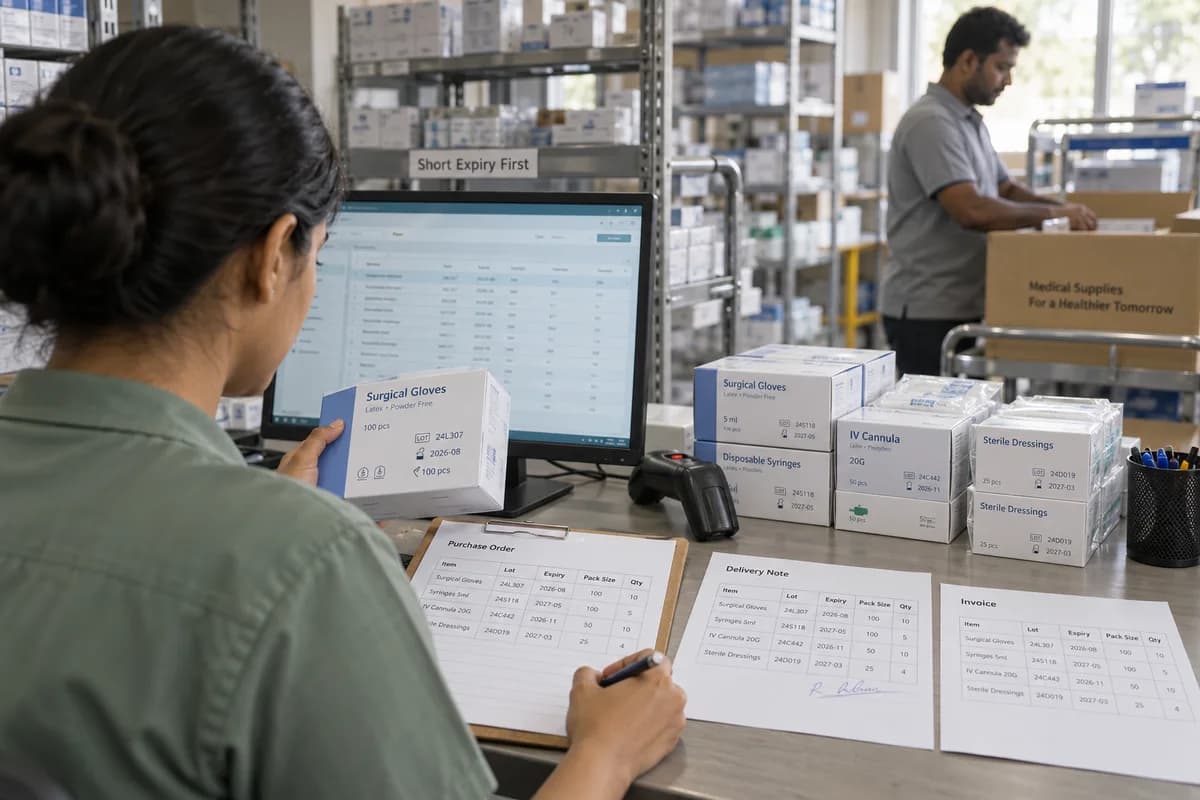
Hundreds of small items move every day, each with a lot number, an expiry date and a pack size. The hospital’s order counts single units, while the company’s shipper carton holds a case. A box of 100 gloves becomes a case of ten boxes on one side and a single pair on the other.
Hospitals pay slowly and buy at agreed rates. Getting the rate, the lot and the paperwork right on the first bill decides when the money comes in.
Hospital stores send purchase orders by email or through their own portal, nursing homes order on WhatsApp, and labs call for the same pipette tips and sample tubes every week. Each order is billed at that buyer’s rate, picked by lot and delivered with a delivery note the stores clerk signs.
Sutures, hernia meshes and bone plates are left at the hospital on consignment in a set. Only what the surgeon uses is billed after the case. The usage slip comes back late, sometimes without lot stickers.
Bills go to the hospital’s accounts with the purchase order, delivery note and goods received note attached, and are chased for weeks through the stores officer. A manufacturer’s recall notice names lots that must be traced to every buyer who received them.
What goes wrong for surgical and medical supplies distributors without a proper system.
What surgical and medical supplies distributors gain from one system.
Not a feature list. These are the moments in the working day that go differently once the records sit together.
What we would build for surgical and medical supplies distributors.
Named the way your team already talks about the work. We start with whichever part the audit shows is costing you most.
A requirements checklist for surgical and medical supplies distributors.
What to cover, which reports to ask for and what to put to every vendor, ready to print or save as a PDF.
The product we start from for surgical and medical supplies distributors.
It is the closest ready product to this trade. The parts your work needs that it lacks are added before it goes live, and we say up front which those are.
Wholesale and B2B Ordering Software
A dealer login with its own rates and schemes, live stock, credit checks, picking and dispatch, part loads, returns and repeat orders.
What Wholesale and B2B Ordering Software covers, feature by feature
- Dealer Logins for Self-Service Ordering
- Price Lists for Retail, Dealer and Project Buyers
- Dealer Schemes with Start and Stop Dates
- Live Stock Visibility for Dealer Orders
- Credit Limit Checks and Order Holds
- Order to Dispatch Status Tracking
- Part Dispatch and Pending Quantity
- Dealer Returns and Damage Claims
- Order History and Repeat Orders for Dealers
- Dealer Ledger and Statements for Distributors
- Ordering on a Dealer’s Behalf for Sales Officers
- Picking and Packing Lists for Wholesale Godowns
Other products in the same sector as surgical and medical supplies distributors.
- Electronics and Appliance Retail Software
- Auctioneer Management Software
- Battery Dealer Management Software
- Building Material Trading Software
- Clothing Store Management Software
- Department Store Management Software
- Discount Store Management Software
- E-commerce Fulfilment Centre Management Software
- Electronic Components Distributor Management Software
- Florist Management System
- Furniture Showroom Management Software
- Home Theatre and AV Dealer Management Software
- All industry products
The business modules surgical and medical supplies distributors use most.
Each one is also available on its own, or inside a system built for you.
Dealer and Distributor Portal
A nursing home signs in, sees its rate and stock, and repeats an order for gloves or syringes. Hospital stores clerks fetch past delivery notes. Orders arrive as drafts for checking.
Learn morePrice Lists and Schemes
Each hospital is billed at its contract rate for an item, and a clinic at the standard list. Rates carry start and end dates. A scheme on cannulas applies only to the clinic list.
Learn moreCredit Limits and Control
Hospital accounts pay after a bill is approved, so credit periods differ from clinic to clinic. Terms sit on each account. A held order shows the bills behind it.
Learn moreOrder Management
A hospital purchase order arrives by email, a nursing home’s on a messaging app and a lab’s as a repeat list. Rates are keyed to the buyer. Part-supplied lines stay open.
Learn moreSales Returns and Credit Notes
Expired or wrongly picked cartons come back with a lot number and a reason. A credit note follows against the original invoice. Items from a recalled lot are quarantined, not restocked.
Learn moreWarehouse Management
Gloves and dressings sit in the main store, orthopaedic implants in a locked cage and consignment sets at hospitals. Stock moves by transfer note between them. First expiry goes out first.
Learn moreTerritory Management
Sales reps cover named hospitals, nursing homes and labs in an area. Hospital visits are planned around purchase committee dates. Neglected accounts show on the rep’s list for the week.
Learn moreAll solutions by area
- Applicant Tracking (5)
- CRM (8)
- Finance & Accounting (10)
- Helpdesk (4)
- Human Resources (13)
- Inventory Management (5)
- Project Management (7)
- Manufacturing (6)
- Procurement (4)
- Sales and Distribution (6)
- Field Service (5)
- Statutory and Compliance (4)
- Retail and POS (4)
- Bookings and Appointments (3)
- Subscriptions (2)
- Assets and Fleet (4)
- Platform (6)
- Analytics (2)
- Documents (1)
Where AI can help surgical and medical supplies distributors.
Each one reads records you already keep, and a person approves every decision.
The services behind it.
ERP, CRM and Business Software Implementation
Lot and expiry capture, hospital rate contracts, consignment sets, delivery notes, bills and collections are put in one system. Stores officers and purchase managers are linked to their hospital’s orders and open dues.
Learn moreBusiness Process Automation
A purchase order can create the pick list by oldest lot, print the delivery note and queue the invoice once the signed note is uploaded. Bills can move through submitted and approved stages with reminders for the collection team.
Learn moreData Engineering and Business Intelligence
Sales by hospital, product group and lot are reported from clean records. Owners see which rate contracts sell, which items expire unsold and how long each hospital takes to pay, built from the billing and stock tables.
Learn moreWhatsApp Business API and Chatbots
Nursing homes and labs can place a repeat order or ask for a bill copy in a messaging app. The order lands in the order list in packs and cases, and a delivery update returns to the same chat.
Learn moreAll our other services
- Custom Software and Product Engineering
- Software Maintenance, Support and Rescue
- AI and Intelligent Automation
- API and System Integration
- UI/UX Design and Prototyping
- Cloud Engineering and Managed Infrastructure
- DevOps & Automation Services
- QA and Software Testing
- Performance Engineering
- Cybersecurity and Application Security
- IoT and Edge Computing
- Technology Strategy and Product Consulting
- E-Commerce and Digital Commerce
- MVP Product Development
- Web and Mobile Application Development
- SaaS Product Development
- Data Migration and Moving Off Spreadsheets
- Training and Adoption
- Data Protection and Privacy Readiness
- Tax and e-Invoice Engineering
- Managed IT Support
- Dedicated Team and Staff Augmentation
- Business Intelligence and Reporting Tools
- Cloud Cost Optimisation
- Global Compliance and Localisation
Written for surgical and medical supplies distributors.
Practical notes on running the business, not product marketing.
How the work runs from Bengaluru for your city.
- 1
The audit, by call
A screen-share and a look at the sheets, accounting reports and WhatsApp groups your team uses. No travel needed.
- 2
A written proposal
Scope, what we build first and the cost, agreed in writing before anything starts.
- 3
Build in short rounds
Working screens shared every few weeks. Your team tests them from your own office.
- 4
Go-live, in person when it helps
For data migration and training we can come to your city. Travel is agreed in advance.
- 5
Support online
Fixes, changes and hosting handled remotely by the same team that built it.
The work we have published.
We only name clients whose work is published. None of them is in this trade; they show how the team works, not that it has built for this trade.
PetSeva: matching owners to the right vet, at any hour
A two-sided veterinary platform where vets are searchable by specialisation and bookable outside clinic hours. It now carries more than 2,000 veterinary doctors.
Read the case study Paying guest accommodationSAM Atithi Pavathi: bed-level occupancy as the source of truth
PG management software where allocation, rates and invoices are derived from bed-level occupancy and not maintained in parallel spreadsheets.
Read the case study School transport servicesSAM Tours: school transport on a single ledger
Registration, fee collection, routing and finance write to the same records, closing the gap between journeys run and fees collected.
Read the case study Microfinance and Self Help GroupsVikasa RDO: making SHG loan recovery auditable
Loan proposals, recoveries and commissions sit on one record, with a person attached to every state change, so a business handling a bank’s money can show where each rupee went.
Read the case studyCheck the difficult cases before choosing software.
Use examples from your own records to test the workflows that matter in your business.
Lot and expiry on every line
How is an expired or held lot kept out of an ordinary issue?
Use “Lot and expiry on every line” to compare a usable lot with one awaiting a decision. Agree how the team identifies the affected quantity before picking or issuing it.
Background reading: ERPNext: batch records
Contract rates are applied wrongly
Which rule wins when two rates or offers apply?
Use “Contract rates are applied wrongly” to check an ordinary sale and one that meets two pricing conditions. Ask for the calculation behind each final amount, rather than only the total.
Background reading: ERPNext: pricing conditions
Questions surgical and medical supplies distributors ask before they call.
Can implants be tracked by serial number as well as lot?
Yes, in a system built for you. Implants carry serial and lot, and usage is recorded against the case reference the hospital gives you.
Does the ready ordering product track lot and expiry?
No. The ordering product listed on this page covers buyer logins, rates, credit limits, dispatch and returns. Lot and expiry tracking is part of what we would build alongside it.
Can bills be uploaded to a hospital’s supplier portal?
Not on its own. Bills and supporting papers can be prepared in the layout each hospital asks for. A direct portal link depends on what the hospital allows and is scoped separately.
Will the accounts stay in our books?
They can. GullySystem has no ready connection to your ledgers, but an export of invoices and receipts is possible, scoped while the system is configured and quoted apart from the build.
How is a supplies distributor system priced?
Warehouses, billing users, hospital contracts and consignment sets in theatres size it. A portal upload, recall tracing and old stock sheets are extra. A few contract rates and lots are keyed in first, and each quotation line then stands separately.
What should the distributor bring first?
A hospital rate contract, a recent invoice with lot and expiry, a consignment usage slip, a recall notice and the unpaid bills sheet. A stores clerk and an accounts colleague should see screens early. Nothing heavy.
Who keeps lot and contract data if we leave?
You keep it, and the programme too. Lots, contract rates and bill follow-up are available as sheets whenever you want. The builders stay on for support. We run the servers unless told otherwise.
What happens after I share my requirements?
We review your brief and clarify the work with you. We then look at the software, spreadsheets and WhatsApp groups your business runs on today and write down what works, what slows your team down and what is missing. A demo login, a screen-share or a few screenshots are enough. You get a short written summary ordered by priority, with no obligation to hire us afterwards.
How much will the software cost?
We don’t publish a price, because it depends on what the system has to do. That first review settles the scope, and the cost goes into a written proposal before any work starts.
Related industries.
- Appliance and electronics dealers
- Auctioneers
- Battery dealers
- Building material suppliers
- Clothing stores
- Corporate gifting companies
- Department stores
- Discount stores
- E-commerce fulfilment centres
- Electrical goods dealers
- Electronic components distributors
- Florists and flower shops
- FMCG distributors
- Furniture showrooms
- Home furnishing stores
- Home theatre and AV dealers
- Industrial tools distributors
- Jewellers
- Kirana and grocery stores
- Lighting stores
- Marble and granite dealers
- Medical equipment dealers
- Office and cleaning supply dealers
- Outdoor and sports goods stores
- Paint dealers
- Pet stores
- Pharmaceutical distributors
- Plumbing material dealers
- Tile and sanitaryware showrooms
- Uniform suppliers
- UPS and power backup dealers
- Water purifier dealers
Part of these wider groups.
Also sell online?
The e-commerce pages cover the online side of this trade: storefronts, dealer ordering and the link to your stock.
Tell us how your business runs today.
A few lines on your spreadsheets, software and WhatsApp groups is enough. We reply the same working day.
What happens after you share your requirements
- We review your brief and the systems you already use.
- We clarify the workflow, missing information and the work to consider first.
- The proposed scope sets out the deliverables, responsibilities and dependencies.
- Review the scope and commercial terms before deciding whether to proceed.
Start with your requirements
Describe your current process, the people involved and the change you need. Start with the details you know; we can clarify the rest together.
Share your requirements