Retail and distribution · Software for battery dealersTrack each battery by serial, exchange, warranty claim and garage credit account.
Battery dealers sell automotive, scooter, tubular inverter and solar batteries to walk-in buyers, garages and electricians, and take the old unit back against an exchange rebate. Billing software covers the invoice, while serial numbers, warranty cards, scrap lead-acid cores and garage dues stay on slips. The system built for you puts one record on each battery.
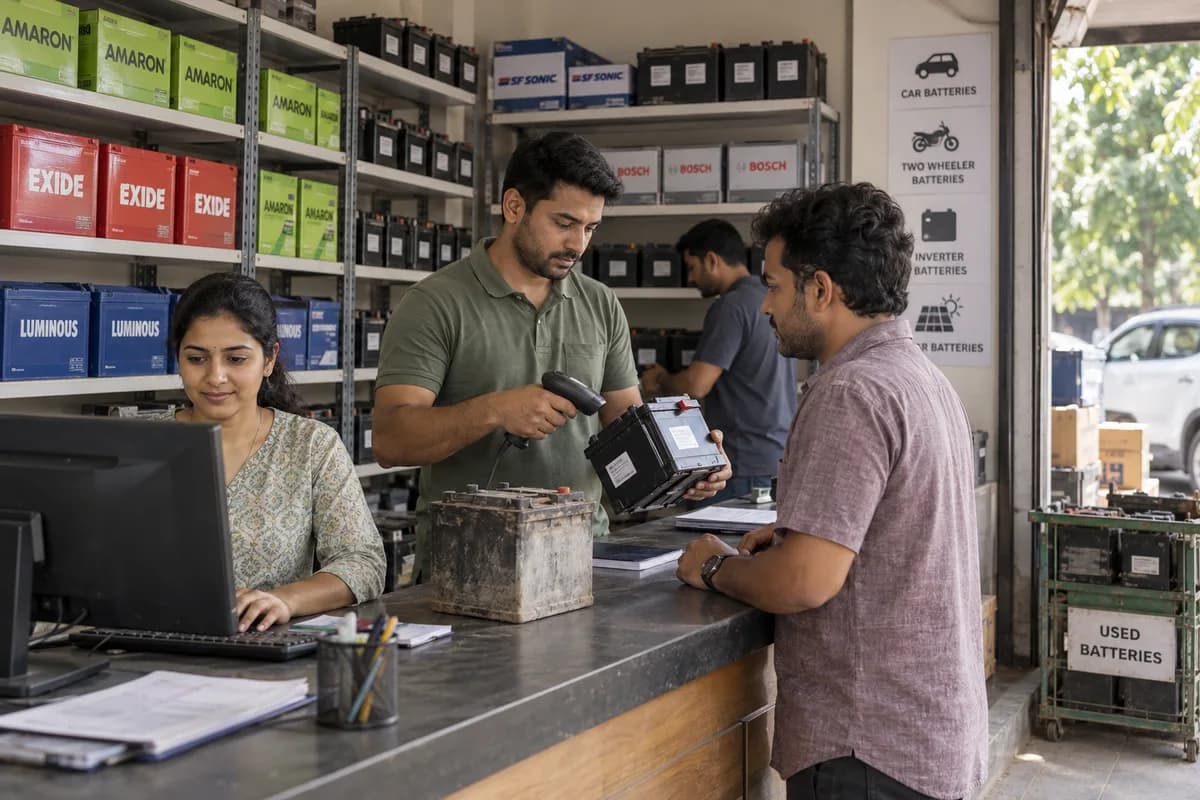
A serial number and a date code are stamped on the lid of each battery that leaves the counter. Months later it returns with a dead cell, and the claim stands or falls on a record the dealer must find in seconds.
No packaged product fits this trade closely enough. A custom system is built around your brands, your old-battery buyback rates and your trade accounts. Everything starts from the serial printed on the battery.
A customer walks in with a flat 12V 35Ah battery from a hatchback, a scooter or a home inverter, and the counter checks the model code. It quotes two rates, one with the old core handed over and one without. The new unit is billed, the warranty card is stamped, and the serial is copied across, sometimes only onto the card.
Garages and electricians collect several tubular and automotive batteries a week on credit, so their dues swell through the month. Distributors supply against quarterly schemes. A slab bonus can hinge on units sold before a fixed date.
Failed batteries come back as warranty cases. The dealer checks the open-circuit voltage, runs a drop tester, tags the unit and sends it to the brand’s service centre to wait for a replacement or a credit note. Meanwhile scrap cores stack up behind the counter until a lead smelter’s buyer weighs the lot.
What goes wrong for battery dealers without a proper system.
What battery dealers gain from one system.
Not a feature list. These are the moments in the working day that go differently once the records sit together.
What we would build for battery dealers.
Named the way your team already talks about the work. We start with whichever part the audit shows is costing you most.
A requirements checklist for battery dealers.
What to cover, which reports to ask for and what to put to every vendor, ready to print or save as a PDF.
A product already built for battery dealers.
It is adapted to how your business works before it goes live, and anything your trade needs that it lacks is added then.
Battery Dealer Management Software
Battery stock by serial and date code, exchange cores, warranty and replacement cases, garage credit accounts and brand scheme targets for battery dealers.
What Battery Dealer Management Software covers, feature by feature
- Battery stock records by brand and serial
- Date code ageing list for battery shelves
- Battery counter billing with exchange rebate
- Battery sale and warranty record by serial
- Old battery exchange register and scrap cores
- Battery warranty and replacement case tracking
- Garage and electrician credit accounts for batteries
- Battery brand scheme and purchase tracker
- Battery charging and home fitting job cards
- Battery supplier orders and delivery receipts
Other products in the same sector as battery dealers.
- Electronics and Appliance Retail Software
- Auctioneer Management Software
- Building Material Trading Software
- Wholesale and B2B Ordering Software
- Clothing Store Management Software
- Department Store Management Software
- Discount Store Management Software
- E-commerce Fulfilment Centre Management Software
- Electronic Components Distributor Management Software
- Florist Management System
- Furniture Showroom Management Software
- Home Theatre and AV Dealer Management Software
- All industry products
The business modules battery dealers use most.
Each one is also available on its own, or inside a system built for you.
Batch and Serial Tracking
Every battery in the shop carries its serial and manufacturing date code, whether a 12V car unit or a tubular inverter cell. A warranty claim finds the sale in seconds. Old stock shows at the top.
Learn morePoint of Sale Billing
A new battery is billed with two rates, one with the old core handed over and one without. The serial goes on the bill, not only the warranty card. A tax invoice prints for garages.
Learn moreStock Tracking and Alerts
Stock is counted by brand, voltage and Ah rating, and fast fitments carry reorder levels. Slow sizes show their age. Charging-room units are separate from shop floor units, so a trade enquiry is answered honestly.
Learn moreCredit Limits and Control
Garages and electricians buy several units a week on credit, and each has a limit set against dues. A new bill over the limit needs the owner’s nod. The limit holds them.
Learn moreCollections and Payment Follow-Up
Garage accounts are listed by amount due and age, with the next promised date. Payments by cash or transfer are marked at the counter. Chasing happens from one list.
Learn morePrice Lists and Schemes
Distributor price lists and brand schemes set the selling rate by model. Quarterly targets show how far the shop is from the next slab. Rebates follow the Ah rating.
Learn moreJob Cards
A flat battery brought for testing or slow charging gets a job card with the symptom, the charger bay and the hours on charge. Hydrometer and load test results are noted. The customer collects against the card.
Learn morePurchase Order Management
Orders to the distributor are built from low stock in fast sizes. Part deliveries are matched against the order and the invoice, and gaps are chased. Scheme buys are tagged.
Learn moreAll solutions by area
- Applicant Tracking (5)
- CRM (8)
- Finance & Accounting (10)
- Helpdesk (4)
- Human Resources (13)
- Inventory Management (5)
- Project Management (7)
- Manufacturing (6)
- Procurement (4)
- Sales and Distribution (6)
- Field Service (5)
- Statutory and Compliance (4)
- Retail and POS (4)
- Bookings and Appointments (3)
- Subscriptions (2)
- Assets and Fleet (4)
- Platform (6)
- Analytics (2)
- Documents (1)
Where AI can help battery dealers.
Each one reads records you already keep, and a person approves every decision.
The services behind it.
ERP, CRM and Business Software Implementation
Stock by serial, sale and warranty records, scrap core ledgers and trade account dues run in one system built around the counter. Brand price lists, rebate rates and garage accounts all sit in the same place.
Learn moreBusiness Process Automation
Warranty claim steps, core rebate approvals and dues reminders run on set rules. A claim can be raised from a serial and tracked until the brand’s credit arrives, without the owner chasing paper.
Learn moreWhatsApp Business API and Chatbots
Customers send a vehicle model or inverter rating on a messaging app and receive a quote with and without the old core. Warranty status and pickup reminders for tubular and automotive batteries go out from the same record.
Learn moreData Migration and Moving Off Spreadsheets
Serial lists, warranty card registers and garage due sheets move into the new records. Brand model codes, ampere-hour ratings and date codes are cleaned so past sales can still be traced.
Learn moreAll our other services
- Custom Software and Product Engineering
- Software Maintenance, Support and Rescue
- AI and Intelligent Automation
- API and System Integration
- Data Engineering and Business Intelligence
- UI/UX Design and Prototyping
- Cloud Engineering and Managed Infrastructure
- DevOps & Automation Services
- QA and Software Testing
- Performance Engineering
- Cybersecurity and Application Security
- IoT and Edge Computing
- Technology Strategy and Product Consulting
- E-Commerce and Digital Commerce
- MVP Product Development
- Web and Mobile Application Development
- SaaS Product Development
- Training and Adoption
- Data Protection and Privacy Readiness
- Tax and e-Invoice Engineering
- Managed IT Support
- Dedicated Team and Staff Augmentation
- Business Intelligence and Reporting Tools
- Cloud Cost Optimisation
- Global Compliance and Localisation
Written for battery dealers.
Practical notes on running the business, not product marketing.
How the work runs from Bengaluru for your city.
- 1
The audit, by call
A screen-share and a look at the sheets, accounting reports and WhatsApp groups your team uses. No travel needed.
- 2
A written proposal
Scope, what we build first and the cost, agreed in writing before anything starts.
- 3
Build in short rounds
Working screens shared every few weeks. Your team tests them from your own office.
- 4
Go-live, in person when it helps
For data migration and training we can come to your city. Travel is agreed in advance.
- 5
Support online
Fixes, changes and hosting handled remotely by the same team that built it.
The work we have published.
We only name clients whose work is published. None of them is in this trade; they show how the team works, not that it has built for this trade.
PetSeva: matching owners to the right vet, at any hour
A two-sided veterinary platform where vets are searchable by specialisation and bookable outside clinic hours. It now carries more than 2,000 veterinary doctors.
Read the case study Paying guest accommodationSAM Atithi Pavathi: bed-level occupancy as the source of truth
PG management software where allocation, rates and invoices are derived from bed-level occupancy and not maintained in parallel spreadsheets.
Read the case study School transport servicesSAM Tours: school transport on a single ledger
Registration, fee collection, routing and finance write to the same records, closing the gap between journeys run and fees collected.
Read the case study Microfinance and Self Help GroupsVikasa RDO: making SHG loan recovery auditable
Loan proposals, recoveries and commissions sit on one record, with a person attached to every state change, so a business handling a bank’s money can show where each rupee went.
Read the case studyCheck the difficult cases before choosing software.
Use examples from your own records to test the workflows that matter in your business.
Battery stock by brand, model and serial
What happens to movements entered while a count is being checked?
For “Battery stock by brand, model and serial”, choose a count date and trace the movements around it. Agree who investigates a difference before an adjustment changes the available balance.
Background reading: ERPNext: stock reconciliation
Sale and warranty record
What proves that a planned task was actually completed?
Select an overdue entry in “Sale and warranty record”. Ask which work record closes it and what remains visible when the visit is postponed or only part of the job is done.
Background reading: ERPNext: maintenance plans
Questions battery dealers ask before they call.
Why not use the auto parts shop product?
That product suits a counter selling spares by vehicle fitment. Serial-level warranty, the scrap core register and brand slabs lie outside it, so a battery dealer is a custom build.
Can we keep billing in our accounting system?
Yes. Many dealers do. There is no live link between the two systems, though a sales export for your accountant can be added as separate work.
Will it rule on a battery warranty claim?
No. The brand decides that. The system keeps the sale date, serial, voltage reading and bench notes, so the claim you send is complete and you can follow it to the answer.
Can serial numbers be entered by scanning?
Yes, if the battery label carries a barcode and the counter has a scanner. Otherwise the serial is typed, and the label layout of each brand is checked during scoping.
How are battery dealer systems priced?
Price follows the number of counters or branches, how many people bill and handle warranty, and whether garage credit and brand scheme tracking are included. A serial scanner and a link to your accounting system add scope. We walk through your records first, then show a separate figure against every part.
What does a battery dealer need to have ready?
The stock list by brand and model, the old-battery exchange register, open warranty cases and the garage dues sheet. Bring a billed invoice and a stamped warranty card. One person from the counter and one from accounts should be able to confirm what the screens show.
Who keeps the serial and warranty history after a departure?
Yes. Serial, sale and claim records belong to you, and so does the software. Exports in ordinary file formats are available whenever you ask. Support stays with the developers. Hosting rests with GullySystem, though you may move it elsewhere. Nothing traps your warranty history.
What happens after I share my requirements?
We review your brief and clarify the work with you. We then look at the software, spreadsheets and WhatsApp groups your business runs on today and write down what works, what slows your team down and what is missing. A demo login, a screen-share or a few screenshots are enough. You get a short written summary ordered by priority, with no obligation to hire us afterwards.
How much will the software cost?
We don’t publish a price, because it depends on what the system has to do. That first review settles the scope, and the cost goes into a written proposal before any work starts.
Related industries.
- Appliance and electronics dealers
- Auctioneers
- Building material suppliers
- Clothing stores
- Corporate gifting companies
- Department stores
- Discount stores
- E-commerce fulfilment centres
- Electrical goods dealers
- Electronic components distributors
- Florists and flower shops
- FMCG distributors
- Furniture showrooms
- Home furnishing stores
- Home theatre and AV dealers
- Industrial tools distributors
- Jewellers
- Kirana and grocery stores
- Lighting stores
- Marble and granite dealers
- Medical equipment dealers
- Office and cleaning supply dealers
- Outdoor and sports goods stores
- Paint dealers
- Pet stores
- Pharmaceutical distributors
- Plumbing material dealers
- Surgical and medical supplies distributors
- Tile and sanitaryware showrooms
- Uniform suppliers
- UPS and power backup dealers
- Water purifier dealers
Part of a wider group.
Also sell online?
The e-commerce pages cover the online side of this trade: storefronts, dealer ordering and the link to your stock.
Tell us how your business runs today.
A few lines on your spreadsheets, software and WhatsApp groups is enough. We reply the same working day.
What happens after you share your requirements
- We review your brief and the systems you already use.
- We clarify the workflow, missing information and the work to consider first.
- The proposed scope sets out the deliverables, responsibilities and dependencies.
- Review the scope and commercial terms before deciding whether to proceed.
Start with your requirements
Describe your current process, the people involved and the change you need. Start with the details you know; we can clarify the rest together.
Share your requirements