Follow each damaged car from assessed estimate to paint booth and delivery check.
A body shop repairs the same car in stages over days or weeks, and most of those stages are waiting. The software holds the assessed estimate, supplements, parts due, panel stage, paint mix and delivery photographs on one job. Insurer approvals and the customer’s own excess are tracked against the same record. Rules for each insurer are set up with your staff.
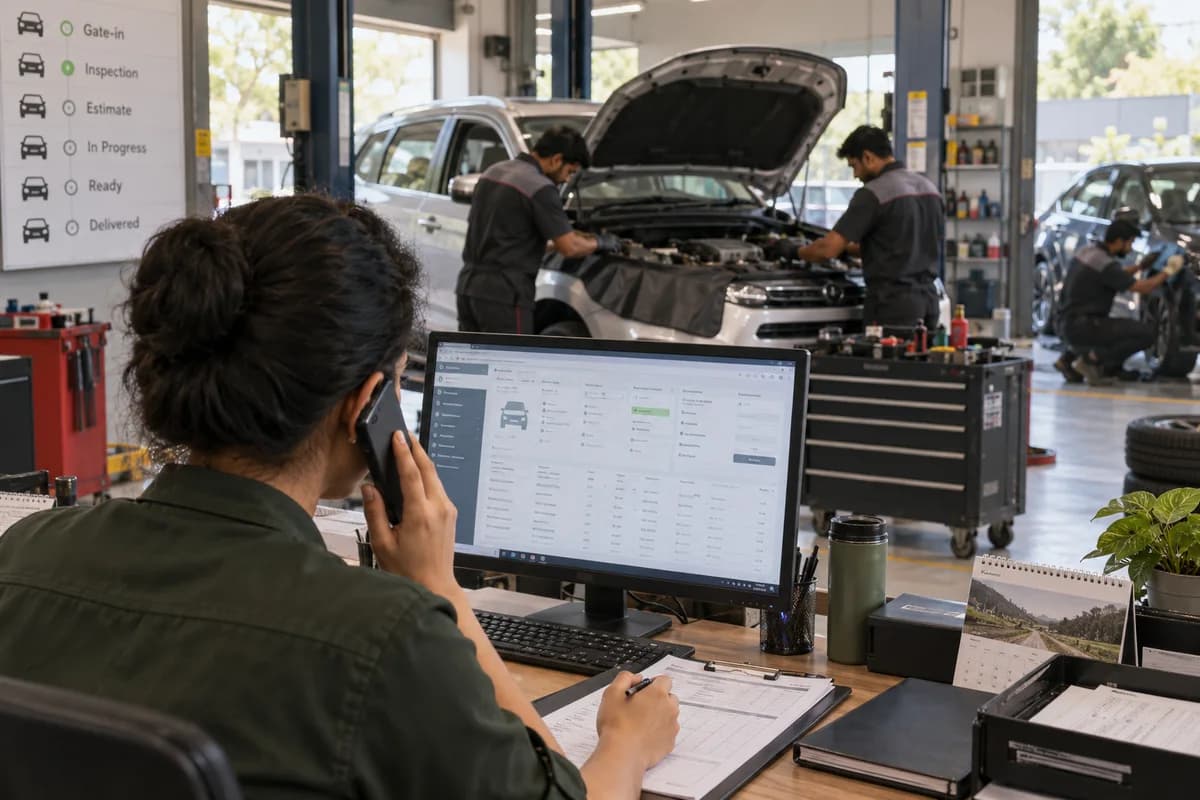
A damaged car comes in on a tow truck or under its own power, with a surveyor’s figure that rarely matches what the teardown shows. Panels are stripped. A hidden crushed member appears behind a bumper. The car then sits in the yard waiting for an approval, a fender or a colour match.
Software for collision repair shops keeps one record for the car from the day it is received. Estimators, panel beaters, painters, the parts clerk and the front desk all read it. Nobody has to ask where it stands.
Intake begins with photographs of every side, the odometer, the fuel level and personal items in the boot. The estimator writes the repair list: panels to repair, panels to replace, paint to refinish, mechanical items to refer out. For an insured car, the assessed figure goes to the insurer for approval, and extra damage found on teardown goes as a supplement.
Work then runs through dent pulling, filler and sanding, primer, colour match, spraying in the booth, baking, polishing and refitting of lamps and trim. The painter mixes the tint from the paint code on the door pillar. The parts clerk chases bumpers, headlamps and clips. Before handover, the foreman inspects every panel in daylight.
What goes wrong for auto body and paint shops without a proper system.
What we would build for auto body and paint shops.
Named the way your team already talks about the work. We start with whichever part the audit shows is costing you most.
A requirements checklist for auto body and paint shops.
What to cover, which reports to ask for and what to put to every vendor, ready to print or save as a PDF.
A product already built for auto body and paint shops.
It is adapted to how your business works before it goes live, and anything your trade needs that it lacks is added then.
Auto Body and Paint Shop Management Software
Intake photographs, estimates and supplements, insurer approvals, parts arrival, panel stages, paint mixing and delivery checks for collision repair shops.
Other products in the same sector as auto body and paint shops.
- Auto Manufacturer Management Software
- Auto Parts Shop Management Software
- Wholesale and B2B Ordering Software
- Bike Service Workshop Management Software
- Auto Dealer Management System
- Car Rental Company Management Software
- Garage Management Software
- Car Detailing Management System
- EV Charging Operator Management Software
- EV Dealer Management Software
- Fleet Leasing Company Management Software
- Motorcycle Dealer Management Software
- All industry products
The business modules auto body and paint shops use most.
Each one is also available on its own, or inside a system built for you.
- Job Cards
- Estimate/Quotation Management
- Workflow and Approvals
- Purchase Order Management
- Goods Receipt (GRN)
- Stock Tracking and Alerts
- Quality Control
- Invoice Management
- All business solutions
All solutions by area
- Applicant Tracking (5)
- CRM (8)
- Finance & Accounting (10)
- Helpdesk (4)
- Human Resources (13)
- Inventory Management (5)
- Project Management (7)
- Manufacturing (6)
- Procurement (4)
- Sales and Distribution (6)
- Field Service (5)
- Statutory and Compliance (4)
- Retail and POS (4)
- Bookings and Appointments (3)
- Subscriptions (2)
- Assets and Fleet (4)
- Platform (6)
- Analytics (2)
- Documents (1)
Where AI can help auto body and paint shops.
Each one reads records you already keep, and a person approves every decision.
The services behind it.
Business Process Automation
Approvals, reminders, follow-ups and reports that run on their own instead of on someone remembering.
Learn moreCustom Software and Product Engineering
Software built around how your business actually runs, when nothing off the shelf fits without workarounds.
Learn moreData Migration and Moving Off Spreadsheets
Data migration and spreadsheet replacement covers auditing existing files, cleaning and deduplicating records, loading them into a new system and reconciling the loaded result against known totals. Both systems then run side by side before cutover. Originals stay untouched.
Learn moreAll our other services
- Software Maintenance, Support and Rescue
- AI and Intelligent Automation
- API and System Integration
- ERP, CRM and Business Software Implementation
- Data Engineering and Business Intelligence
- UI/UX Design and Prototyping
- Cloud Engineering and Managed Infrastructure
- DevOps & Automation Services
- QA and Software Testing
- Performance Engineering
- Cybersecurity and Application Security
- IoT and Edge Computing
- Technology Strategy and Product Consulting
- E-Commerce and Digital Commerce
- MVP Product Development
- Web and Mobile Application Development
- SaaS Product Development
- WhatsApp Business API and Chatbots
- Training and Adoption
- Data Protection and Privacy Readiness
- Tax and e-Invoice Engineering
- Managed IT Support
- Dedicated Team and Staff Augmentation
- Business Intelligence and Reporting Tools
- Cloud Cost Optimisation
- Global Compliance and Localisation
How the work runs from Bengaluru for your city.
- 1
The audit, by call
A screen-share and a look at the sheets, accounting reports and WhatsApp groups your team uses. No travel needed.
- 2
A written proposal
Scope, what we build first and the cost, agreed in writing before anything starts.
- 3
Build in short rounds
Working screens shared every few weeks. Your team tests them from your own office.
- 4
Go-live, in person when it helps
For data migration and training we can come to your city. Travel is agreed in advance.
- 5
Support online
Fixes, changes and hosting handled remotely by the same team that built it.
The work we have published.
We only name clients whose work is published. None of them is in this trade; they show how the team works, not that it has built for this trade.
PetSeva: matching owners to the right vet, at any hour
A two-sided veterinary platform where vets are searchable by specialisation and bookable outside clinic hours. It now carries more than 2,000 veterinary doctors.
Read the case study Paying guest accommodationSAM Atithi Pavathi: bed-level occupancy as the source of truth
PG management software where allocation, rates and invoices are derived from bed-level occupancy and not maintained in parallel spreadsheets.
Read the case study School transport servicesSAM Tours: school transport on a single ledger
Registration, fee collection, routing and finance write to the same records, closing the gap between journeys run and fees collected.
Read the case study Microfinance and Self Help GroupsVikasa RDO: making SHG loan recovery auditable
Loan proposals, recoveries and commissions sit on one record, with a person attached to every state change, so a business handling a bank’s money can show where each rupee went.
Read the case studyQuestions auto body and paint shops ask before they call.
Does it handle insured and walk-in repairs together?
Yes. An insured job carries claim details, approved figure and excess. A private job has a customer estimate and a normal invoice. Both use the same stage board.
Can a supplement be tracked separately from the first estimate?
Yes. Each supplement is dated, lists its own lines and carries its own approval state. The original estimate stays unchanged beside it.
Does it mix paint formulas for us?
No. Mixing happens on your own scales or tinting system. The software records the paint code, the quantity drawn and the job it was drawn for.
Where do intake and delivery photographs go?
They are attached to the job from a phone and kept with it. The advisor opens one card to see how the car arrived and how it left.
How is software for a body shop quoted?
Bays and booths in use, the estimators, painters and parts clerks who log in, and the insurers needing their own approval rules drive it. A paint mixing scale or printer adds scope. Pricing is given after we read your jobs and show screens, part by part.
What does a collision repair shop need to have ready?
Gather a few finished jobs with estimates, supplements and insurer emails, your intake sheet, the parts order book and the tint codes you mix from. Name the estimator, the foreman, the painter and the parts clerk as contacts. Each can look at screens as they take shape.
If the shop closes the system, what happens to job history?
Nothing is lost. Your shop owns the software and every record in it, and estimates, photographs, supplements and paint records can be handed back in plain files. Support continues from the original builders, and hosting stays with GullySystem unless you ask otherwise.
What happens after I share my requirements?
An engineer reads what you send and replies within one business day. We then look at the software, spreadsheets and WhatsApp groups your business runs on today and write down what works, what slows your team down and what is missing. A demo login, a screen-share or a few screenshots are enough. You get a short written summary ordered by priority, with no obligation to hire us afterwards.
How much will the software cost?
We don’t publish a price, because it depends on what the system has to do. That first review settles the scope, and the cost goes into a written proposal before any work starts.
Part of a wider group.
Tell us how your business runs today.
A few lines on your spreadsheets, software and WhatsApp groups is enough. We reply the same working day.
What happens after you share your requirements
- A senior engineer reads your answers. Nobody phones first.
- Within one business day you get a written note: what we understood, what we would start with, and the questions we still have.
- If it fits, a proposal follows with the order of work, what we need from you and what you receive at each step.
- No call is booked and nothing is paid until you have read the note. Your details stay with us.
Start with your requirements
Seven short steps that tell us what you need. A senior engineer reads them before anyone gets in touch.
Share your requirements