Automotive · Software for motorcycle dealersOne record per bike. Frame number, delivery check, free services.
A dealership sells a machine, then looks after it through scheduled free services, recalls and warranty claims that the manufacturer audits against frame numbers. The software ties frame and engine numbers to the sale, the registration plate, the insurance cover and every workshop visit that follows, so nobody retypes a chassis number. Spares and finance share that record.
A bike leaves with a frame number, an engine number, two keys, a service booklet and a promise of free service visits, each recorded in a different register. The allocation sheet, invoice book, registration file and workshop register never meet, so a question about one bike becomes four searches by four people. Nothing here joins them.
The software starts from the machine. The frame number opens the enquiry, the quotation, the delivery check, the registration status and every job card raised later, so counter and workshop read identical facts.
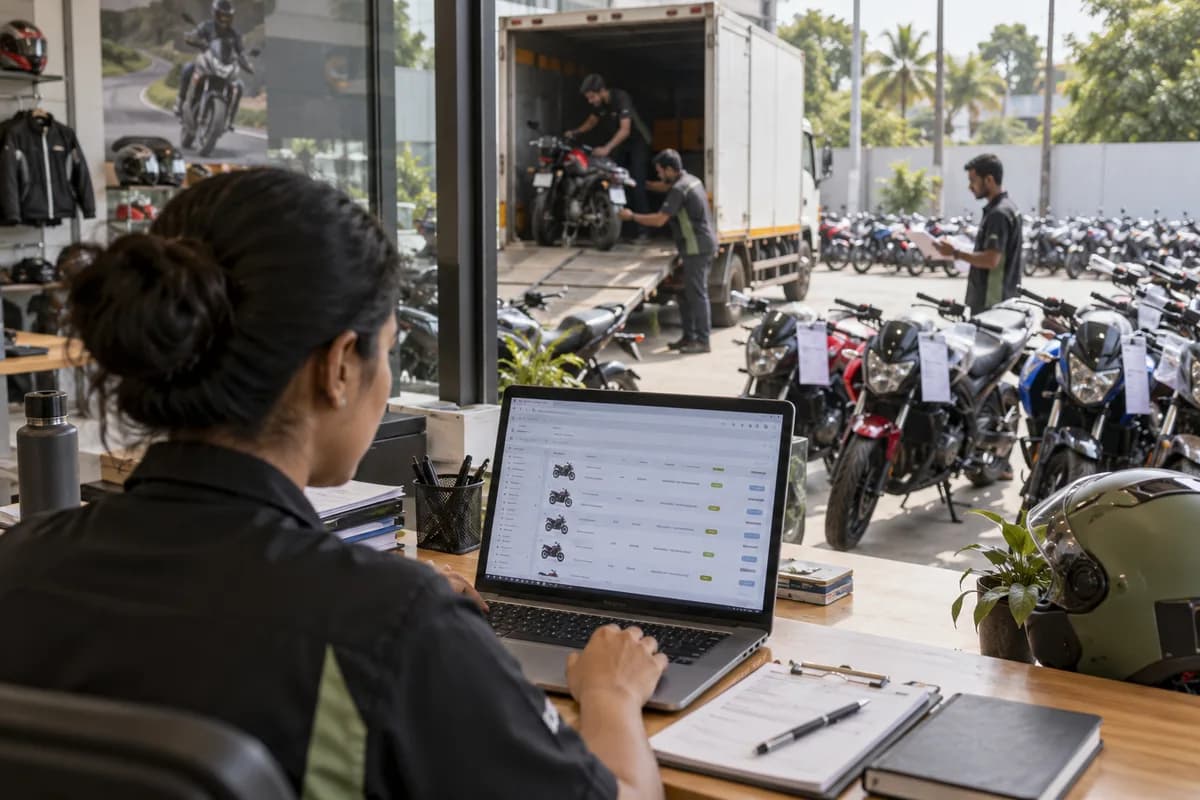
Enquiries come from walk-ins, manufacturer leads, online listings and phone calls, and a salesperson books a test ride on a demo bike before anything is quoted. The quotation adds a crash guard, helmet, insurance premium and finance scheme, and a booking amount is taken against one colour and variant. Stock reaches the yard against a manufacturer allocation, and each unit is matched to a booking while the carrier truck is still being unloaded.
Before handover the workshop runs a pre-delivery inspection, fits accessories and notes the odometer reading, while accounts raises the tax invoice for the registration papers. The bike comes back. Free services, repairs and recall work follow. They draw on a parts counter that also sells chains, sprockets, helmets and jackets to walk-in riders, and warranty claims travel to the manufacturer with proof attached.
What goes wrong for motorcycle dealers without a proper system.
What motorcycle dealers gain from one system.
Not a feature list. These are the moments in the working day that go differently once the records sit together.
What we would build for motorcycle dealers.
Named the way your team already talks about the work. We start with whichever part the audit shows is costing you most.
A requirements checklist for motorcycle dealers.
What to cover, which reports to ask for and what to put to every vendor, ready to print or save as a PDF.
A product already built for motorcycle dealers.
It is adapted to how your business works before it goes live, and anything your trade needs that it lacks is added then.
Motorcycle Dealer Management Software
Bike stock by frame number, test rides, bookings, exchange, delivery checks, registration, free services, job cards and spare parts for motorcycle dealers.
What Motorcycle Dealer Management Software covers, feature by feature
- Motorcycle stock by frame and engine number
- Manufacturer allocation and inward stock for motorcycle dealers
- Enquiries and test rides for motorcycle showrooms
- Bookings and quotations for motorcycle dealers
- Exchange and used bikes for motorcycle dealers
- Pre-delivery inspection and handover for motorcycles
- Registration and insurance tracking for motorcycle dealers
- Job cards and free services for motorcycle workshops
- Workshop bay and mechanic plan for motorcycle dealers
- Spare parts and riding gear for motorcycle dealers
- Warranty and recall claims for motorcycle dealers
- Customer receipts and balances for motorcycle dealers
Other products in the same sector as motorcycle dealers.
- Auto Body and Paint Shop Management Software
- Auto Manufacturer Management Software
- Auto Parts Shop Management Software
- Wholesale and B2B Ordering Software
- Bike Service Workshop Management Software
- Auto Dealer Management System
- Car Rental Company Management Software
- Garage Management Software
- Car Detailing Management System
- EV Charging Operator Management Software
- EV Dealer Management Software
- Fleet Leasing Company Management Software
- All industry products
The business modules motorcycle dealers use most.
Each one is also available on its own, or inside a system built for you.
Batch and Serial Tracking
Frame and engine numbers are captured when a bike is unloaded, and follow it through sale, registration and each workshop visit. Manufacturer claims quote the same numbers. Nothing is retyped.
Learn moreLead Management
Walk-ins, online listing enquiries and manufacturer leads are logged with the model they like. A test ride is booked on a demo bike. Salespeople see who has not been called back.
Learn moreQuote & Proposal Management
A quotation lists the bike, crash guard, helmet, insurance premium and finance scheme. A booking amount holds one variant and colour. Revised quotes after an exchange valuation keep the same number.
Learn moreJob Cards
A rider arriving for a first free service gets a job card with the odometer reading and complaints. Parts, oil and labour hours are added. Warranty work is marked for the manufacturer’s audit.
Learn moreService Reminders
Free service milestones by kilometre and date are worked out from the sale. A rider is reminded before the first service is missed. Lapsed warranty visits are flagged for the advisor.
Learn moreTechnician Scheduling
Mechanics are assigned to bays by the bike’s service type, such as a periodic check, a repair or a pre-delivery inspection. Walk-in breakdowns fit around booked slots. Overruns are visible to the advisor.
Learn moreStock Tracking and Alerts
Engine oil, brake pads, chain sets and riding gear have reorder levels at the spare parts counter. Fast-moving items for popular models warn the parts manager before a bike waits in the bay. Bays stay busy.
Learn morePurchase Order Management
Spare parts and accessory orders go to the manufacturer’s depot with the bike model and the job card behind them. Pending items are tracked. Received parts are matched to the order.
Learn moreAll solutions by area
- Applicant Tracking (5)
- CRM (8)
- Finance & Accounting (10)
- Helpdesk (4)
- Human Resources (13)
- Inventory Management (5)
- Project Management (7)
- Manufacturing (6)
- Procurement (4)
- Sales and Distribution (6)
- Field Service (5)
- Statutory and Compliance (4)
- Retail and POS (4)
- Bookings and Appointments (3)
- Subscriptions (2)
- Assets and Fleet (4)
- Platform (6)
- Analytics (2)
- Documents (1)
Where AI can help motorcycle dealers.
Each one reads records you already keep, and a person approves every decision.
Where we work with motorcycle dealers.
The services behind it.
ERP, CRM and Business Software Implementation
We set up bike stock by frame and engine number, bookings, insurance, spares and workshop job cards in one system. Sales, the yard, the service bay and accounts work on the same unit from allocation to the last free service.
Learn moreBusiness Process Automation
A booking can raise the registration request, the insurance quote and the pre-delivery inspection in sequence. The workshop gets a reminder for the next scheduled service, and the sales desk sees which enquiries still need a call.
Learn moreWhatsApp Business API and Chatbots
Riders receive a booking confirmation, a delivery date, a service reminder and a job-card update in their messaging app. A chatbot answers questions about variants and test ride slots, then hands the lead to a salesperson.
Learn moreAll our other services
- Custom Software and Product Engineering
- Software Maintenance, Support and Rescue
- AI and Intelligent Automation
- API and System Integration
- Data Engineering and Business Intelligence
- UI/UX Design and Prototyping
- Cloud Engineering and Managed Infrastructure
- DevOps & Automation Services
- QA and Software Testing
- Performance Engineering
- Cybersecurity and Application Security
- IoT and Edge Computing
- Technology Strategy and Product Consulting
- E-Commerce and Digital Commerce
- MVP Product Development
- Web and Mobile Application Development
- SaaS Product Development
- Data Migration and Moving Off Spreadsheets
- Training and Adoption
- Data Protection and Privacy Readiness
- Tax and e-Invoice Engineering
- Managed IT Support
- Dedicated Team and Staff Augmentation
- Business Intelligence and Reporting Tools
- Cloud Cost Optimisation
- Global Compliance and Localisation
How the work runs from Bengaluru for your city.
- 1
The audit, by call
A screen-share and a look at the sheets, accounting reports and WhatsApp groups your team uses. No travel needed.
- 2
A written proposal
Scope, what we build first and the cost, agreed in writing before anything starts.
- 3
Build in short rounds
Working screens shared every few weeks. Your team tests them from your own office.
- 4
Go-live, in person when it helps
For data migration and training we can come to your city. Travel is agreed in advance.
- 5
Support online
Fixes, changes and hosting handled remotely by the same team that built it.
The work we have published.
We only name clients whose work is published. None of them is in this trade; they show how the team works, not that it has built for this trade.
PetSeva: matching owners to the right vet, at any hour
A two-sided veterinary platform where vets are searchable by specialisation and bookable outside clinic hours. It now carries more than 2,000 veterinary doctors.
Read the case study Paying guest accommodationSAM Atithi Pavathi: bed-level occupancy as the source of truth
PG management software where allocation, rates and invoices are derived from bed-level occupancy and not maintained in parallel spreadsheets.
Read the case study School transport servicesSAM Tours: school transport on a single ledger
Registration, fee collection, routing and finance write to the same records, closing the gap between journeys run and fees collected.
Read the case study Microfinance and Self Help GroupsVikasa RDO: making SHG loan recovery auditable
Loan proposals, recoveries and commissions sit on one record, with a person attached to every state change, so a business handling a bank’s money can show where each rupee went.
Read the case studyCheck the difficult cases before choosing software.
Use examples from your own records to test the workflows that matter in your business.
Booking, finance and exchange
What becomes available when a booking is moved or cancelled?
Use “Booking, finance and exchange” to move a booking, then cancel a second example. Check the released slot, the person or resource still assigned, and any amount left to settle before accepting the revised schedule.
Background reading: ERPNext: appointment records
Free service visits are missed
What proves that a planned task was actually completed?
Select an overdue entry in “Free service visits are missed”. Ask which work record closes it and what remains visible when the visit is postponed or only part of the job is done.
Background reading: ERPNext: maintenance plans
Questions motorcycle dealers ask before they call.
Can it handle new and used bikes together?
Yes. A used bike taken in exchange enters stock with its own frame number, valuation and reconditioning cost. It sells from the same list as new units, so the showroom keeps no second register for secondhand machines.
Does it follow scheduled free services?
Yes. Each bike carries the number of free services it is owed. A visit is counted when the job card closes, and the rider then receives a reminder for the next free service that falls due.
Can the workshop see which bikes are booked in?
Yes. Service advisers book a bay and a mechanic against a bike, and the mechanic opens the complaint and earlier visits on their own screen.
Can we run more than one showroom?
Yes. Showrooms and workshops share one bike and customer list, while stock, service bays and cash drawers stay separate for each location, so every outlet closes its own day.
What does the price of a two-wheeler showroom system turn on?
The number of showrooms and workshops, how many salespeople and mechanics use it, and the parts picked: stock by frame number, bookings, handover checks, job cards or parts. A link to the manufacturer’s portal or your books is counted. The quotation shows a separate price for each part.
What should a bike dealer prepare ahead of work?
A stock list with frame and engine numbers, a booking form, the delivery inspection sheet, a job card and the free service schedule. Nominate a sales lead, a workshop manager and a registration clerk to confirm the screens.
After we leave, who has the bike, customer and service records?
The dealership does. Stock, bookings, job cards and registrations are yours, as is the code, and each leaves in plain files. Our team supports it, and hosting is with GullySystem, though another host can be arranged.
What happens after I share my requirements?
We review your brief and clarify the work with you. We then look at the software, spreadsheets and WhatsApp groups your business runs on today and write down what works, what slows your team down and what is missing. A demo login, a screen-share or a few screenshots are enough. You get a short written summary ordered by priority, with no obligation to hire us afterwards.
How much will the software cost?
We don’t publish a price, because it depends on what the system has to do. That first review settles the scope, and the cost goes into a written proposal before any work starts.
Related industries.
- Auto body and paint shops
- Auto manufacturers
- Auto parts dealers
- Bike service workshops
- Car and bike dealers
- Car rental companies
- Car service and detailing centres
- EV charging operators
- EV dealers
- Fleet leasing companies
- RV dealers
- Towing and vehicle recovery services
- Truck and trailer companies
- Tyre dealers
- Used car dealers
Part of these wider groups.
Tell us how your business runs today.
A few lines on your spreadsheets, software and WhatsApp groups is enough. We reply the same working day.
What happens after you share your requirements
- We review your brief and the systems you already use.
- We clarify the workflow, missing information and the work to consider first.
- The proposed scope sets out the deliverables, responsibilities and dependencies.
- Review the scope and commercial terms before deciding whether to proceed.
Start with your requirements
Describe your current process, the people involved and the change you need. Start with the details you know; we can clarify the rest together.
Share your requirements