Automotive · Software for tyre dealersTrack tyres by size and serial, fleet credit, fitting jobs and every claim to the maker.
Tyre dealers sell car, two-wheeler and truck tyres with tubes and flaps, fit them in the bay and supply fleet owners and smaller dealers on credit. Stock is counted by size and pattern, claim tyres wait for the maker’s inspection, and transporter balances live in a notebook. The software holds each tyre’s size, serial and manufacture week, the fitting job, the claim and the account it was billed to.
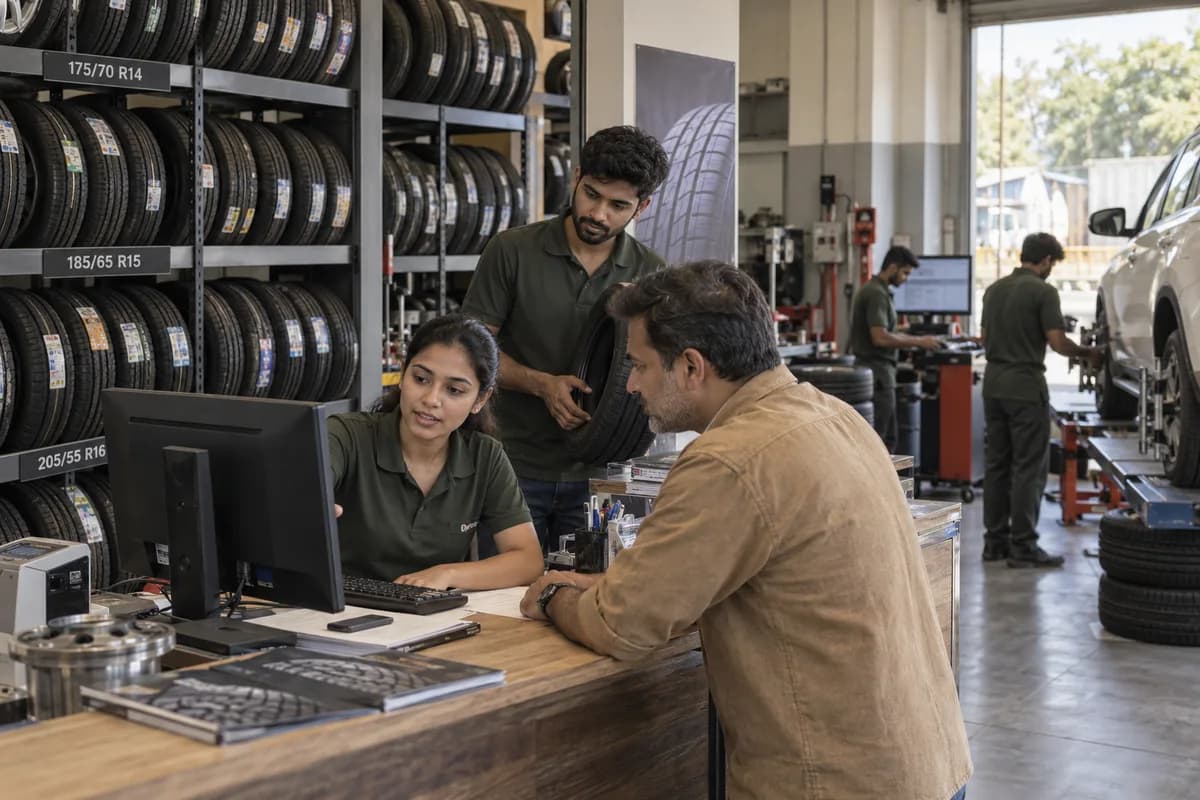
A brand tyre dealer buys from the maker’s depot against a monthly target. The range runs from scooter tyres to radial truck tyres, with tubes, flaps, valves and wheel weights alongside.
Retail buyers expect a fitting and an alignment on the same visit. Transporters want credit, a tyre history for each truck and a straight answer when a tyre fails early, and the dealer sits between them and the maker.
At the counter a customer names the vehicle or reads the size off the sidewall, and staff check which brands and patterns are on the rack. The sale moves to the bay for mounting, balancing and wheel alignment, with old tyres taken in exchange.
Fleet owners buy several truck tyres at once on account, for vehicle numbers the dealer has never recorded. A failed tyre comes back, is tagged with the customer’s name and waits for the maker’s inspection before the claim is settled.
Smaller dealers in nearby towns order by phone. Month end brings the maker’s target, the slab discount and a stock count.
What goes wrong for tyre dealers without a proper system.
What tyre dealers gain from one system.
Not a feature list. These are the moments in the working day that go differently once the records sit together.
What we would build for tyre dealers.
Named the way your team already talks about the work. We start with whichever part the audit shows is costing you most.
A requirements checklist for tyre dealers.
What to cover, which reports to ask for and what to put to every vendor, ready to print or save as a PDF.
Ready products we start from for tyre dealers.
Each one is adapted to how your business works before it goes live, and anything your trade needs that it lacks is added then. You are not paying to build the basics again.
Tyre Shop Management Software
Tyre stock by size and brand, fitting and alignment jobs, old-tyre exchange, warranty claims, credit accounts and tax billing for tyre shops.
Learn moreWholesale and B2B Ordering Software
A dealer login with its own rates and schemes, live stock, credit checks, picking and dispatch, part loads, returns and repeat orders.
Learn moreOther products in the same sector as tyre dealers.
- Auto Body and Paint Shop Management Software
- Auto Manufacturer Management Software
- Auto Parts Shop Management Software
- Bike Service Workshop Management Software
- Auto Dealer Management System
- Car Rental Company Management Software
- Garage Management Software
- Car Detailing Management System
- EV Charging Operator Management Software
- EV Dealer Management Software
- Fleet Leasing Company Management Software
- Motorcycle Dealer Management Software
- All industry products
The business modules tyre dealers use most.
Each one is also available on its own, or inside a system built for you.
Credit Limits and Control
Fleet owners and sub-dealers buy on credit. Limits, overdue bills and post-dated cheques are shown at the counter. A truck owner’s balance is clear before more tyres go out.
Learn moreStock Tracking and Alerts
Stock by size, pattern and brand, such as 295/80 R22.5 truck tyres or two-wheeler sizes, has a minimum level. An alert fires before a fast size runs out. Tubes and flaps are counted too.
Learn moreBatch and Serial Tracking
Each tyre’s serial and manufacture week are recorded at sale, so an age check or recall is answered from the invoice. Claim tyres carry the same number to the maker. Old stock is sold first.
Learn moreJob Cards
Every fitting, balancing and alignment visit is a job card for a vehicle, with the tyres removed, the ones fitted and the bay time. Valve and weight charges are added. The advisor closes it on handover.
Learn morePurchase Order Management
Orders to makers and distributors are raised by size, pattern and quantity, with scheme targets in view. Pending deliveries are shown per supplier. Buyers see what is in transit.
Learn moreInvoice Management
Invoices list tyre size, pattern, serial, fitting charge and old-tyre exchange credit as separate lines. Fleet invoices combine all the vehicles of an owner. Sub-dealer billing carries its own price list.
Learn moreService Reminders
Rotation, alignment and replacement reminders go to car owners and fleets by kilometre or date. Seasonal checks before monsoon are scheduled. Customers return well before a tyre fails.
Learn moreDealer and Distributor Portal
Sub-dealers log in to see price lists, stock by size, their order status and ledger. They place a tyre order without phoning. The dealer’s sales desk handles fewer calls.
Learn more- Price Lists and Schemes
- Order Management
- Sales Returns and Credit Notes
- Warehouse Management
- Territory Management
- All business solutions
All solutions by area
- Applicant Tracking (5)
- CRM (8)
- Finance & Accounting (10)
- Helpdesk (4)
- Human Resources (13)
- Inventory Management (5)
- Project Management (7)
- Manufacturing (6)
- Procurement (4)
- Sales and Distribution (6)
- Field Service (5)
- Statutory and Compliance (4)
- Retail and POS (4)
- Bookings and Appointments (3)
- Subscriptions (2)
- Assets and Fleet (4)
- Platform (6)
- Analytics (2)
- Documents (1)
Where AI can help tyre dealers.
Each one reads records you already keep, and a person approves every decision.
The services behind it.
ERP, CRM and Business Software Implementation
Tyre stock by size, brand and pattern, bay jobs, credit customers and claims are held in one ERP and CRM. Fleet owners and smaller dealers are recorded with their balances and past purchases. Each sale links to its bay job.
Learn moreWhatsApp Business API and Chatbots
Fleet owners and dealers can ask whether a size and pattern is in stock on a messaging chat. Reminders for outstanding balances and claim status messages go out from the live record.
Learn moreData Migration and Moving Off Spreadsheets
Stock lists by size, transporter ledgers and claim notes kept in books or sheets are moved into one record. Opening balances and serial numbers are checked before the counter works from the new system. Nothing is lost between books.
Learn moreBusiness Intelligence and Reporting Tools
Reports can show sales by brand and pattern, claim tyres waiting for inspection and fleet balances by vehicle. The owner sees which sizes move slowly and which dealers are late in paying.
Learn moreAll our other services
- Business Process Automation
- Custom Software and Product Engineering
- Software Maintenance, Support and Rescue
- AI and Intelligent Automation
- API and System Integration
- Data Engineering and Business Intelligence
- UI/UX Design and Prototyping
- Cloud Engineering and Managed Infrastructure
- DevOps & Automation Services
- QA and Software Testing
- Performance Engineering
- Cybersecurity and Application Security
- IoT and Edge Computing
- Technology Strategy and Product Consulting
- E-Commerce and Digital Commerce
- MVP Product Development
- Web and Mobile Application Development
- SaaS Product Development
- Training and Adoption
- Data Protection and Privacy Readiness
- Tax and e-Invoice Engineering
- Managed IT Support
- Dedicated Team and Staff Augmentation
- Cloud Cost Optimisation
- Global Compliance and Localisation
Written for tyre dealers.
Practical notes on running the business, not product marketing.
How the work runs from Bengaluru for your city.
- 1
The audit, by call
A screen-share and a look at the sheets, accounting reports and WhatsApp groups your team uses. No travel needed.
- 2
A written proposal
Scope, what we build first and the cost, agreed in writing before anything starts.
- 3
Build in short rounds
Working screens shared every few weeks. Your team tests them from your own office.
- 4
Go-live, in person when it helps
For data migration and training we can come to your city. Travel is agreed in advance.
- 5
Support online
Fixes, changes and hosting handled remotely by the same team that built it.
The work we have published.
We only name clients whose work is published. None of them is in this trade; they show how the team works, not that it has built for this trade.
PetSeva: matching owners to the right vet, at any hour
A two-sided veterinary platform where vets are searchable by specialisation and bookable outside clinic hours. It now carries more than 2,000 veterinary doctors.
Read the case study Paying guest accommodationSAM Atithi Pavathi: bed-level occupancy as the source of truth
PG management software where allocation, rates and invoices are derived from bed-level occupancy and not maintained in parallel spreadsheets.
Read the case study School transport servicesSAM Tours: school transport on a single ledger
Registration, fee collection, routing and finance write to the same records, closing the gap between journeys run and fees collected.
Read the case study Microfinance and Self Help GroupsVikasa RDO: making SHG loan recovery auditable
Loan proposals, recoveries and commissions sit on one record, with a person attached to every state change, so a business handling a bank’s money can show where each rupee went.
Read the case studyCheck the difficult cases before choosing software.
Use examples from your own records to test the workflows that matter in your business.
Stock by size, brand and pattern
What happens to movements entered while a count is being checked?
For “Stock by size, brand and pattern”, choose a count date and trace the movements around it. Agree who investigates a difference before an adjustment changes the available balance.
Background reading: ERPNext: stock reconciliation
Questions tyre dealers ask before they call.
Does it work out what the maker will pay on a claim?
Not on its own. It holds the invoice, serial, fitting date and inspection notes against each claim. What the maker allows is decided under the maker’s own warranty policy.
Can truck tyres be recorded against each vehicle in a fleet?
Yes. Registration numbers, sizes fitted and odometer readings sit on the vehicle record. A transporter’s statement then lists tyres by truck as well as by bill.
Can our sub-dealers place orders themselves?
Yes. Each can have a login showing their own rates, the stock you choose to show and their ledger. Orders past the credit limit are held until someone releases them.
Will the sales and purchase figures reach our accounts?
Not built in. Your accountant can read sales and purchases on screen, and a file export for your accounting system is quoted separately once the ledger layout is agreed.
What changes the price of a tyre dealer’s system?
The number of outlets and bays, how many staff use it, and the parts chosen: stock by size and pattern, serial tracking, fitting jobs, fleet history or claims. Sub-dealer ordering and an accounts link are counted. The quotation prices every part separately.
What does a tyre dealer gather to start?
Hand over the stock list by size and brand, the fleet account ledger, a fitting job slip, a claim file and the sub-dealer order list. The shop manager, a bay supervisor and an accounts clerk then try the screens for us.
If we stop, can we keep stock, fleet and claim records?
Yes. Stock, serials, fleets and claims are yours, together with the code. Ordinary files carry them out. The same builders handle support, with hosting by GullySystem, or elsewhere if you prefer.
What happens after I share my requirements?
We review your brief and clarify the work with you. We then look at the software, spreadsheets and WhatsApp groups your business runs on today and write down what works, what slows your team down and what is missing. A demo login, a screen-share or a few screenshots are enough. You get a short written summary ordered by priority, with no obligation to hire us afterwards.
How much will the software cost?
We don’t publish a price, because it depends on what the system has to do. That first review settles the scope, and the cost goes into a written proposal before any work starts.
Cities where tyre dealers are common.
Related industries.
- Auto body and paint shops
- Auto manufacturers
- Auto parts dealers
- Bike service workshops
- Car and bike dealers
- Car rental companies
- Car service and detailing centres
- EV charging operators
- EV dealers
- Fleet leasing companies
- Motorcycle dealers
- RV dealers
- Towing and vehicle recovery services
- Truck and trailer companies
- Used car dealers
Part of a wider group.
Also sell online?
The e-commerce pages cover the online side of this trade: storefronts, dealer ordering and the link to your stock.
Tell us how your business runs today.
A few lines on your spreadsheets, software and WhatsApp groups is enough. We reply the same working day.
What happens after you share your requirements
- We review your brief and the systems you already use.
- We clarify the workflow, missing information and the work to consider first.
- The proposed scope sets out the deliverables, responsibilities and dependencies.
- Review the scope and commercial terms before deciding whether to proceed.
Start with your requirements
Describe your current process, the people involved and the change you need. Start with the details you know; we can clarify the rest together.
Share your requirements