Home services · Software for carpet cleaning companiesKeep every quote, room, stain note and repeat visit on one record per customer.
Carpet cleaning software holds each customer as one record with every property, room and visit. Quotes are built from area and fibre. Crews see their day on a phone, record what they found and what they used, and the office bills from the job once the customer has signed. Reminders bring customers back when a clean is due again.
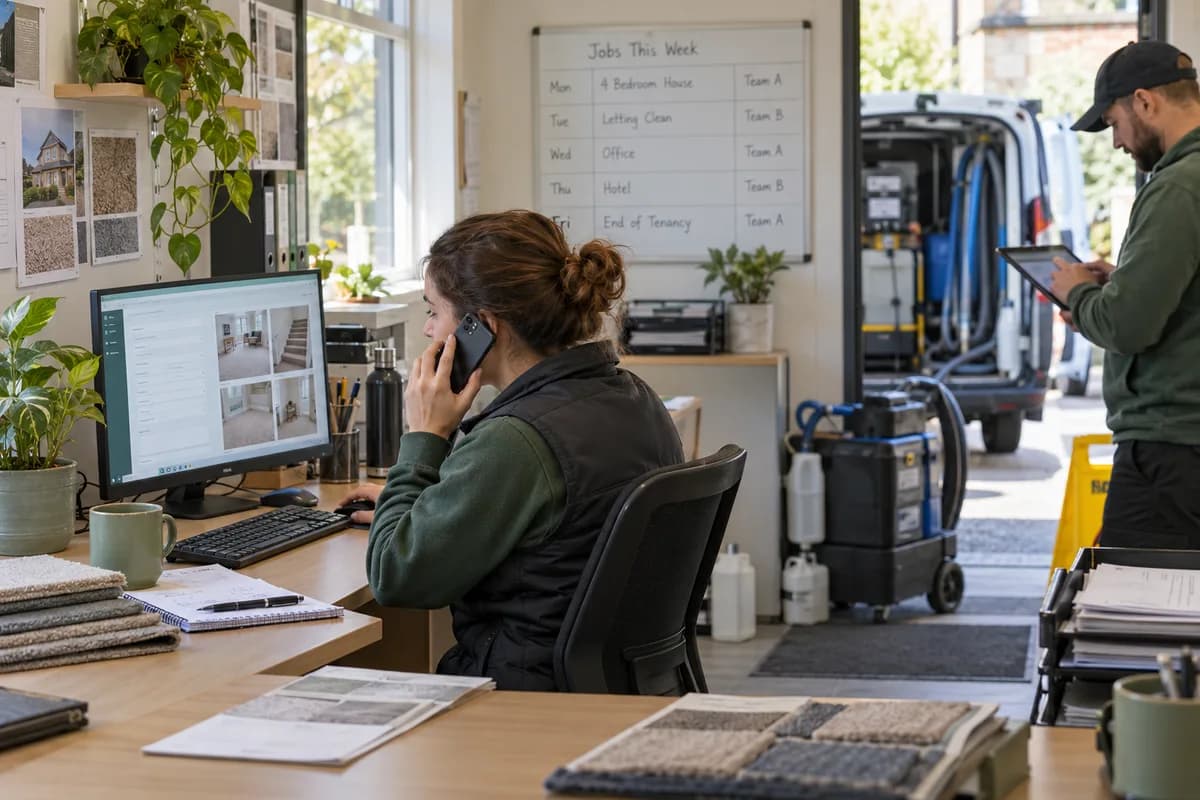
A carpet cleaning company sells a result that the customer judges on the day. The price depends on area, fibre, soiling and access, and the work depends on a crew arriving with the right machine and the right product.
Most firms run this from a phone, a van diary and a notebook of stain treatments. The software keeps the lot together. Ask for a walk-through and we follow one customer, from the first enquiry call to the reminder for the next scheduled clean.
The call comes from a homeowner, a landlord, an agent, an office manager or a hotel. The office asks for rooms, approximate area, carpet or rug type, pets, stairs and parking, and gives a quote by area, by room or as a set charge. Some customers send photographs. Others need a visit first. It varies. Commercial sites ask for a contract with a monthly or quarterly schedule, and end-of-tenancy work is booked around a handover date that the letting agent and the landlord have already fixed.
On the day, a two-person crew loads the van with an extraction machine, a rotary tool, chemicals, drying fans and protective covers for furniture, then drives to the first address. They check the carpet before starting, note existing damage and treat stains in order. Drying fans may be left behind and collected next day. The customer signs and pays by card or transfer, then expects a reminder some months later, when the season changes or a tenancy is about to end. A stain that returns is answered from the notes. Without notes, it is a dispute.
What goes wrong for carpet cleaning companies without a proper system.
What carpet cleaning companies gain from one system.
Not a feature list. These are the moments in the working day that go differently once the records sit together.
What we would build for carpet cleaning companies.
Named the way your team already talks about the work. We start with whichever part the audit shows is costing you most.
A requirements checklist for carpet cleaning companies.
What to cover, which reports to ask for and what to put to every vendor, ready to print or save as a PDF.
A product already built for carpet cleaning companies.
It is adapted to how your business works before it goes live, and anything your trade needs that it lacks is added then.
Carpet Cleaning Management Software
Quotations, crew bookings, job cards with stain notes, supplies, machines, invoices and repeat reminders for carpet cleaning companies.
What Carpet Cleaning Management Software covers, feature by feature
- Enquiry log and customer records for carpet cleaners
- Rate lists and room-by-room carpet cleaning quotes
- Crew schedule and bookings for carpet cleaning vans
- Job cards with condition notes for carpet crews
- Chemical and consumable stock for carpet cleaning vans
- Machine and equipment register for carpet cleaners
- Tax invoices and payments for carpet cleaning firms
- Commercial carpet cleaning contracts and visit schedules
- Cleaning reminders and repeat bookings for carpet firms
- Crew attendance and pay for carpet cleaners
Other products in the same sector as carpet cleaning companies.
- Home Cleaning Management System
- Deck Contractor Management Software
- Fencing Contractor Management Software
- Garage Door Company Management Software
- Gutter Contractor Management Software
- Handyman Management Software
- Hardscaping Contractor Management Software
- Home Improvement Management Software
- Locksmith Management Software
- Masonry Contractor Management Software
- Utility Contractor Management Software
- Pressure Washing Company Management Software
- All industry products
The business modules carpet cleaning companies use most.
Each one is also available on its own, or inside a system built for you.
Lead Management
A call from a landlord, a hotel or an agent is logged with rooms, fibre and parking. The coordinator sees which enquiries still need a visit. Repeat agents are marked.
Learn moreQuote & Proposal Management
A quote is built from area, fibre, stairs and add-ons such as pet odour treatment. Commercial quotes list contract visits. The customer approves the version the crew will see.
Learn moreTechnician Scheduling
Crews are assigned by area, equipment and job length. Travel time between jobs counts. A cancelled slot is refilled from the waiting list of customers who asked for an earlier visit.
Learn moreJob Cards
The crew records the carpet type, stains, pet marks and photos on arrival. Products used and time spent are added. The customer signs at the end and the card closes.
Learn moreStock Tracking and Alerts
Detergent, deodoriser, protector and machine filters each carry a reorder level. Job card usage reduces stock. The supervisor sees a low chemical before a van leaves the depot without it.
Learn moreAsset AMC Tracking
Extraction machines, truck-mounted units and air movers carry service dates and repair history. Breakdowns are linked to the jobs they affected. The owner decides whether to repair or replace.
Learn moreService Reminders
Customers get a message when a carpet is due its next clean or protector top-up. A landlord’s tenancy change prompts a booking.
Learn moreInvoice Management
A residential invoice lists rooms, rugs and add-ons, while a commercial one covers the month’s contract visits. Any deposit is deducted. The customer’s payment is recorded at the doorstep.
Learn moreAll solutions by area
- Applicant Tracking (5)
- CRM (8)
- Finance & Accounting (10)
- Helpdesk (4)
- Human Resources (13)
- Inventory Management (5)
- Project Management (7)
- Manufacturing (6)
- Procurement (4)
- Sales and Distribution (6)
- Field Service (5)
- Statutory and Compliance (4)
- Retail and POS (4)
- Bookings and Appointments (3)
- Subscriptions (2)
- Assets and Fleet (4)
- Platform (6)
- Analytics (2)
- Documents (1)
Where AI can help carpet cleaning companies.
Each one reads records you already keep, and a person approves every decision.
The services behind it.
Business Process Automation
Moves an enquiry to quote, booking, crew assignment, job card, customer signature and invoice, and then schedules the reminder for the next clean. Commercial contracts generate their monthly or quarterly visits automatically.
Learn moreWeb and Mobile Application Development
Gives crews a phone view of the day’s jobs, condition notes, photographs of stains and a signature screen for the customer. Customers get a booking page for rooms, fibre type and photographs.
Learn moreWhatsApp Business API and Chatbots
Lets customers send room photographs and book through the messaging app, and sends confirmations, arrival windows and aftercare advice. Reminders for the next clean go out from the same conversation.
Learn moreAll our other services
- Custom Software and Product Engineering
- Software Maintenance, Support and Rescue
- AI and Intelligent Automation
- API and System Integration
- ERP, CRM and Business Software Implementation
- Data Engineering and Business Intelligence
- UI/UX Design and Prototyping
- Cloud Engineering and Managed Infrastructure
- DevOps & Automation Services
- QA and Software Testing
- Performance Engineering
- Cybersecurity and Application Security
- IoT and Edge Computing
- Technology Strategy and Product Consulting
- E-Commerce and Digital Commerce
- MVP Product Development
- SaaS Product Development
- Data Migration and Moving Off Spreadsheets
- Training and Adoption
- Data Protection and Privacy Readiness
- Tax and e-Invoice Engineering
- Managed IT Support
- Dedicated Team and Staff Augmentation
- Business Intelligence and Reporting Tools
- Cloud Cost Optimisation
- Global Compliance and Localisation
How the work runs from Bengaluru for your city.
- 1
The audit, by call
A screen-share and a look at the sheets, accounting reports and WhatsApp groups your team uses. No travel needed.
- 2
A written proposal
Scope, what we build first and the cost, agreed in writing before anything starts.
- 3
Build in short rounds
Working screens shared every few weeks. Your team tests them from your own office.
- 4
Go-live, in person when it helps
For data migration and training we can come to your city. Travel is agreed in advance.
- 5
Support online
Fixes, changes and hosting handled remotely by the same team that built it.
The work we have published.
We only name clients whose work is published. None of them is in this trade; they show how the team works, not that it has built for this trade.
PetSeva: matching owners to the right vet, at any hour
A two-sided veterinary platform where vets are searchable by specialisation and bookable outside clinic hours. It now carries more than 2,000 veterinary doctors.
Read the case study Paying guest accommodationSAM Atithi Pavathi: bed-level occupancy as the source of truth
PG management software where allocation, rates and invoices are derived from bed-level occupancy and not maintained in parallel spreadsheets.
Read the case study School transport servicesSAM Tours: school transport on a single ledger
Registration, fee collection, routing and finance write to the same records, closing the gap between journeys run and fees collected.
Read the case study Microfinance and Self Help GroupsVikasa RDO: making SHG loan recovery auditable
Loan proposals, recoveries and commissions sit on one record, with a person attached to every state change, so a business handling a bank’s money can show where each rupee went.
Read the case studyCheck the difficult cases before choosing software.
Use examples from your own records to test the workflows that matter in your business.
Invoices and commercial contracts
Can you explain the balance from its original documents?
Select a partly settled example in “Invoices and commercial contracts”. Ask for the invoice, allocated receipts and remaining balance to be shown together before agreeing the opening figures.
Background reading: ERPNext: outstanding invoices
Enquiries and quotations
Which assumptions stop being valid when the quotation changes?
For “Enquiries and quotations”, compare an accepted version with a later revision. Identify changed quantities, exclusions and validity dates before the revised amount is used downstream.
Background reading: ERPNext: quotation terms
Questions carpet cleaning companies ask before they call.
Can we quote by room or by square metre?
Yes. Rates can be set by area, by room, by stair or as a set charge for a package. The quote shows which basis was used.
Does it handle rugs, upholstery and curtains?
Yes. Items other than fitted carpet are added as lines on the same job, with their own rates and care notes. Your list of services is set up with you.
Can crews take before and after photographs?
Yes. Crews add photographs from a phone to the job card, and they stay with the customer’s property. Photographs help when a customer disputes a result.
Can customers be reminded to rebook?
Yes. Every customer carries a cleaning interval, and when the due date arrives a reminder goes out as a text, an email or a chat message. Wording is yours to set.
How is a cleaning-business system priced?
Crew size, the properties and customers to load, and whether commercial contracts need separate billing all play a part. Chemical and machine tracking can be added early or later. After the scope has been studied and screens shown, you receive a quotation with a price per part.
What should a cleaning firm have on hand before the build?
Collect recent quotes, job sheets with condition notes, your customer list, the chemical stock sheet and a commercial contract. Name one scheduler and one crew lead who can explain daily habits and confirm the phone screens work for the crews.
If we stop, who keeps customer and job history?
You keep all of it: customer files, stain notes, invoices and the code. Any of it can be taken out in plain files. Support carries on from our side. GullySystem handles hosting, or you can pick another route.
What happens after I share my requirements?
We review your brief and clarify the work with you. We then look at the software, spreadsheets and WhatsApp groups your business runs on today and write down what works, what slows your team down and what is missing. A demo login, a screen-share or a few screenshots are enough. You get a short written summary ordered by priority, with no obligation to hire us afterwards.
How much will the software cost?
We don’t publish a price, because it depends on what the system has to do. That first review settles the scope, and the cost goes into a written proposal before any work starts.
Related industries.
- Cleaning service companies
- Deck contractors
- Fencing contractors
- Garage door companies
- Gutter contractors
- Handyman and home repair services
- Hardscaping contractors
- Home improvement companies
- Locksmiths
- Masonry contractors
- Power and utility contractors
- Pressure washing companies
- Remodelling contractors
- Restoration contractors
- Roofing contractors
- Tree service companies
Part of a wider group.
Tell us how your business runs today.
A few lines on your spreadsheets, software and WhatsApp groups is enough. We reply the same working day.
What happens after you share your requirements
- We review your brief and the systems you already use.
- We clarify the workflow, missing information and the work to consider first.
- The proposed scope sets out the deliverables, responsibilities and dependencies.
- Review the scope and commercial terms before deciding whether to proceed.
Start with your requirements
Describe your current process, the people involved and the change you need. Start with the details you know; we can clarify the rest together.
Share your requirements