Home services · Software for deck contractorsKeep every deck design, material take-off, permit and stage payment on one record per job.
Deck contractor software holds each deck as one job. The job carries its measured layout, the boards, joists, posts and railings priced for it, the permit and inspection dates, and the payments due at each stage. Change orders are recorded where they are agreed. Maintenance visits and workmanship warranty terms stay on the same record after handover.
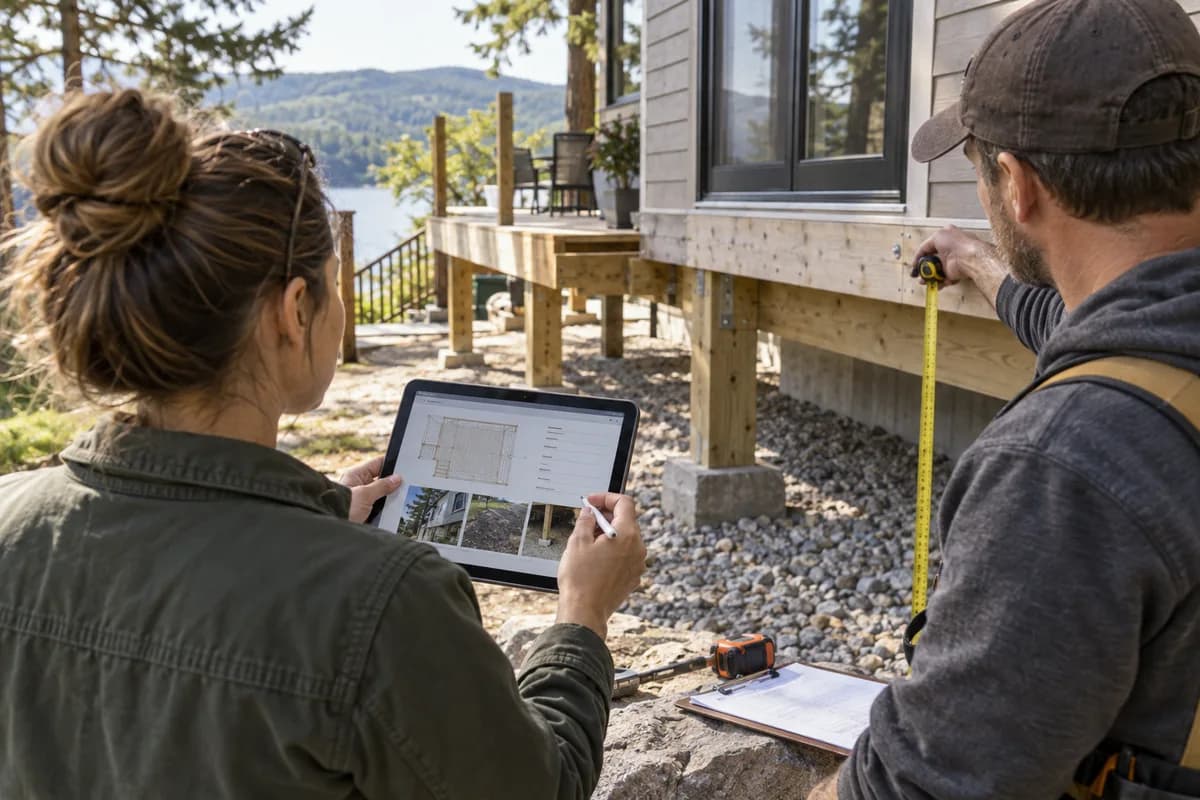
A deck contractor sells a design, then builds it from footings to railings. Between those two points sit measurements, material selections, permit paperwork, inspections, crew days and a payment schedule. Each belongs to one deck. Most firms keep them apart.
The software joins them. Office staff, estimators and site leads read the same job. A scoping call follows one deck from first visit to final payment, whether it is a ground-level platform or a raised deck with stairs.
Enquiries come from homeowners, builders and property managers. An estimator visits, measures the area, checks the ground and the height above it, and notes how the deck meets the house, taking photographs for the file. The written quotation lists footings, posts, beams, joists, decking boards, fasteners, balusters, stairs, lighting and labour, priced from your supplier rates and the area measured. The client chooses between pressure-treated, cedar or composite boards and a colour, and the choice is written into the quote.
After acceptance, a deposit is taken and permit drawings are prepared where local rules ask for them. Material is ordered and delivered to the driveway, where the crew checks boards and posts against the order. Crews dig footings, set posts, frame, board and rail the deck over several days. Inspectors visit at set stages to pass the footings, the framing and the finished rail. Payments follow those stages. Extras asked for mid-build, such as a wider stair or one more post, are priced and agreed first. Some clients book a yearly seal.
What goes wrong for deck contractors without a proper system.
What deck contractors gain from one system.
Not a feature list. These are the moments in the working day that go differently once the records sit together.
What we would build for deck contractors.
Named the way your team already talks about the work. We start with whichever part the audit shows is costing you most.
A requirements checklist for deck contractors.
What to cover, which reports to ask for and what to put to every vendor, ready to print or save as a PDF.
A product already built for deck contractors.
It is adapted to how your business works before it goes live, and anything your trade needs that it lacks is added then.
Deck Contractor Management Software
Site measures, quotations, material selections, permits, build crews, change orders and stage payments for deck contractors, with one record for each deck.
What Deck Contractor Management Software covers, feature by feature
- Deck enquiries and site visits for contractors
- Deck quotations built from your own rate list
- Recording each client’s deck material choices
- Deck lumber orders and delivery checking
- Deck jobs and a build schedule on one calendar
- Tracking deck permits and inspections
- Crew days and subcontractor pay by deck
- Deck change orders with price and approval
- Deposit, stage and final invoices for decks
- Deck warranty terms and yearly care visits
Other products in the same sector as deck contractors.
- Carpet Cleaning Management Software
- Home Cleaning Management System
- Fencing Contractor Management Software
- Garage Door Company Management Software
- Gutter Contractor Management Software
- Handyman Management Software
- Hardscaping Contractor Management Software
- Home Improvement Management Software
- Locksmith Management Software
- Masonry Contractor Management Software
- Utility Contractor Management Software
- Pressure Washing Company Management Software
- All industry products
The business modules deck contractors use most.
Each one is also available on its own, or inside a system built for you.
Lead Management
Homeowners, builders and property managers ask for decks, and each enquiry records the site address, board material and budget talked about. A site visit is booked from it. Cold leads are chased after the quote.
Learn moreEstimate/Quotation Management
The estimator prices footings, joists, boards, balusters and stairs from the measured layout, and the client picks cedar, treated pine or composite. Revisions are kept. A higher deck or longer rail gets its own version beside the first.
Learn morePurchase Order Management
Once a deck is approved, timber, composite boards, post bases and fasteners are ordered from the supplier against that job. Lighting kits go on a separate order. The order shows what is promised for which build week.
Learn moreGoods Receipt (GRN)
When the lumber truck unloads in the yard, the foreman checks lengths, board counts and crown damage against the delivery note. Bundles are marked by job. Warped boards are recorded for a credit.
Learn moreWork Order Management
A deck becomes a sequence of jobs: layout, footings, framing, decking, railing, stairs and lighting. Crews get their own order with the measured drawing. Stages are signed off.
Learn moreProject Document Management
Permit drawings, the inspector’s approval, the engineer’s footing detail and signed change orders sit on each deck’s file. The crew on site opens the latest drawing on a phone. Old versions are marked superseded.
Learn moreAttendance & Time Tracking
Carpenters and labourers log arrival at the client’s address, and hours post to that deck. Weather days and rework are marked. The foreman sees which crew was on which site on any date.
Learn moreInvoice Management
A deck is billed at agreed stages: deposit, framing done, boards down and final. Added stairs go on the next invoice. Unpaid invoices are listed against the job, not the client alone.
Learn moreAll solutions by area
- Applicant Tracking (5)
- CRM (8)
- Finance & Accounting (10)
- Helpdesk (4)
- Human Resources (13)
- Inventory Management (5)
- Project Management (7)
- Manufacturing (6)
- Procurement (4)
- Sales and Distribution (6)
- Field Service (5)
- Statutory and Compliance (4)
- Retail and POS (4)
- Bookings and Appointments (3)
- Subscriptions (2)
- Assets and Fleet (4)
- Platform (6)
- Analytics (2)
- Documents (1)
Where AI can help deck contractors.
Each one reads records you already keep, and a person approves every decision.
The services behind it.
Business Process Automation
Quote acceptance can trigger the deposit invoice, permit drawing task and supplier order for the deck. Inspection reminders and stage invoices follow the job from footings to railings, so the office does not chase each one by hand.
Learn moreWeb and Mobile Application Development
An estimator’s tablet app captures deck dimensions, ground notes and ledger photographs at the house. The crew leader reads the same cutting and board list on site, and homeowners can approve colours and change orders from a link.
Learn moreData Migration and Moving Off Spreadsheets
Past quotes, supplier rate sheets and the permit notebook move into the job record. Old measured layouts and warranty dates become searchable, so a repeat homeowner’s earlier deck is found by address instead of a folder of spreadsheets.
Learn moreAll our other services
- Custom Software and Product Engineering
- Software Maintenance, Support and Rescue
- AI and Intelligent Automation
- API and System Integration
- ERP, CRM and Business Software Implementation
- Data Engineering and Business Intelligence
- UI/UX Design and Prototyping
- Cloud Engineering and Managed Infrastructure
- DevOps & Automation Services
- QA and Software Testing
- Performance Engineering
- Cybersecurity and Application Security
- IoT and Edge Computing
- Technology Strategy and Product Consulting
- E-Commerce and Digital Commerce
- MVP Product Development
- SaaS Product Development
- WhatsApp Business API and Chatbots
- Training and Adoption
- Data Protection and Privacy Readiness
- Tax and e-Invoice Engineering
- Managed IT Support
- Dedicated Team and Staff Augmentation
- Business Intelligence and Reporting Tools
- Cloud Cost Optimisation
- Global Compliance and Localisation
How the work runs from Bengaluru for your city.
- 1
The audit, by call
A screen-share and a look at the sheets, accounting reports and WhatsApp groups your team uses. No travel needed.
- 2
A written proposal
Scope, what we build first and the cost, agreed in writing before anything starts.
- 3
Build in short rounds
Working screens shared every few weeks. Your team tests them from your own office.
- 4
Go-live, in person when it helps
For data migration and training we can come to your city. Travel is agreed in advance.
- 5
Support online
Fixes, changes and hosting handled remotely by the same team that built it.
The work we have published.
We only name clients whose work is published. None of them is in this trade; they show how the team works, not that it has built for this trade.
PetSeva: matching owners to the right vet, at any hour
A two-sided veterinary platform where vets are searchable by specialisation and bookable outside clinic hours. It now carries more than 2,000 veterinary doctors.
Read the case study Paying guest accommodationSAM Atithi Pavathi: bed-level occupancy as the source of truth
PG management software where allocation, rates and invoices are derived from bed-level occupancy and not maintained in parallel spreadsheets.
Read the case study School transport servicesSAM Tours: school transport on a single ledger
Registration, fee collection, routing and finance write to the same records, closing the gap between journeys run and fees collected.
Read the case study Microfinance and Self Help GroupsVikasa RDO: making SHG loan recovery auditable
Loan proposals, recoveries and commissions sit on one record, with a person attached to every state change, so a business handling a bank’s money can show where each rupee went.
Read the case studyCheck the difficult cases before choosing software.
Use examples from your own records to test the workflows that matter in your business.
Maintenance visits and workmanship warranty
What proves that a planned task was actually completed?
Select an overdue entry in “Maintenance visits and workmanship warranty”. Ask which work record closes it and what remains visible when the visit is postponed or only part of the job is done.
Background reading: ERPNext: maintenance plans
Permits and inspections
Who decides whether a failed result blocks the next step?
For “Permits and inspections”, bring an accepted result and a failed one. Agree who can authorise an exception and what evidence must accompany that decision.
Background reading: ERPNext: inspection criteria
Questions deck contractors ask before they call.
Can the quotation keep the colour and board type the client chose?
Yes. Selections such as board type, colour and baluster style are stored on the quotation and passed to the supplier order. If the client changes a choice later, the revision is kept beside the first one for the estimator to compare.
Does it handle permits for each deck?
It records them. The approval status, the drawings and each inspection date sit on the job record. Rules differ by region, so the fields are set with you during implementation.
Can we price extras that the client asks for during the build?
Yes. A change order carries its description, its price and the client’s approval, then adds to the stage payments. The final invoice matches what was agreed, including a wider landing or a second stair.
Would a two-person deck crew find this heavy going?
A crew taking a handful of decks a season can run on a spreadsheet and a phone camera. A firm with several crews, subcontractors and a steady stream of quotations is a different case. This software is built for that firm.
What moves the deck business system quotation?
Choosing site measures first, or quotations, or permits, changes the base most. Users and crews matter, as do users. Mention a supplier price list early. A later stage can take the site measures.
Gathering for the deck business system: what first?
Bring recent quotations, measured layouts, permit files and stage payment schedules. Contacts from the estimator, the site lead and the office are needed. Samples of measured layouts help most.
Can we take our site measures elsewhere?
The code is the deck builder’s, and so are site measures, permit files and stage payments. Plain-file exports cover site measures, permit files and stage payments. Support for site measures stays in-house.
What happens after I share my requirements?
We review your brief and clarify the work with you. We then look at the software, spreadsheets and WhatsApp groups your business runs on today and write down what works, what slows your team down and what is missing. A demo login, a screen-share or a few screenshots are enough. You get a short written summary ordered by priority, with no obligation to hire us afterwards.
How much will the software cost?
We don’t publish a price, because it depends on what the system has to do. That first review settles the scope, and the cost goes into a written proposal before any work starts.
Related industries.
- Carpet cleaning companies
- Cleaning service companies
- Fencing contractors
- Garage door companies
- Gutter contractors
- Handyman and home repair services
- Hardscaping contractors
- Home improvement companies
- Locksmiths
- Masonry contractors
- Power and utility contractors
- Pressure washing companies
- Remodelling contractors
- Restoration contractors
- Roofing contractors
- Tree service companies
Part of a wider group.
Tell us how your business runs today.
A few lines on your spreadsheets, software and WhatsApp groups is enough. We reply the same working day.
What happens after you share your requirements
- We review your brief and the systems you already use.
- We clarify the workflow, missing information and the work to consider first.
- The proposed scope sets out the deliverables, responsibilities and dependencies.
- Review the scope and commercial terms before deciding whether to proceed.
Start with your requirements
Describe your current process, the people involved and the change you need. Start with the details you know; we can clarify the rest together.
Share your requirements