Home services · Software for masonry contractorsKeep every wall measured, every delivery checked and every stage billed on one job record.
Masonry software for contractors holds each job as one record. Measured quantities of brick, block, stone and mortar, the material delivered to site, the mason crews on each day and the stage bills all sit together. Repair and restoration work, such as repointing and chimney rebuilds, is logged beside new construction.
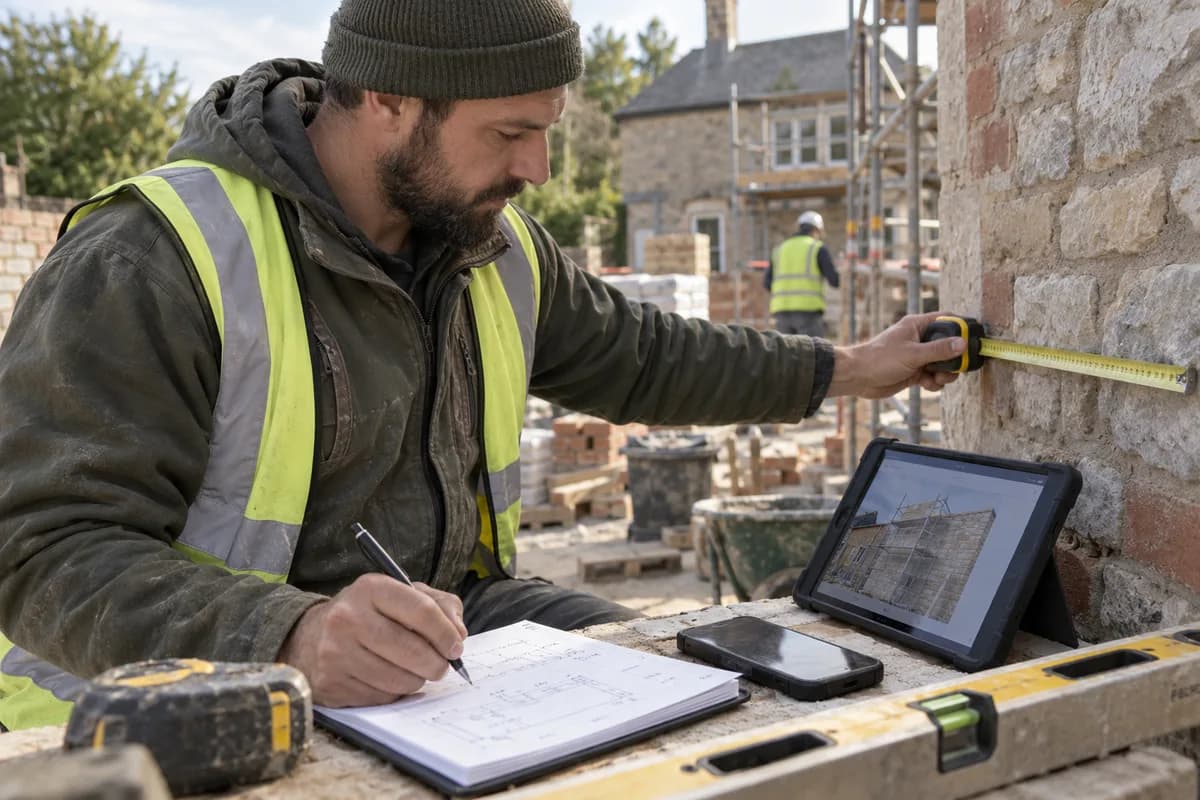
A masonry contractor builds walls, piers, arches, chimneys, paving and stone facing, and repairs old work that has failed. Quotes come from measured quantities, and bills follow what has been laid.
The facts sit in a site engineer’s notebook, a supplier’s delivery slips and a foreman’s attendance list. The software keeps them on the same job.
The call comes from a builder, an architect, a homeowner or a property manager. Someone visits, measures the walls or the area to be repaired, and notes the material: common brick, facing brick, concrete block, natural stone or reclaimed stone. The quote lists quantities, mortar type, scaffolding, labour and waste. Restoration work needs more care, with sketches and photographs of what is there before it is touched.
Bricks, blocks and sand come from yards and quarries, and each load is counted against the order when the truck unloads. A foreman assigns masons and labourers, and the day’s work is recorded as lengths, areas or counts. Weather stops work, so the schedule moves. Bills go in stages, raised against a measurement. Retention is held back by the client. At the end come snags, and a call-back months later when a joint fails.
What goes wrong for masonry contractors without a proper system.
What masonry contractors gain from one system.
Not a feature list. These are the moments in the working day that go differently once the records sit together.
What we would build for masonry contractors.
Named the way your team already talks about the work. We start with whichever part the audit shows is costing you most.
A requirements checklist for masonry contractors.
What to cover, which reports to ask for and what to put to every vendor, ready to print or save as a PDF.
A product already built for masonry contractors.
It is adapted to how your business works before it goes live, and anything your trade needs that it lacks is added then.
Masonry Contractor Management Software
Site measurements, estimates, material orders, mason crews, stage bills, retention and repair call-backs for masonry contractors.
What Masonry Contractor Management Software covers, feature by feature
- Enquiries and site visits for masonry contractors
- Masonry estimates built from your own rate lists
- Masonry site jobs and work orders on one record
- Material orders and delivery checks for masons
- Material issue and site store for masonry jobs
- Mason crews, attendance and wages for contractors
- Subcontractors and vendors for masonry contractors
- Measurements and stage bills for masonry contractors
- Repairs, restoration and call-backs for masons
- Receipts and dues for masonry contractors
Other products in the same sector as masonry contractors.
- Carpet Cleaning Management Software
- Home Cleaning Management System
- Deck Contractor Management Software
- Fencing Contractor Management Software
- Garage Door Company Management Software
- Gutter Contractor Management Software
- Handyman Management Software
- Hardscaping Contractor Management Software
- Home Improvement Management Software
- Locksmith Management Software
- Utility Contractor Management Software
- Pressure Washing Company Management Software
- All industry products
The business modules masonry contractors use most.
Each one is also available on its own, or inside a system built for you.
Lead Management
Enquiries arrive from builders, architects, homeowners and property managers, each wanting a different kind of wall. Repointing leads are tagged apart from boundary wall builds. Site visits are booked from the lead.
Learn moreEstimate/Quotation Management
A quote for a boundary wall lists brick count, mortar, scaffolding, labour and an allowance for breakage. Reclaimed stone carries its own rate. Revised quantities after the site visit replace the earlier figures.
Learn moreWork Order Management
A job order sends a crew to a site with the wall to build, its height and the bond pattern. Foundation, plinth and lintel stages are ticked off. Rework is logged against the stage.
Learn morePurchase Order Management
Brick, block and sand orders go to yards and quarries with quantity, rate and drop date. Every truck is counted on arrival. Short loads are noted before the driver leaves.
Learn moreStock Tracking and Alerts
Bricks, cement bags and sand piles on each site are counted against what was issued to the crews. A site short of blocks shows before masons stand idle. Surplus moves to the next job.
Learn moreAttendance & Time Tracking
Masons, helpers and labourers are marked present site by site, with half days and overtime for rain-delayed work. A foreman marks it on the phone at the site gate. Wages are drawn from these marks.
Learn moreVendor Management
Brick kilns, sand suppliers, scaffolding hirers and stone yards each have one record with rates, delivery performance and payment terms. A kiln that sent under-burnt bricks is flagged. The next order sees the history.
Learn moreInvoice Management
Stage bills are raised as foundation, walls and plastering are completed, with measured quantity against the agreed rate. Retention held by the client shows separately. The balance due is clear at each stage.
Learn moreAll solutions by area
- Applicant Tracking (5)
- CRM (8)
- Finance & Accounting (10)
- Helpdesk (4)
- Human Resources (13)
- Inventory Management (5)
- Project Management (7)
- Manufacturing (6)
- Procurement (4)
- Sales and Distribution (6)
- Field Service (5)
- Statutory and Compliance (4)
- Retail and POS (4)
- Bookings and Appointments (3)
- Subscriptions (2)
- Assets and Fleet (4)
- Platform (6)
- Analytics (2)
- Documents (1)
Where AI can help masonry contractors.
Each one reads records you already keep, and a person approves every decision.
The services behind it.
Business Process Automation
A confirmed quote can raise the material order, the scaffold hire request and the crew booking. Delivery counts and stage completions can trigger the next bill, so the office stops retyping measured areas between sheets.
Learn moreWeb and Mobile Application Development
A foreman’s phone app can record deliveries, crew attendance, wall areas laid and site photographs, even on weak signal. Clients and architects can see stage progress and approve a stage bill from a simple page.
Learn moreData Migration and Moving Off Spreadsheets
Rate sheets for brick, block and stone work, old quotations and supplier price lists move into one system. Open jobs, unpaid stage bills and subcontractor balances come across so the first week starts without a gap.
Learn moreAll our other services
- Custom Software and Product Engineering
- Software Maintenance, Support and Rescue
- AI and Intelligent Automation
- API and System Integration
- ERP, CRM and Business Software Implementation
- Data Engineering and Business Intelligence
- UI/UX Design and Prototyping
- Cloud Engineering and Managed Infrastructure
- DevOps & Automation Services
- QA and Software Testing
- Performance Engineering
- Cybersecurity and Application Security
- IoT and Edge Computing
- Technology Strategy and Product Consulting
- E-Commerce and Digital Commerce
- MVP Product Development
- SaaS Product Development
- WhatsApp Business API and Chatbots
- Training and Adoption
- Data Protection and Privacy Readiness
- Tax and e-Invoice Engineering
- Managed IT Support
- Dedicated Team and Staff Augmentation
- Business Intelligence and Reporting Tools
- Cloud Cost Optimisation
- Global Compliance and Localisation
How the work runs from Bengaluru for your city.
- 1
The audit, by call
A screen-share and a look at the sheets, accounting reports and WhatsApp groups your team uses. No travel needed.
- 2
A written proposal
Scope, what we build first and the cost, agreed in writing before anything starts.
- 3
Build in short rounds
Working screens shared every few weeks. Your team tests them from your own office.
- 4
Go-live, in person when it helps
For data migration and training we can come to your city. Travel is agreed in advance.
- 5
Support online
Fixes, changes and hosting handled remotely by the same team that built it.
The work we have published.
We only name clients whose work is published. None of them is in this trade; they show how the team works, not that it has built for this trade.
PetSeva: matching owners to the right vet, at any hour
A two-sided veterinary platform where vets are searchable by specialisation and bookable outside clinic hours. It now carries more than 2,000 veterinary doctors.
Read the case study Paying guest accommodationSAM Atithi Pavathi: bed-level occupancy as the source of truth
PG management software where allocation, rates and invoices are derived from bed-level occupancy and not maintained in parallel spreadsheets.
Read the case study School transport servicesSAM Tours: school transport on a single ledger
Registration, fee collection, routing and finance write to the same records, closing the gap between journeys run and fees collected.
Read the case study Microfinance and Self Help GroupsVikasa RDO: making SHG loan recovery auditable
Loan proposals, recoveries and commissions sit on one record, with a person attached to every state change, so a business handling a bank’s money can show where each rupee went.
Read the case studyCheck the difficult cases before choosing software.
Use examples from your own records to test the workflows that matter in your business.
Estimates from your own rates
Which assumptions stop being valid when the quotation changes?
For “Estimates from your own rates”, compare an accepted version with a later revision. Identify changed quantities, exclusions and validity dates before the revised amount is used downstream.
Background reading: ERPNext: quotation terms
Deliveries are not checked
Can a partial delivery be distinguished from a completed order?
For “Deliveries are not checked”, follow an example that leaves in more than one trip. Compare the quantity handed over with the quantity still owed before closing the order.
Background reading: ERPNext: delivery notes
Questions masonry contractors ask before they call.
Can we estimate by wall area, volume or brick count?
Yes. Rates can be entered for each basis and mixed in one estimate. The measured quantities stay on the job and feed the quote, the order and the bill.
Does it cover restoration and chimney work?
Yes. Repair and restoration jobs carry before-and-after photographs, the material and mix used, and the crew. Call-backs are logged against the same structure.
Can we track subcontractors?
Yes. Stone cutters, scaffold hirers and other subcontractors are held as vendors with their agreed rates, work done and balance owed. Payment terms are set with you.
Can foremen use it from site?
Yes. Foremen open their own jobs in a phone browser, mark attendance, record work done and add photographs. The office sees the same record without a call.
How is a mason contractor’s system quoted?
Active jobs and crews, the estimators, foremen and billing people who sign in, and the choice to start with restoration records and call-backs all define the scope. An accounts package to link adds more. Prices are set per part in the quotation.
What does a masonry contractor need ready before we start?
Prepare a recent site measurement with its quote, your material rate list, delivery counts from yards, a crew attendance sheet and a stage bill with retention. A foreman and an estimator each need time to check screens.
If the contractor leaves the system, do job and measurement records remain ours?
They do. The code and the records of measurements, deliveries, crew days and bills belong to the contractor, with spreadsheet exports available on request. Building and support stay in one group. GullySystem hosts it, or another host can.
What happens after I share my requirements?
We review your brief and clarify the work with you. We then look at the software, spreadsheets and WhatsApp groups your business runs on today and write down what works, what slows your team down and what is missing. A demo login, a screen-share or a few screenshots are enough. You get a short written summary ordered by priority, with no obligation to hire us afterwards.
How much will the software cost?
We don’t publish a price, because it depends on what the system has to do. That first review settles the scope, and the cost goes into a written proposal before any work starts.
Related industries.
- Carpet cleaning companies
- Cleaning service companies
- Deck contractors
- Fencing contractors
- Garage door companies
- Gutter contractors
- Handyman and home repair services
- Hardscaping contractors
- Home improvement companies
- Locksmiths
- Power and utility contractors
- Pressure washing companies
- Remodelling contractors
- Restoration contractors
- Roofing contractors
- Tree service companies
Part of these wider groups.
Tell us how your business runs today.
A few lines on your spreadsheets, software and WhatsApp groups is enough. We reply the same working day.
What happens after you share your requirements
- We review your brief and the systems you already use.
- We clarify the workflow, missing information and the work to consider first.
- The proposed scope sets out the deliverables, responsibilities and dependencies.
- Review the scope and commercial terms before deciding whether to proceed.
Start with your requirements
Describe your current process, the people involved and the change you need. Start with the details you know; we can clarify the rest together.
Share your requirements