Construction · Software for carpentry and woodwork contractorsCarry a carpentry job from the first measurement to the last snag without losing a dimension.
Carpentry contractors fit wardrobes, doors, panelling and furniture in homes and offices. Each job starts as a tape measure and a sketch. It ends as a signed handover. In between sit ply and laminate stock, workshop hours, fitting gangs, polish schedules and stage payments, all tied to one client and one address.
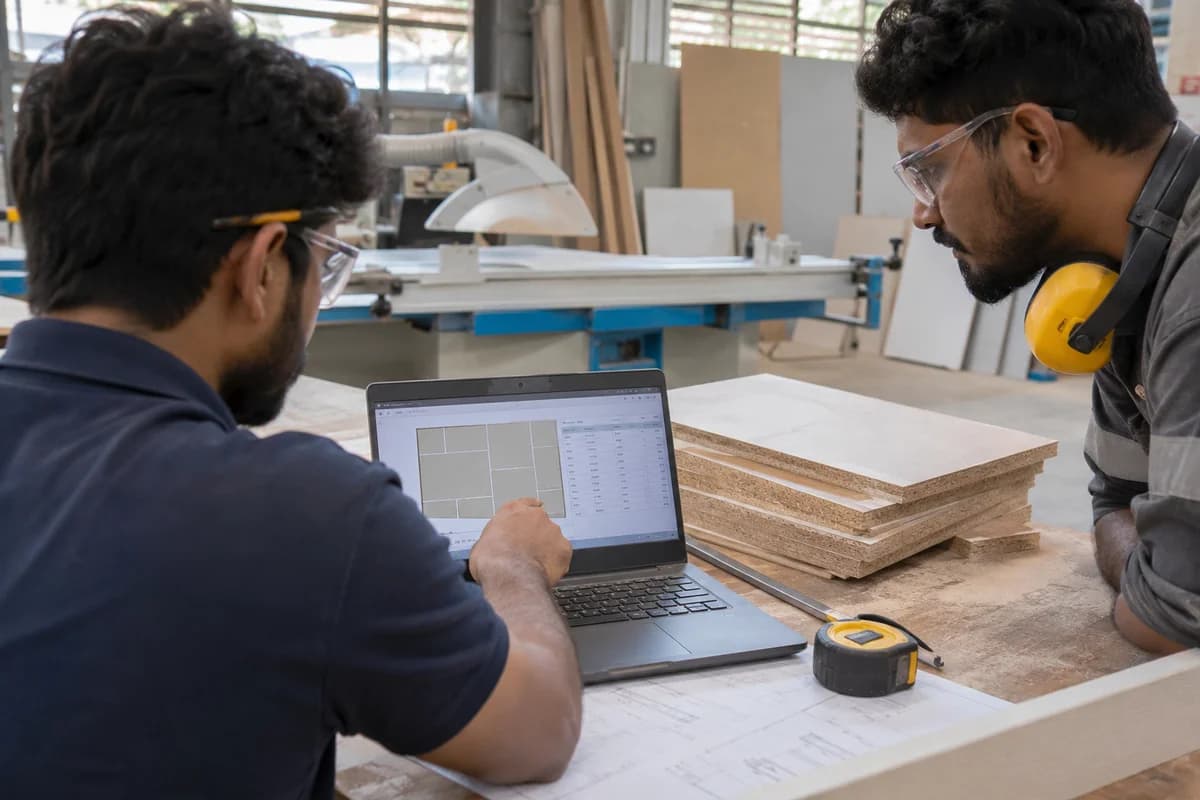
A carpenter does not sell a catalogue item. Every wardrobe is cut to a wall. Every door is cut to a frame that is never quite square. The price depends on measured area, the board chosen and the finish, and small errors in a measurement become wasted sheets later.
Work is split between the workshop and the site. Panels are cut and edge-banded under cover, then carried up to the flat or office and fitted by a gang that has never seen the drawing. If the cutting list is wrong, the fitters find out in front of the client. Rework is slow.
The owner or a site engineer visits. Walls are measured, the layout is noted and the room is photographed. A quotation follows, priced by square foot or by item, with the ply, laminate and hardware named. Once the client approves a drawing, a cutting list is made. Sheets are marked out to waste little. Teak beading, edge tape, soft-close hinges and telescopic channels are checked against the store.
Panels are cut, banded and drilled in the workshop. Then they are loaded for the site. Fitters work by the day or by the piece, and a foreman records who fitted what, in which room and at what rate. Month-end wages then come from a record and not from memory. Veneer, PU and polish finishes wait between coats. Stage payments are raised as the carcass goes up and the shutters are hung. The client walks through with a snag list. Repair visits come months later under warranty.
What goes wrong for carpentry and woodwork contractors without a proper system.
What carpentry and woodwork contractors gain from one system.
Not a feature list. These are the moments in the working day that go differently once the records sit together.
What we would build for carpentry and woodwork contractors.
Named the way your team already talks about the work. We start with whichever part the audit shows is costing you most.
A requirements checklist for carpentry and woodwork contractors.
What to cover, which reports to ask for and what to put to every vendor, ready to print or save as a PDF.
A product already built for carpentry and woodwork contractors.
It is adapted to how your business works before it goes live, and anything your trade needs that it lacks is added then.
Carpentry Contractor Management Software
Measured quotations, cutting lists, board and hardware stock, workshop job cards, fitting gangs, stage payments and snag lists for carpentry and woodwork contractors.
What Carpentry Contractor Management Software covers, feature by feature
- Enquiries and Site Visits for Carpentry Contractors
- Site Measurement Sheets for Carpentry Jobs
- Quotations by Area or Item for Carpenters
- Design Approval Records for Carpentry Jobs
- Cutting Lists and Board Planning for Carpentry
- Timber, Plywood and Hardware Stock for Carpenters
- Purchase Orders and Dealer Accounts for Carpenters
- Workshop Job Cards for Carpentry Jobs
- Fitting Crews and Wages for Carpentry Contractors
- Stage Payments and Invoices for Carpentry Contractors
- Snag Lists and Handover for Carpentry Jobs
- Warranty and Repair Visits for Carpentry Jobs
Other products in the same sector as carpentry and woodwork contractors.
- Construction Project Management Software
- Expense Management Software
- Interior Design Management System
- Electrical Contractor Management Software
- Elevator Service Management Software
- IoT Monitoring Dashboard
- Tile and Sanitaryware Showroom Software
- Glass and Facade Company Management Software
- Home Automation Company Management Software
- HVAC and AC Service Management Software
- Modular Kitchen Business Management Software
- Painting Contractor Management Software
- All industry products
The business modules carpentry and woodwork contractors use most.
Each one is also available on its own, or inside a system built for you.
Lead Management
Enquiries from a homeowner, a builder or an architect’s referral are recorded with the site address and the rooms needed. Visit dates are set. Measurement visits are planned from the list.
Learn moreEstimate/Quotation Management
A quote is priced by square foot or by item, naming the ply, laminate and hardware. A change in the wardrobe layout makes a new numbered version. The approved one starts the cutting list.
Learn moreStock Tracking and Alerts
Sheets of ply, rolls of laminate, hinges and adhesives carry reorder levels. A site’s issue reduces yard stock at once. Orders go out before a gang waits for boards.
Learn moreAttendance & Time Tracking
Fitters and helpers are marked present by site each day, with overtime noted. Hours are linked to the job’s labour cost. Daily wages are worked from this record.
Learn moreInvoice Management
Stage payments for advance, delivery of carcass and final fitting are invoiced against the signed quotation. Extra work is added as a variation line. The client sees what was agreed.
Learn moreTask Management
Delayed tasks show in red. The site engineer sees what holds the handover.
Learn moreAll solutions by area
- Applicant Tracking (5)
- CRM (8)
- Finance & Accounting (10)
- Helpdesk (4)
- Human Resources (13)
- Inventory Management (5)
- Project Management (7)
- Manufacturing (6)
- Procurement (4)
- Sales and Distribution (6)
- Field Service (5)
- Statutory and Compliance (4)
- Retail and POS (4)
- Bookings and Appointments (3)
- Subscriptions (2)
- Assets and Fleet (4)
- Platform (6)
- Analytics (2)
- Documents (1)
Where AI can help carpentry and woodwork contractors.
Each one reads records you already keep, and a person approves every decision.
Where we work with carpentry and woodwork contractors.
The services behind it.
Business Process Automation
Moves a job from site visit and quotation to approval, cutting list, workshop, fitting and handover with the next task assigned at each step. Stage payment reminders start when a milestone is marked complete.
Learn moreWeb and Mobile Application Development
Gives site engineers a phone screen for room dimensions, photographs and client approvals, and gives fitting gangs the drawing and checklist on site. Measurements entered at the wall reach the workshop immediately.
Learn moreERP, CRM and Business Software Implementation
Sets up client jobs, quotations, plywood and laminate stock, hardware, workshop hours and stage payments in one system. Each wardrobe, door or panelling job is one record from measurement to handover.
Learn moreAll our other services
- Custom Software and Product Engineering
- Software Maintenance, Support and Rescue
- AI and Intelligent Automation
- API and System Integration
- Data Engineering and Business Intelligence
- UI/UX Design and Prototyping
- Cloud Engineering and Managed Infrastructure
- DevOps & Automation Services
- QA and Software Testing
- Performance Engineering
- Cybersecurity and Application Security
- IoT and Edge Computing
- Technology Strategy and Product Consulting
- E-Commerce and Digital Commerce
- MVP Product Development
- SaaS Product Development
- WhatsApp Business API and Chatbots
- Data Migration and Moving Off Spreadsheets
- Training and Adoption
- Data Protection and Privacy Readiness
- Tax and e-Invoice Engineering
- Managed IT Support
- Dedicated Team and Staff Augmentation
- Business Intelligence and Reporting Tools
- Cloud Cost Optimisation
- Global Compliance and Localisation
How the work runs from Bengaluru for your city.
- 1
The audit, by call
A screen-share and a look at the sheets, accounting reports and WhatsApp groups your team uses. No travel needed.
- 2
A written proposal
Scope, what we build first and the cost, agreed in writing before anything starts.
- 3
Build in short rounds
Working screens shared every few weeks. Your team tests them from your own office.
- 4
Go-live, in person when it helps
For data migration and training we can come to your city. Travel is agreed in advance.
- 5
Support online
Fixes, changes and hosting handled remotely by the same team that built it.
The work we have published.
We only name clients whose work is published. None of them is in this trade; they show how the team works, not that it has built for this trade.
PetSeva: matching owners to the right vet, at any hour
A two-sided veterinary platform where vets are searchable by specialisation and bookable outside clinic hours. It now carries more than 2,000 veterinary doctors.
Read the case study Paying guest accommodationSAM Atithi Pavathi: bed-level occupancy as the source of truth
PG management software where allocation, rates and invoices are derived from bed-level occupancy and not maintained in parallel spreadsheets.
Read the case study School transport servicesSAM Tours: school transport on a single ledger
Registration, fee collection, routing and finance write to the same records, closing the gap between journeys run and fees collected.
Read the case study Microfinance and Self Help GroupsVikasa RDO: making SHG loan recovery auditable
Loan proposals, recoveries and commissions sit on one record, with a person attached to every state change, so a business handling a bank’s money can show where each rupee went.
Read the case studyCheck the difficult cases before choosing software.
Use examples from your own records to test the workflows that matter in your business.
Site measurement and requirement sheet
Do purchasing, operating and billing quantities use the same unit?
Check the measurement unit and rounding used in “Site measurement and requirement sheet”. Compare the result with a known sample before accepting a converted quantity or calculated charge.
Background reading: ERPNext: units of measure
Stage payments and invoices
Can the same receipt be allocated without counting the money twice?
Take an unallocated amount in “Stage payments and invoices” and apply it to the intended balance. Review the remaining amount and the original receipt reference together.
Background reading: ERPNext: payment allocation
Questions carpentry and woodwork contractors ask before they call.
Can a job be priced by area for one client and by item for another?
Yes. Each quotation chooses its own basis, so a wardrobe can go by square foot and a door by piece. The rates themselves are entered at setup from your own rate card.
We pay some fitters daily and some by piece. Is that handled?
Yes. Each worker carries a pay basis. The wages sheet works from days marked or pieces recorded, then subtracts advances so the balance is plain.
What moves the price of a carpentry system?
The number of users, the modules you start with, whether stock and wages are included at once, and how much old data is brought over. Every wardrobe, door and panel is priced as a separate line. A figure is only given after we read your scope.
Who owns our job records if we stop?
You keep your jobs, drawings, stock lists and payment records. Plain-file exports are available for each, and the source code is handed over as agreed in the contract.
What happens after I share my requirements?
We review your brief and clarify the work with you. We then look at the software, spreadsheets and WhatsApp groups your business runs on today and write down what works, what slows your team down and what is missing. A demo login, a screen-share or a few screenshots are enough. You get a short written summary ordered by priority, with no obligation to hire us afterwards.
How much will the software cost?
We don’t publish a price, because it depends on what the system has to do. That first review settles the scope, and the cost goes into a written proposal before any work starts.
Related industries.
- Builders and contractors
- Commercial interior fit-out contractors
- Construction project managers
- Electrical contractors
- Elevator companies
- Energy management companies
- Flooring companies
- Glass and façade companies
- Home automation companies
- HVAC contractors
- Interior designers
- Modular kitchen companies
- Painting contractors
- Pest control companies
- Plumbing contractors
- Solar installers
- Solar plant maintenance companies
- Waterproofing contractors
- Windows and doors companies
Part of a wider group.
Tell us how your business runs today.
A few lines on your spreadsheets, software and WhatsApp groups is enough. We reply the same working day.
What happens after you share your requirements
- We review your brief and the systems you already use.
- We clarify the workflow, missing information and the work to consider first.
- The proposed scope sets out the deliverables, responsibilities and dependencies.
- Review the scope and commercial terms before deciding whether to proceed.
Start with your requirements
Describe your current process, the people involved and the change you need. Start with the details you know; we can clarify the rest together.
Share your requirements