Construction · Software for solar plant maintenance companiesKeep every plant’s tickets, washing rounds, spares and generation reports in one place.
A solar operations and maintenance company looks after rooftop and ground-mounted plants for several owners, each with its own contract, inverter make and monitoring portal. The software built for you holds the plant register, tickets, washing rounds, megger readings, spares and engineer visits. The owner’s report then comes from one record, not five portals.
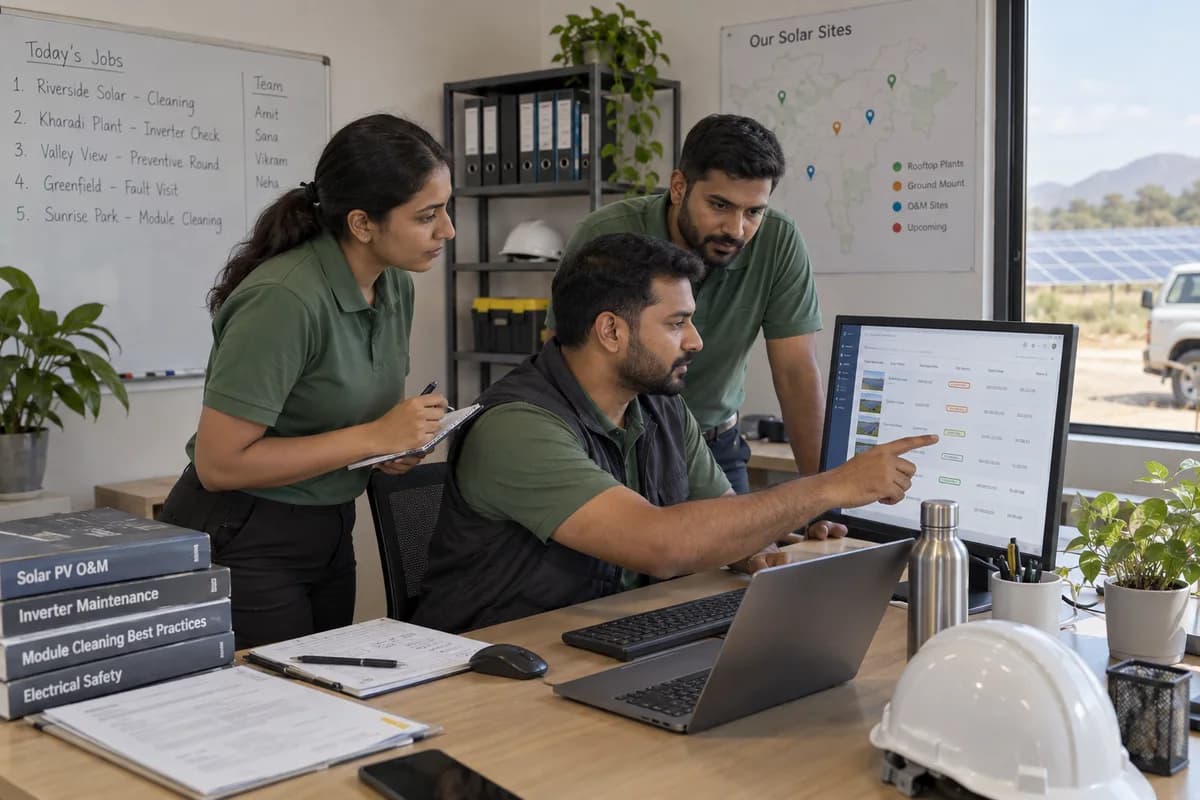
Your engineers cover every site under contract, and every plant reports its generation through a different inverter portal. Each contract is signed per plant, so response times and the promised performance ratio differ from one site to the next.
No standard package is written for this trade. A custom system is built around your plants, contracts and crews. We start with how a fault travels from a string alarm on the portal to the closed ticket. Owners and supervisors then read the same chain the engineers follow, from the portal alarm through the site visit and the spare fitted to the closed ticket and the report.
The morning starts on the monitoring portals. Someone scans each plant for zero generation, a tripped inverter or a string running low, and rings the site engineer. Faults also arrive as phone calls from plant owners. Those are written on a pad or in a WhatsApp group, and the ticket is opened only when someone remembers.
Panel washing follows a calendar that bends with dust, bird droppings and the season. Preventive rounds cover inverters, DC isolators, MC4 connectors, megger readings on cables, earth pit resistance, thermography for hotspots and mounting structures. Each round yields a checklist and photographs. Spares such as string fuses, connectors and surge protection devices ride with the engineers.
At month end the owner expects a report covering generation, performance ratio, availability, tickets closed and washing done. It is assembled by hand. Mondays are heavy. Overnight alarms, weekend calls from owners and unfinished checklists meet the supervisor together. Crews must be sent out before the sun is high.
What goes wrong for solar plant maintenance companies without a proper system.
What solar plant maintenance companies gain from one system.
Not a feature list. These are the moments in the working day that go differently once the records sit together.
What we would build for solar plant maintenance companies.
Named the way your team already talks about the work. We start with whichever part the audit shows is costing you most.
A requirements checklist for solar plant maintenance companies.
What to cover, which reports to ask for and what to put to every vendor, ready to print or save as a PDF.
A product already built for solar plant maintenance companies.
It is adapted to how your business works before it goes live, and anything your trade needs that it lacks is added then.
Solar Plant Maintenance Company Management Software
Fault tickets, cleaning rounds, preventive visits, spares, warranty claims, contracts and owner reports for solar operation and maintenance companies.
What Solar Plant Maintenance Company Management Software covers, feature by feature
- Plant and Contract Register for Solar Maintenance
- Fault Tickets and Response Clocks for Solar O&M
- Engineer Scheduling and Visit Routes for Solar Plants
- Visit Reports with Photographs for Solar Plants
- Module Cleaning Rounds for Solar Plant Crews
- Preventive Inspection Plans for Solar Plant Upkeep
- Spares and Tools Issue for Solar Engineers
- Warranty and Replacement Claims for Solar Operators
- Owner Report and Dashboard for Solar Plants
- Crew Attendance and Site Logs for Solar Sites
- Contract Renewals and Reminders for Solar Plants
Other products in the same sector as solar plant maintenance companies.
- Construction Project Management Software
- Expense Management Software
- Carpentry Contractor Management Software
- Interior Design Management System
- Electrical Contractor Management Software
- Elevator Service Management Software
- IoT Monitoring Dashboard
- Tile and Sanitaryware Showroom Software
- Glass and Facade Company Management Software
- Home Automation Company Management Software
- HVAC and AC Service Management Software
- Modular Kitchen Business Management Software
- All industry products
The business modules solar plant maintenance companies use most.
Each one is also available on its own, or inside a system built for you.
AMC and Service Contracts
A plant owner’s contract lists capacity in kW, visits promised, washing rounds and any promised generation level. Renewal dates are flagged. Managers see which owner’s contract is nearing its end.
Learn moreTicket Management
Zero generation alerts, tripped inverters and owner calls become tickets against the plant and inverter. Ownership and status are visible. A fault written on a pad no longer waits for memory.
Learn moreTechnician Scheduling
Engineers are booked to plant visits by location and skill, with washing rounds and fault calls in one calendar. A tripped inverter jumps the queue. Coordinators avoid sending a crew across the city twice.
Learn moreService Reports and Proof of Visit
A visit report records megger readings, torque checks, isolator condition and photos of panels and combiner boxes. The owner receives a signed copy. Engineers stop writing the same findings into a chat group.
Learn moreService Reminders
Washing rounds, thermography scans and quarterly checks are set for each plant and fall due on a calendar. Dust seasons move the dates. Coordinators see overdue plants before an owner complains.
Learn moreStock Tracking and Alerts
Spare fuses, MC4 connectors, string cables and isolators are counted in the store and in each van. Low items raise alerts. The stores clerk refills before an engineer reaches a plant without a part.
Learn moreAsset AMC Tracking
Inverters, meters, transformers and monitoring units are listed by plant with serial, warranty end and last service. A failed inverter shows whether its warranty still runs. Claims start from the record.
Learn moreAttendance & Time Tracking
Crew check-ins at each plant record arrival, departure and the task done. Overtime during washing rounds is counted. Supervisors confirm that visits promised to an owner were actually made.
Learn moreAll solutions by area
- Applicant Tracking (5)
- CRM (8)
- Finance & Accounting (10)
- Helpdesk (4)
- Human Resources (13)
- Inventory Management (5)
- Project Management (7)
- Manufacturing (6)
- Procurement (4)
- Sales and Distribution (6)
- Field Service (5)
- Statutory and Compliance (4)
- Retail and POS (4)
- Bookings and Appointments (3)
- Subscriptions (2)
- Assets and Fleet (4)
- Platform (6)
- Analytics (2)
- Documents (1)
Where AI can help solar plant maintenance companies.
Each one reads records you already keep, and a person approves every decision.
The services behind it.
IoT and Edge Computing
Dataloggers, string monitors and inverter gateways at each plant can report into one place, whatever the inverter make. The ticket desk sees a low string or a tripped inverter before the owner phones in.
Learn moreBusiness Process Automation
Automation opens a ticket from a monitoring alarm and assigns the nearest crew. It schedules washing and thermography rounds from the contract, and drafts the owner report once the visits are closed.
Learn moreWeb and Mobile Application Development
A mobile app gives the site engineer the plant register, the ticket, megger and thermography forms and the spares issue, working at the plant. An owner portal shows generation, tickets and reports for that owner’s plants only.
Learn moreBusiness Intelligence and Reporting Tools
Reporting here means generation against expected output by plant, ticket response times by contract, spares consumed and washing coverage. The operations head and each plant owner see their own cut of the same records.
Learn moreAll our other services
- Custom Software and Product Engineering
- Software Maintenance, Support and Rescue
- AI and Intelligent Automation
- API and System Integration
- ERP, CRM and Business Software Implementation
- Data Engineering and Business Intelligence
- UI/UX Design and Prototyping
- Cloud Engineering and Managed Infrastructure
- DevOps & Automation Services
- QA and Software Testing
- Performance Engineering
- Cybersecurity and Application Security
- Technology Strategy and Product Consulting
- E-Commerce and Digital Commerce
- MVP Product Development
- SaaS Product Development
- WhatsApp Business API and Chatbots
- Data Migration and Moving Off Spreadsheets
- Training and Adoption
- Data Protection and Privacy Readiness
- Tax and e-Invoice Engineering
- Managed IT Support
- Dedicated Team and Staff Augmentation
- Cloud Cost Optimisation
- Global Compliance and Localisation
Written for solar plant maintenance companies.
Practical notes on running the business, not product marketing.
How the work runs from Bengaluru for your city.
- 1
The audit, by call
A screen-share and a look at the sheets, accounting reports and WhatsApp groups your team uses. No travel needed.
- 2
A written proposal
Scope, what we build first and the cost, agreed in writing before anything starts.
- 3
Build in short rounds
Working screens shared every few weeks. Your team tests them from your own office.
- 4
Go-live, in person when it helps
For data migration and training we can come to your city. Travel is agreed in advance.
- 5
Support online
Fixes, changes and hosting handled remotely by the same team that built it.
The work we have published.
We only name clients whose work is published. None of them is in this trade; they show how the team works, not that it has built for this trade.
PetSeva: matching owners to the right vet, at any hour
A two-sided veterinary platform where vets are searchable by specialisation and bookable outside clinic hours. It now carries more than 2,000 veterinary doctors.
Read the case study Paying guest accommodationSAM Atithi Pavathi: bed-level occupancy as the source of truth
PG management software where allocation, rates and invoices are derived from bed-level occupancy and not maintained in parallel spreadsheets.
Read the case study School transport servicesSAM Tours: school transport on a single ledger
Registration, fee collection, routing and finance write to the same records, closing the gap between journeys run and fees collected.
Read the case study Microfinance and Self Help GroupsVikasa RDO: making SHG loan recovery auditable
Loan proposals, recoveries and commissions sit on one record, with a person attached to every state change, so a business handling a bank’s money can show where each rupee went.
Read the case studyCheck the difficult cases before choosing software.
Use examples from your own records to test the workflows that matter in your business.
Warranty and replacement claims
What proves that a planned task was actually completed?
Select an overdue entry in “Warranty and replacement claims”. Ask which work record closes it and what remains visible when the visit is postponed or only part of the job is done.
Background reading: ERPNext: maintenance plans
Owner report and plant dashboard
What does one row mean before totals are combined?
Choose one period in “Owner report and plant dashboard” and compare it with the source records. Define the date basis and grouping before accepting a total that combines several kinds of entry.
Background reading: Microsoft: reporting grain and relationships
Questions solar plant maintenance companies ask before they call.
Can it pull generation data from our inverters automatically?
Not on its own. Monitoring portals and data loggers differ by make, and some do not open their data. A link is scoped plant by plant, and until then generation figures can be loaded as a file.
Is there a ready product for this?
No. The solar installation product follows rooftop jobs from survey to handover, and it is not an O&M system. Your plant register, tickets and reports are a custom build.
Can our bookkeeper’s software read what it produces?
No real-time sync with your books exists. Your accountant can take invoice and expense records as reports. A file shaped to match your books is a separate piece of work.
Can engineers use it on a site with a weak signal?
Only where the phone has a connection. There is no offline mode today. Tickets and checklists are filled as soon as the engineer is back in coverage.
What happens after I share my requirements?
We review your brief and clarify the work with you. We then look at the software, spreadsheets and WhatsApp groups your business runs on today and write down what works, what slows your team down and what is missing. A demo login, a screen-share or a few screenshots are enough. You get a short written summary ordered by priority, with no obligation to hire us afterwards.
How much will the software cost?
We don’t publish a price, because it depends on what the system has to do. That first review settles the scope, and the cost goes into a written proposal before any work starts.
Cities where solar plant maintenance companies are common.
Related industries.
- Builders and contractors
- Carpentry and woodwork contractors
- Commercial interior fit-out contractors
- Construction project managers
- Electrical contractors
- Elevator companies
- Energy management companies
- Flooring companies
- Glass and façade companies
- Home automation companies
- HVAC contractors
- Interior designers
- Modular kitchen companies
- Painting contractors
- Pest control companies
- Plumbing contractors
- Solar installers
- Waterproofing contractors
- Windows and doors companies
Part of a wider group.
Tell us how your business runs today.
A few lines on your spreadsheets, software and WhatsApp groups is enough. We reply the same working day.
What happens after you share your requirements
- We review your brief and the systems you already use.
- We clarify the workflow, missing information and the work to consider first.
- The proposed scope sets out the deliverables, responsibilities and dependencies.
- Review the scope and commercial terms before deciding whether to proceed.
Start with your requirements
Describe your current process, the people involved and the change you need. Start with the details you know; we can clarify the rest together.
Share your requirements