Trace every food pouch and carton from film reel lot to pallet label.
Food packaging converters gravure-print, laminate, slit and form material that ends up touching someone’s dinner, so each reel and each pallet must be traceable. The food packaging manufacturer software holds artwork approvals, film structures, solventless adhesive and ink lots, hygiene checks and customer specifications against every job. Reels are followed from receipt to finished goods. Migration test reports and declarations are filed with the order that needed them.
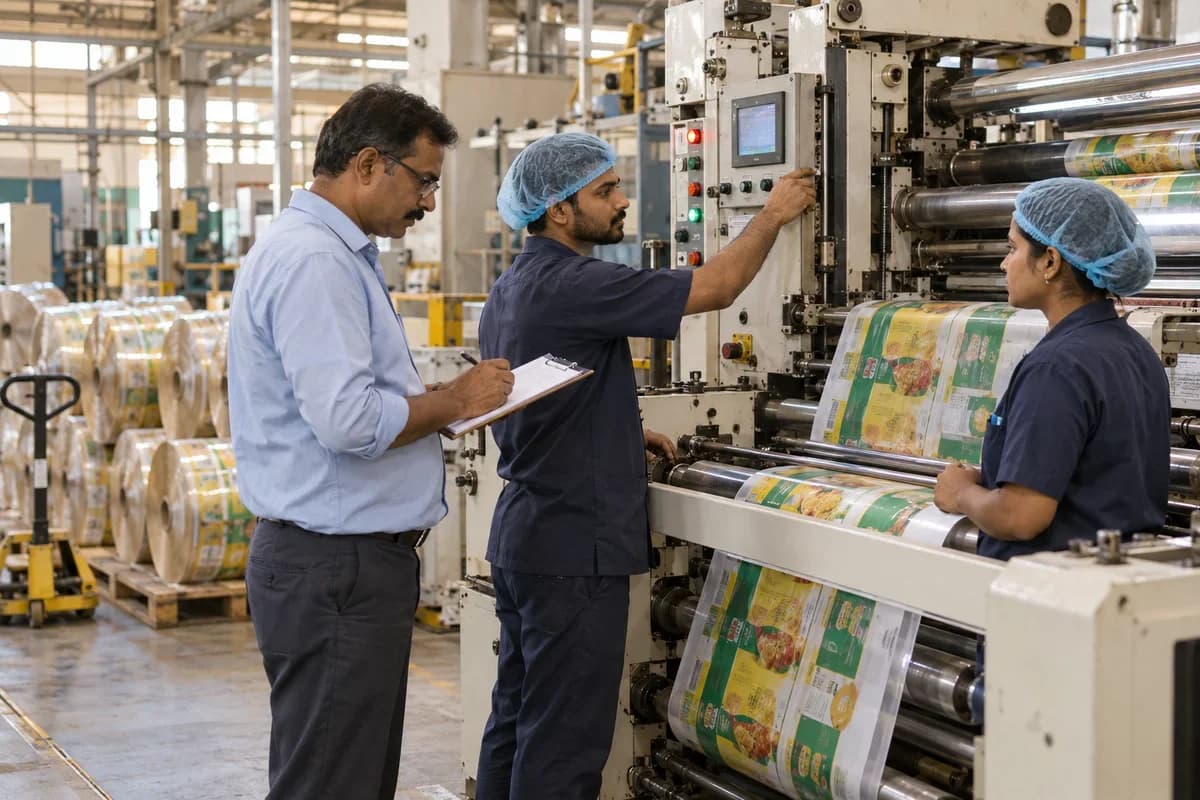
A food packaging plant converts rolls of BOPP, PET and aluminium foil into stand-up pouches, flow wrappers, folding cartons and peelable lidding. Brand owners fill them with crisps, yoghurt, biscuits and ready meals. Packaging is cheap to ship empty. It is costly to get wrong once food is inside, because a weak heat seal or a wrong barcode turns a full pallet into a recall at someone else’s filling line.
Software for food packaging converters keeps the film structure, the approved artwork and the lot numbers on one job record. Estimating, the gravure press, the laminator, the pouch machines and the quality desk all read it. Customers ask who made a pack and from which reel. The answer comes from the record. Nobody guesses.
A brand owner sends an artwork file, a pack size and a structure such as PET over metallised film over polyethylene. Estimating prices the film by weight and square metre and adds cylinder cost for gravure print. It also asks each film and ink supplier for a food-contact declaration. Artwork travels back and forth as proofs until the customer signs one version. Only that one is made.
On the floor the press runs the job in colours matched to a Pantone reference. The laminator joins the layers with adhesive that needs a cure period before slitting, and web tension is watched for wrinkle and curling. Pouch machines form side seals and bottom gussets. Then the checks begin. Operators test seal strength, print registration, ghosting and residual solvent odour at set intervals and weigh each carton of finished pouches. Every reel and ink lot used goes against the order.
Dispatch packs by pallet with a label for job, lot and count. A certificate of conformity travels with the delivery note when the customer asks for one.
What goes wrong for food packaging manufacturers without a proper system.
What we would build for food packaging manufacturers.
Named the way your team already talks about the work. We start with whichever part the audit shows is costing you most.
A requirements checklist for food packaging manufacturers.
What to cover, which reports to ask for and what to put to every vendor, ready to print or save as a PDF.
A product already built for food packaging manufacturers.
It is adapted to how your business works before it goes live, and anything your trade needs that it lacks is added then.
Food Packaging Manufacturer Management Software
Artwork proofs, BOPP and PET reel lots, gravure and lamination stages, seal and metal detector checks, migration test reports and pallet labels for food packaging converters.
Other products in the same sector as food packaging manufacturers.
- Adhesive Manufacturer Management Software
- Aerospace Manufacturer Management Software
- Aerospace CNC Part Manufacturer Management Software
- Aerospace Fabrication Company Management Software
- Aerospace Tooling Company Management Software
- Agricultural Implement Manufacturer Management Software
- Agricultural Pump Manufacturer Management Software
- Aluminium Die Casting Company Management Software
- API Manufacturer Management Software
- Apparel Manufacturer Management Software
- Auto Parts Manufacturer Management Software
- Automation Equipment Manufacturer Management Software
- All industry products
The business modules food packaging manufacturers use most.
Each one is also available on its own, or inside a system built for you.
- Estimate/Quotation Management
- Project Document Management
- Bill of Materials
- Batch and Serial Tracking
- Production Planning
- Quality Control
- Document Management
- Barcodes and Labels
- All business solutions
All solutions by area
- Applicant Tracking (5)
- CRM (8)
- Finance & Accounting (10)
- Helpdesk (4)
- Human Resources (13)
- Inventory Management (5)
- Project Management (7)
- Manufacturing (6)
- Procurement (4)
- Sales and Distribution (6)
- Field Service (5)
- Statutory and Compliance (4)
- Retail and POS (4)
- Bookings and Appointments (3)
- Subscriptions (2)
- Assets and Fleet (4)
- Platform (6)
- Analytics (2)
- Documents (1)
Where AI can help food packaging manufacturers.
Each one reads records you already keep, and a person approves every decision.
The services behind it.
Business Process Automation
Approvals, reminders and reports triggered by agreed rules, with exceptions assigned to a responsible person.
Learn moreCustom Software and Product Engineering
Software built around how your business actually runs, when nothing off the shelf fits without workarounds.
Learn moreData Migration and Moving Off Spreadsheets
Data migration and spreadsheet replacement covers auditing existing files, cleaning and deduplicating records, loading them into a new system and reconciling the loaded result against known totals. Both systems then run side by side before cutover. Originals stay untouched.
Learn moreTraining and Adoption
Adoption work starts after launch. Each role is trained at its own screen on its own tasks, such as billing returns, goods receipts or closing job cards. Support stands on the floor at go-live. Afterwards the records are reviewed to find which steps staff skip, which fields stay blank and why the stores or field team still reach for a notebook. Share your requirements and we will plan it with you.
Learn moreAll our other services
- Software Maintenance, Support and Rescue
- AI and Intelligent Automation
- API and System Integration
- ERP, CRM and Business Software Implementation
- Data Engineering and Business Intelligence
- UI/UX Design and Prototyping
- Cloud Engineering and Managed Infrastructure
- DevOps & Automation Services
- QA and Software Testing
- Performance Engineering
- Cybersecurity and Application Security
- IoT and Edge Computing
- Technology Strategy and Product Consulting
- E-Commerce and Digital Commerce
- MVP Product Development
- Web and Mobile Application Development
- SaaS Product Development
- WhatsApp Business API and Chatbots
- Data Protection and Privacy Readiness
- Tax and e-Invoice Engineering
- Managed IT Support
- Dedicated Team and Staff Augmentation
- Business Intelligence and Reporting Tools
- Cloud Cost Optimisation
- Global Compliance and Localisation
How the work runs from Bengaluru for your city.
- 1
The audit, by call
A screen-share and a look at the sheets, accounting reports and WhatsApp groups your team uses. No travel needed.
- 2
A written proposal
Scope, what we build first and the cost, agreed in writing before anything starts.
- 3
Build in short rounds
Working screens shared every few weeks. Your team tests them from your own office.
- 4
Go-live, in person when it helps
For data migration and training we can come to your city. Travel is agreed in advance.
- 5
Support online
Fixes, changes and hosting handled remotely by the same team that built it.
The work we have published.
We only name clients whose work is published. None of them is in this trade; they show how the team works, not that it has built for this trade.
PetSeva: matching owners to the right vet, at any hour
A two-sided veterinary platform where vets are searchable by specialisation and bookable outside clinic hours. It now carries more than 2,000 veterinary doctors.
Read the case study Paying guest accommodationSAM Atithi Pavathi: bed-level occupancy as the source of truth
PG management software where allocation, rates and invoices are derived from bed-level occupancy and not maintained in parallel spreadsheets.
Read the case study School transport servicesSAM Tours: school transport on a single ledger
Registration, fee collection, routing and finance write to the same records, closing the gap between journeys run and fees collected.
Read the case study Microfinance and Self Help GroupsVikasa RDO: making SHG loan recovery auditable
Loan proposals, recoveries and commissions sit on one record, with a person attached to every state change, so a business handling a bank’s money can show where each rupee went.
Read the case studyCheck the difficult cases before choosing software.
Use examples from your own records to test the workflows that matter in your business.
Seal, colour and weight checks
Do purchasing, operating and billing quantities use the same unit?
Check the measurement unit and rounding used in “Seal, colour and weight checks”. Compare the result with a known sample before accepting a converted quantity or calculated charge.
Background reading: ERPNext: units of measure
Artwork and proof approval
What needs fresh approval after a record is changed?
For “Artwork and proof approval”, change a material detail after approval during a scoped walkthrough. Agree the next responsible person and the evidence needed before the work can continue.
Background reading: ERPNext: approval transitions
Questions food packaging manufacturers ask before they call.
Can we go from a pallet label to its reels?
Each job lists the film, ink and adhesive lots drawn for it. From a pallet label you reach the job, and from the job you reach every reel. Your quality staff decide how far back the trail must run.
Does it hold food-contact declarations?
It files the declarations and test reports your suppliers send, against the materials and the jobs that used them. Whether a document satisfies a given customer or regulator is for your quality team to judge.
Can it price a job from its film structure?
You enter layers, micron gauge, print coverage and cylinder cost once. A quotation then builds from those, and repeat orders reuse the saved structure.
What affects the cost for a pouch and film converter?
Presses, laminators and pouch lines in scope, plus reel and ink stock to load, set the size. Scales and label printers widen the job. A film structure and one job are costed on screen from your data first, then parts are priced.
What happens after I share my requirements?
An engineer reads what you send and replies within one business day. We then look at the software, spreadsheets and WhatsApp groups your business runs on today and write down what works, what slows your team down and what is missing. A demo login, a screen-share or a few screenshots are enough. You get a short written summary ordered by priority, with no obligation to hire us afterwards.
How much will the software cost?
We don’t publish a price, because it depends on what the system has to do. That first review settles the scope, and the cost goes into a written proposal before any work starts.
Related industries.
- Adhesive manufacturers
- Aerospace and aviation manufacturers
- Aerospace CNC part manufacturers
- Aerospace fabrication companies
- Aerospace tooling companies
- Agricultural implement manufacturers
- Agricultural pump manufacturers
- Aluminium die casting companies
- API manufacturers
- Apparel manufacturers
- Auto parts manufacturers
- Automation equipment manufacturers
- Automotive component manufacturers
- Automotive fastener manufacturers
- Automotive plastics manufacturers
- Avionics hardware manufacturers
- Bakery product manufacturers
- Battery pack manufacturers
- Bearing manufacturers
- Beverage manufacturers
- Blow moulding companies
- Brake component manufacturers
- Cabinet manufacturers
- Cable and wire manufacturers
- Capsule manufacturers
- Cement product manufacturers
- Chemical manufacturers
- Cleaning product manufacturers
- CNC bending shops
- CNC machining companies
- CNC milling shops
- CNC turning shops
- Cold forging companies
- Commercial furniture manufacturers
- Commercial printers
- Commercial refrigeration companies
- Compressor manufacturers
- Concrete block manufacturers
- Construction chemical manufacturers
- Construction material manufacturers
- Contract pharma manufacturers
- Control panel manufacturers
- Conveyor belt manufacturers
- Conveyor manufacturers
- Corrugated box manufacturers
- Countertop manufacturers
- Deep drawing companies
- Defence component manufacturers
- Diagnostic equipment manufacturers
- Digital printers
- Door and window manufacturers
- Drone component manufacturers
- Electric motor manufacturers
- Electrical equipment manufacturers
- Electronic manufacturing services providers
- Electronic product manufacturers
- Embedded systems companies
- Energy storage system manufacturers
- Engine component manufacturers
- Engineering plastics processors
- EV charger manufacturers
- EV component manufacturers
- Fabric manufacturers
- Farm machinery manufacturers
- Fastener manufacturers
- Five-axis machining shops
- Flexible packaging manufacturers
- Flour mills
- Folding carton manufacturers
- Food ingredient manufacturers
- Food manufacturers
- Food processing machinery manufacturers
- Forged automotive parts manufacturers
- Foundry component manufacturers
- Frozen food manufacturers
- Furniture manufacturers
- Gear manufacturers
- Gravity die casting companies
- Herbal product manufacturers
- Home appliance manufacturers
- Home textile manufacturers
- Hospital furniture manufacturers
- Hot forging companies
- Household plastics manufacturers
- Household products manufacturers
- Hydraulic component manufacturers
- Industrial chemical manufacturers
- Industrial cleaning chemical manufacturers
- Industrial electronics manufacturers
- Industrial enclosure manufacturers
- Industrial lighting manufacturers
- Industrial packaging manufacturers
- Industrial printing companies
- Industrial pump manufacturers
- Industrial repair companies
- Industrial rubber parts manufacturers
- Industrial sensor suppliers
- Injection moulding companies
- Investment casting companies
- IoT device manufacturers
- Iron foundries
- Irrigation equipment manufacturers
- Jig and fixture makers
- Kitchenware manufacturers
- Label and sticker printers
- Label manufacturers
- Laser cutting shops
- Lighting manufacturers
- Machine tool manufacturers
- Machine vision companies
- Machinery manufacturers
- Material handling equipment manufacturers
- Medical device manufacturers
- Medical disposables manufacturers
- Medical equipment manufacturers
- Medical plastics manufacturers
- Metal fabricators
- Metal stamping companies
- Modular furniture manufacturers
- Nutraceutical manufacturers
- Office furniture manufacturers
- Offset printers
- Orthopaedic implant manufacturers
- Orthotics manufacturers
- Packaged food manufacturers
- Packaging film manufacturers
- Packaging machinery manufacturers
- Packaging manufacturers
- Paper bag manufacturers
- Paper product manufacturers
- Paver manufacturers
- PCB assembly companies
- PCB manufacturers
- Personal care product manufacturers
- Pharma packaging manufacturers
- Pharmaceutical manufacturers
- Pipe fitting manufacturers
- Plastic component manufacturers
- Plastic extrusion companies
- Plastic mould makers
- Plastic packaging manufacturers
- Plating companies
- PLC panel builders
- Plywood and timber dealers
- Plywood manufacturers
- Pneumatic component manufacturers
- Power distribution equipment manufacturers
- PPE manufacturers
- Precast concrete manufacturers
- Precision component manufacturers
- Precision forging companies
- Precision grinding shops
- Resin manufacturers
- Rice mills
- Rigid packaging manufacturers
- Robotic systems integrators
- Roll forming companies
- Roofing material manufacturers
- Rubber gasket manufacturers
- Rubber hose manufacturers
- Rubber moulding companies
- Sand casting foundries
- SCADA system integrators
- School furniture manufacturers
- Seal and O-ring manufacturers
- Sensor manufacturers
- Shaft manufacturers
- Sheet metal fabricators
- Silicone component manufacturers
- Snack manufacturers
- Solar component manufacturers
- Solar inverter manufacturers
- Solar mounting structure manufacturers
- Solar panel manufacturers
- Solvent manufacturers
- Special purpose machine builders
- Specialty chemical manufacturers
- Spice manufacturers
- Spring manufacturers
- Stainless steel fabricators
- Stationery manufacturers
- Steel foundries
- Steel mills
- Structural steel fabricators
- Surgical instrument manufacturers
- Suspension component manufacturers
- Switchgear manufacturers
- Tablet manufacturers
- Technical textile manufacturers
- Textile processors
- Tile manufacturers
- Tool rooms
- Toy manufacturers
- Tractor attachment manufacturers
- Transformer manufacturers
- Uniform manufacturers
- Valve manufacturers
- VMC machining shops
- Water treatment chemical manufacturers
- Water treatment companies
- Welding shops
- Wind turbine component manufacturers
- Wire EDM shops
- Wiring harness manufacturers
- Wooden door manufacturers
- Yarn manufacturers
Part of a wider group.
Tell us how your business runs today.
A few lines on your spreadsheets, software and WhatsApp groups is enough. We reply the same working day.
What happens after you share your requirements
- A senior engineer reads your answers. Nobody phones first.
- Within one business day you get a written note: what we understood, what we would start with, and the questions we still have.
- If it fits, a proposal follows with the order of work, what we need from you and what you receive at each step.
- No call is booked and nothing is paid until you have read the note. Your details stay with us.
Start with your requirements
Seven short steps that tell us what you need. A senior engineer reads them before anyone gets in touch.
Share your requirements