Manufacturing · Software for water treatment companiesFollow each treatment plant from water survey to commissioning, membrane change and chemical refill.
Water treatment software holds each site as one record. The record carries the water analysis, the softener or reverse osmosis plant installed, its sediment cartridges, membranes and antiscalant dosing, and the service contract that covers it. Technicians are scheduled against due dates, and consumables are issued against the visit. The office sees which plants are due and which contracts are about to lapse.
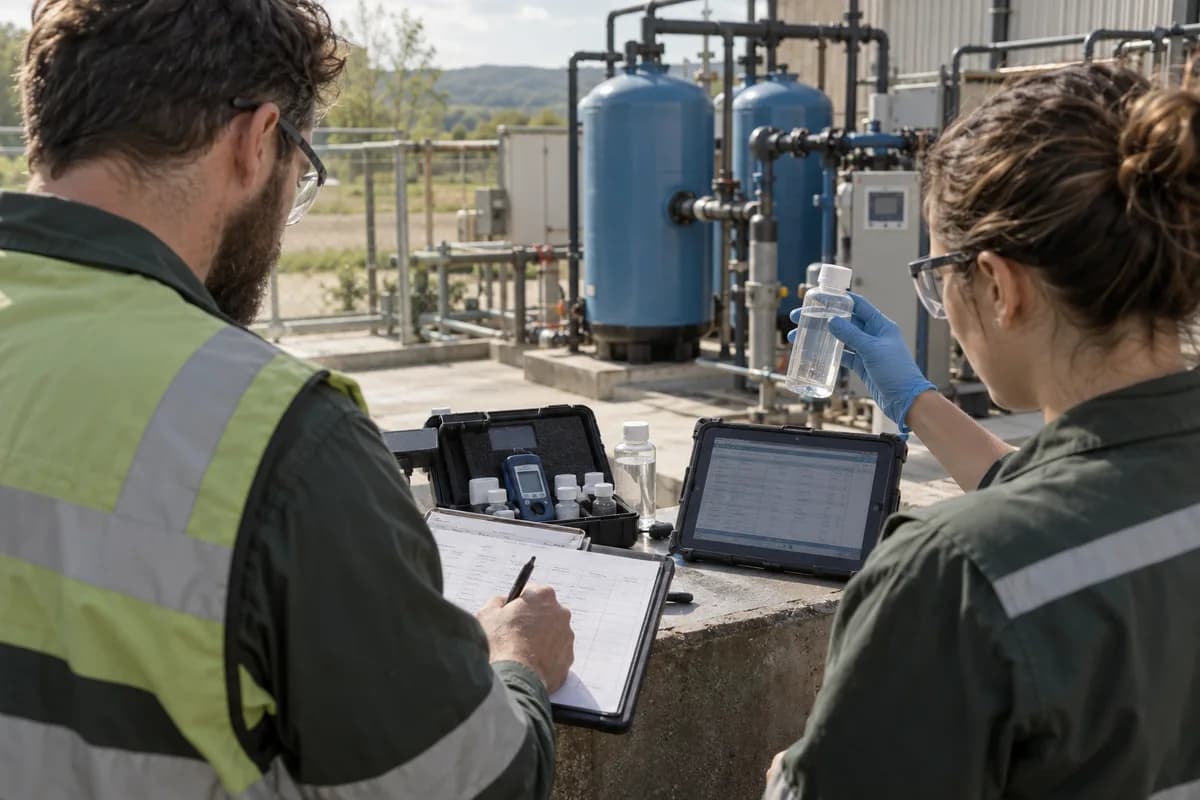
A water treatment company sells a result that depends on upkeep. A softener, a reverse osmosis plant or a chlorine dosing skid is installed once, then needs resin, membranes, cartridges and chemicals on a schedule for years. The sale is the start. Upkeep is the business.
Most firms keep the plant list in a spreadsheet, lab reports in a folder and service dates in a technician’s head. The software ties these to one record per site, so the next visit is planned from what was fitted and what has been used up.
An enquiry comes from a bottling unit, a hotel, a housing complex or a homeowner. A surveyor draws a sample, notes the well or mains source, the flow needed and the plant room space, and sends the sample for analysis of dissolved solids, hardness, iron and chlorides. The quotation names the plant, its litres per hour, the multimedia filter and the commissioning scope, priced from current supplier rates.
After approval the team orders vessels, pumps, pipes and fittings, then installs and commissions the plant. Outlet dissolved solids and pH are recorded at handover. A contract may then cover scheduled visits for cartridge changes, membrane cleaning, resin regeneration and dosing refills.
Technicians visit on a route, take readings, replace parts and log what they used. A larger site may buy sodium hypochlorite on a standing order that must arrive before the dosing tank runs dry. A failed reading starts a callout. Records decide who pays.
What goes wrong for water treatment companies without a proper system.
What water treatment companies gain from one system.
Not a feature list. These are the moments in the working day that go differently once the records sit together.
What we would build for water treatment companies.
Named the way your team already talks about the work. We start with whichever part the audit shows is costing you most.
A requirements checklist for water treatment companies.
What to cover, which reports to ask for and what to put to every vendor, ready to print or save as a PDF.
A product already built for water treatment companies.
It is adapted to how your business works before it goes live, and anything your trade needs that it lacks is added then.
Water Treatment Company Management Software
Water analysis, plant quotations, installation jobs, service contracts, readings, filters, membranes and chemical stock for water treatment companies.
What Water Treatment Company Management Software covers, feature by feature
- Enquiries and Site Survey for Water Treatment Firms
- Water Analysis Records for Treatment Companies
- Plant Quotations Built From Your Own Price List
- Installation Jobs for Softener and RO Plants
- Plant and Asset Register for Treatment Companies
- Service Contracts and Visit Scheduling for Water Plants
- Readings and Signed Service Reports for Water Plants
- Cartridge, Membrane and Chemical Stock by Store and Van
- Stage Invoices and Contract Renewals for Water Firms
- Visit Reminders and Customer Messages for Treatment Firms
Other products in the same sector as water treatment companies.
- Adhesive Manufacturer Management Software
- Aerospace Manufacturer Management Software
- Aerospace CNC Part Manufacturer Management Software
- Aerospace Fabrication Company Management Software
- Aerospace Tooling Company Management Software
- Agricultural Implement Manufacturer Management Software
- Agricultural Pump Manufacturer Management Software
- Aluminium Die Casting Company Management Software
- API Manufacturer Management Software
- Apparel Manufacturer Management Software
- Auto Parts Manufacturer Management Software
- Automation Equipment Manufacturer Management Software
- All industry products
The business modules water treatment companies use most.
Each one is also available on its own, or inside a system built for you.
Quote & Proposal Management
A proposal describes the softener, reverse osmosis or effluent plant offered, with capacity, media and warranty terms. Revisions after a site visit are kept. Clients compare two plant sizes side by side.
Learn moreJob Cards
A job card follows a plant from delivery of vessels to commissioning, with the fitters, pipework done and tests passed. Photos of skids and panels are attached. The card closes on customer sign-off.
Learn moreAMC and Service Contracts
A plant’s service contract lists the visits owed, consumables included and chemicals covered. Industrial and residential contracts follow different terms. Renewal dates are shown to the sales desk.
Learn moreTechnician Scheduling
Technicians are placed on commissioning, contract visits and breakdowns by plant location and skill. A softener regeneration problem goes to someone who knows the valve. Late changes shift only the affected jobs.
Learn moreService Reports and Proof of Visit
The visit report notes inlet and outlet hardness, TDS, pressure drop across the membrane and the dosing rate. The client engineer signs it. Trends across visits show a failing membrane early.
Learn moreStock Tracking and Alerts
Membranes, cartridges, resin bags, antiscalant drums and valve heads are counted at the store and in each service vehicle. Alerts fire for items the contracts will need. Slow spares are visible.
Learn moreAsset AMC Tracking
Each pump, vessel, membrane skid and dosing set is held as an asset with install date and warranty. Contract cover is shown beside it. Items outside warranty become quotation prompts.
Learn moreService Reminders
Cartridge changes, membrane cleaning and contract renewals become reminders to plant managers and householders. Technicians see the next due visit on their route. Ignored reminders reach a manager.
Learn moreAll solutions by area
- Applicant Tracking (5)
- CRM (8)
- Finance & Accounting (10)
- Helpdesk (4)
- Human Resources (13)
- Inventory Management (5)
- Project Management (7)
- Manufacturing (6)
- Procurement (4)
- Sales and Distribution (6)
- Field Service (5)
- Statutory and Compliance (4)
- Retail and POS (4)
- Bookings and Appointments (3)
- Subscriptions (2)
- Assets and Fleet (4)
- Platform (6)
- Analytics (2)
- Documents (1)
Where AI can help water treatment companies.
Each one reads records you already keep, and a person approves every decision.
The services behind it.
ERP, CRM and Business Software Implementation
Enquiries, site surveys, quotations, installation jobs, contracts, spares and invoices would sit in one system for a treatment company. A softener or RO plant would carry its full history from first survey to renewal.
Learn moreBusiness Process Automation
A signed quotation would open the installation job, order the media and cartridges, and schedule commissioning. Contract dates would generate visit tasks and renewal reminders without a coordinator maintaining a separate calendar.
Learn moreIoT and Edge Computing
Flow meters, pressure gauges, TDS probes and dosing pump controllers at customer plants could report to the system. Engineers would see abnormal readings on a plant before a scheduled visit and arrive prepared.
Learn moreWeb and Mobile Application Development
Technicians would enter water readings, photographs and consumables used on a phone app at the plant. Customers could view their contract, visit history and service reports through a web portal.
Learn moreAll our other services
- Custom Software and Product Engineering
- Software Maintenance, Support and Rescue
- AI and Intelligent Automation
- API and System Integration
- Data Engineering and Business Intelligence
- UI/UX Design and Prototyping
- Cloud Engineering and Managed Infrastructure
- DevOps & Automation Services
- QA and Software Testing
- Performance Engineering
- Cybersecurity and Application Security
- Technology Strategy and Product Consulting
- E-Commerce and Digital Commerce
- MVP Product Development
- SaaS Product Development
- WhatsApp Business API and Chatbots
- Data Migration and Moving Off Spreadsheets
- Training and Adoption
- Data Protection and Privacy Readiness
- Tax and e-Invoice Engineering
- Managed IT Support
- Dedicated Team and Staff Augmentation
- Business Intelligence and Reporting Tools
- Cloud Cost Optimisation
- Global Compliance and Localisation
How the work runs from Bengaluru for your city.
- 1
The audit, by call
A screen-share and a look at the sheets, accounting reports and WhatsApp groups your team uses. No travel needed.
- 2
A written proposal
Scope, what we build first and the cost, agreed in writing before anything starts.
- 3
Build in short rounds
Working screens shared every few weeks. Your team tests them from your own office.
- 4
Go-live, in person when it helps
For data migration and training we can come to your city. Travel is agreed in advance.
- 5
Support online
Fixes, changes and hosting handled remotely by the same team that built it.
The work we have published.
We only name clients whose work is published. None of them is in this trade; they show how the team works, not that it has built for this trade.
PetSeva: matching owners to the right vet, at any hour
A two-sided veterinary platform where vets are searchable by specialisation and bookable outside clinic hours. It now carries more than 2,000 veterinary doctors.
Read the case study Paying guest accommodationSAM Atithi Pavathi: bed-level occupancy as the source of truth
PG management software where allocation, rates and invoices are derived from bed-level occupancy and not maintained in parallel spreadsheets.
Read the case study School transport servicesSAM Tours: school transport on a single ledger
Registration, fee collection, routing and finance write to the same records, closing the gap between journeys run and fees collected.
Read the case study Microfinance and Self Help GroupsVikasa RDO: making SHG loan recovery auditable
Loan proposals, recoveries and commissions sit on one record, with a person attached to every state change, so a business handling a bank’s money can show where each rupee went.
Read the case studyCheck the difficult cases before choosing software.
Use examples from your own records to test the workflows that matter in your business.
Quotations by plant
Which assumptions stop being valid when the quotation changes?
For “Quotations by plant”, compare an accepted version with a later revision. Identify changed quantities, exclusions and validity dates before the revised amount is used downstream.
Background reading: ERPNext: quotation terms
Readings and service reports
What does one row mean before totals are combined?
Choose one period in “Readings and service reports” and compare it with the source records. Define the date basis and grouping before accepting a total that combines several kinds of entry.
Background reading: Microsoft: reporting grain and relationships
Questions water treatment companies ask before they call.
Does it suit a company that sells plants and chemicals?
Yes. One business can install plant, hold service contracts and deliver repeat chemicals together. Stock is shared, and each sale is traced to the customer and site.
Can it store lab reports and test readings?
Yes. Reports attach to the site as files, and the readings you enter on each visit build a history for that plant. Whether you track dissolved solids, hardness or turbidity is your choice.
Can it read sensors on the plant?
Not by default. Connecting flow meters, pressure transmitters or conductivity probes is possible as a separate integration, scoped and quoted after a review of the equipment.
Does it deal with water quality regulation?
No. It records what you measure and do. What your customers or regulator require is decided by you and your advisers, and nothing here replaces that.
What moves the water treatment system quotation?
Each of site surveys, quotations by plant and service contracts adds to the base. Size counts: technicians, sites, logins. Old plant lists can change the total. Site surveys can be priced alone.
Gathering for the water treatment system: what first?
Bring water analysis reports, plant details by site, visit calendars and chemical stock lists. A named person covers a surveyor, a service lead and accounts. Samples of plant details by site help most.
What becomes of our service contracts on leaving?
Ownership of plant details, service contracts and reading sheets sits with the firm, source code included. Exports come as plain files. Plant details support stays in-house.
What happens after I share my requirements?
We review your brief and clarify the work with you. We then look at the software, spreadsheets and WhatsApp groups your business runs on today and write down what works, what slows your team down and what is missing. A demo login, a screen-share or a few screenshots are enough. You get a short written summary ordered by priority, with no obligation to hire us afterwards.
How much will the software cost?
We don’t publish a price, because it depends on what the system has to do. That first review settles the scope, and the cost goes into a written proposal before any work starts.
Related industries.
- Adhesive manufacturers
- Aerospace and aviation manufacturers
- Aerospace CNC part manufacturers
- Aerospace fabrication companies
- Aerospace tooling companies
- Agricultural implement manufacturers
- Agricultural pump manufacturers
- Aluminium die casting companies
- API manufacturers
- Apparel manufacturers
- Auto parts manufacturers
- Automation equipment manufacturers
- Automotive component manufacturers
- Automotive fastener manufacturers
- Automotive plastics manufacturers
- Avionics hardware manufacturers
- Bakery product manufacturers
- Battery pack manufacturers
- Bearing manufacturers
- Beverage manufacturers
- Blow moulding companies
- Brake component manufacturers
- Cabinet manufacturers
- Cable and wire manufacturers
- Capsule manufacturers
- Cement product manufacturers
- Chemical manufacturers
- Cleaning product manufacturers
- CNC bending shops
- CNC machining companies
- CNC milling shops
- CNC turning shops
- Cold forging companies
- Commercial furniture manufacturers
- Commercial printers
- Commercial refrigeration companies
- Compressor manufacturers
- Concrete block manufacturers
- Construction chemical manufacturers
- Construction material manufacturers
- Contract pharma manufacturers
- Control panel manufacturers
- Conveyor belt manufacturers
- Conveyor manufacturers
- Corrugated box manufacturers
- Countertop manufacturers
- Deep drawing companies
- Defence component manufacturers
- Diagnostic equipment manufacturers
- Digital printers
- Door and window manufacturers
- Drone component manufacturers
- Electric motor manufacturers
- Electrical equipment manufacturers
- Electronic manufacturing services providers
- Electronic product manufacturers
- Embedded systems companies
- Energy storage system manufacturers
- Engine component manufacturers
- Engineering plastics processors
- EV charger manufacturers
- EV component manufacturers
- Fabric manufacturers
- Farm machinery manufacturers
- Fastener manufacturers
- Five-axis machining shops
- Flexible packaging manufacturers
- Flour mills
- Folding carton manufacturers
- Food ingredient manufacturers
- Food manufacturers
- Food packaging manufacturers
- Food processing machinery manufacturers
- Forged automotive parts manufacturers
- Foundry component manufacturers
- Frozen food manufacturers
- Furniture manufacturers
- Gear manufacturers
- Gravity die casting companies
- Herbal product manufacturers
- Home appliance manufacturers
- Home textile manufacturers
- Hospital furniture manufacturers
- Hot forging companies
- Household plastics manufacturers
- Household products manufacturers
- Hydraulic component manufacturers
- Industrial chemical manufacturers
- Industrial cleaning chemical manufacturers
- Industrial electronics manufacturers
- Industrial enclosure manufacturers
- Industrial lighting manufacturers
- Industrial packaging manufacturers
- Industrial printing companies
- Industrial pump manufacturers
- Industrial repair companies
- Industrial rubber parts manufacturers
- Industrial sensor suppliers
- Injection moulding companies
- Investment casting companies
- IoT device manufacturers
- Iron foundries
- Irrigation equipment manufacturers
- Jig and fixture makers
- Kitchenware manufacturers
- Label and sticker printers
- Label manufacturers
- Laser cutting shops
- Lighting manufacturers
- Machine tool manufacturers
- Machine vision companies
- Machinery manufacturers
- Material handling equipment manufacturers
- Medical device manufacturers
- Medical disposables manufacturers
- Medical equipment manufacturers
- Medical plastics manufacturers
- Metal fabricators
- Metal stamping companies
- Modular furniture manufacturers
- Nutraceutical manufacturers
- Office furniture manufacturers
- Offset printers
- Orthopaedic implant manufacturers
- Orthotics manufacturers
- Packaged food manufacturers
- Packaging film manufacturers
- Packaging machinery manufacturers
- Packaging manufacturers
- Paper bag manufacturers
- Paper product manufacturers
- Paver manufacturers
- PCB assembly companies
- PCB manufacturers
- Personal care product manufacturers
- Pharma packaging manufacturers
- Pharmaceutical manufacturers
- Pipe fitting manufacturers
- Plastic component manufacturers
- Plastic extrusion companies
- Plastic mould makers
- Plastic packaging manufacturers
- Plating companies
- PLC panel builders
- Plywood and timber dealers
- Plywood manufacturers
- Pneumatic component manufacturers
- Power distribution equipment manufacturers
- PPE manufacturers
- Precast concrete manufacturers
- Precision component manufacturers
- Precision forging companies
- Precision grinding shops
- Resin manufacturers
- Rice mills
- Rigid packaging manufacturers
- Robotic systems integrators
- Roll forming companies
- Roofing material manufacturers
- Rubber gasket manufacturers
- Rubber hose manufacturers
- Rubber moulding companies
- Sand casting foundries
- SCADA system integrators
- School furniture manufacturers
- Seal and O-ring manufacturers
- Sensor manufacturers
- Shaft manufacturers
- Sheet metal fabricators
- Silicone component manufacturers
- Snack manufacturers
- Solar component manufacturers
- Solar inverter manufacturers
- Solar mounting structure manufacturers
- Solar panel manufacturers
- Solvent manufacturers
- Special purpose machine builders
- Specialty chemical manufacturers
- Spice manufacturers
- Spring manufacturers
- Stainless steel fabricators
- Stationery manufacturers
- Steel foundries
- Steel mills
- Structural steel fabricators
- Surgical instrument manufacturers
- Suspension component manufacturers
- Switchgear manufacturers
- Tablet manufacturers
- Technical textile manufacturers
- Textile processors
- Tile manufacturers
- Tool rooms
- Toy manufacturers
- Tractor attachment manufacturers
- Transformer manufacturers
- Uniform manufacturers
- Valve manufacturers
- VMC machining shops
- Water treatment chemical manufacturers
- Welding shops
- Wind turbine component manufacturers
- Wire EDM shops
- Wiring harness manufacturers
- Wooden door manufacturers
- Yarn manufacturers
Part of these wider groups.
Tell us how your business runs today.
A few lines on your spreadsheets, software and WhatsApp groups is enough. We reply the same working day.
What happens after you share your requirements
- We review your brief and the systems you already use.
- We clarify the workflow, missing information and the work to consider first.
- The proposed scope sets out the deliverables, responsibilities and dependencies.
- Review the scope and commercial terms before deciding whether to proceed.
Start with your requirements
Describe your current process, the people involved and the change you need. Start with the details you know; we can clarify the rest together.
Share your requirements