Turn showroom orders into factory work orders, material lists and outsourced finishing.
Furniture makers take orders at a showroom counter or from interior designers, then build them from sketches forwarded on WhatsApp. The factory hears late and delivery dates slip. Furniture showroom software holds the order end, while production management software holds the shop floor, and both are joined during implementation. One order number then follows a wardrobe from cutting list through French polish to the installation visit.
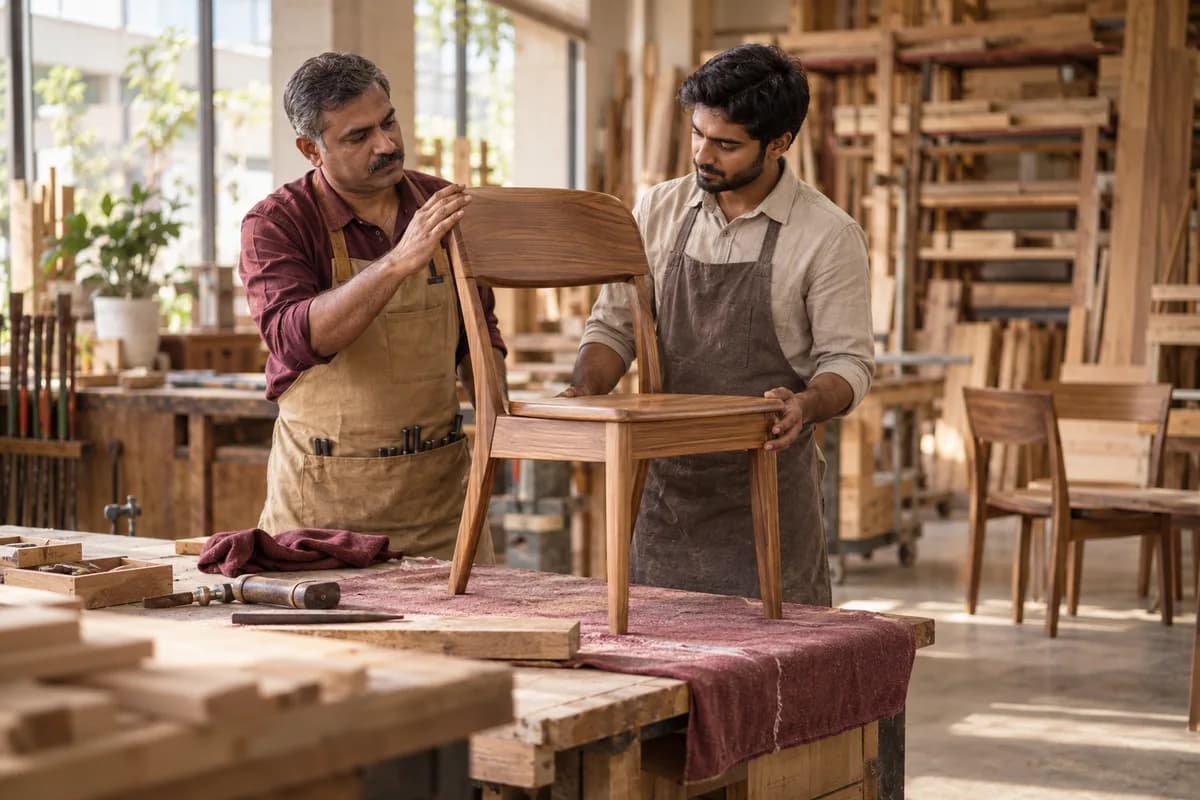
You make sofas, divans, wardrobes, dining sets and office workstations. Some are catalogue models for dealers. Many are built to order, with the buyer’s carcass width, upholstery swatch and veneer shade pencilled on a drawing.
Each made-to-order piece is a small project, with a sketch, a board list and a handover date already promised across the counter. Two products meet at that order number. One faces the showroom, the other faces the saw.
An order arrives from the showroom, a designer or an office fit-out, each in its own format. Someone sketches it and lists pre-lam board, MDF, laminate sheets, PVC edge tape, soft-close hinges, telescopic drawer channels and fabric from memory, and an advance is collected. The sketch then travels to the factory as a phone photo.
The supervisor books the beam saw, assigns carpenters and sends frames out for PU lacquer or upholstery on a dispatch slip, which is what the factory calls job work. Meanwhile the storekeeper eyeballs the racks. Plywood and fittings are bought only after a shortage is shouted across the shop.
Finished pieces are inspected for edge chipping, shade mismatch and drawer alignment, then wrapped in foam sheet and corrugated board. They leave with an invoice and a delivery note. Fitters assemble them at the customer’s flat, and the balance payment waits for their signature.
What goes wrong for furniture manufacturers without a proper system.
What we would build for furniture manufacturers.
Named the way your team already talks about the work. We start with whichever part the audit shows is costing you most.
A requirements checklist for furniture manufacturers.
What to cover, which reports to ask for and what to put to every vendor, ready to print or save as a PDF.
Ready products we start from for furniture manufacturers.
Each one is adapted to how your business works before it goes live, and anything your trade needs that it lacks is added then. You are not paying to build the basics again.
Furniture Showroom Management Software
Display and warehouse stock, quotations, custom orders in fabric and finish, advance and balance payments, delivery and fitting schedules and after-sales complaints for furniture showrooms.
Learn moreManufacturing Production Management Software
Work orders, multi-level bill of materials, job cards by stage, bar and sheet issue, rejection reasons, subcontracted job work, dispatch and tax billing for manufacturers.
Learn moreOther products in the same sector as furniture manufacturers.
- Adhesive Manufacturer Management Software
- Aerospace Manufacturer Management Software
- Aerospace CNC Part Manufacturer Management Software
- Aerospace Fabrication Company Management Software
- Aerospace Tooling Company Management Software
- Agricultural Implement Manufacturer Management Software
- Agricultural Pump Manufacturer Management Software
- Aluminium Die Casting Company Management Software
- API Manufacturer Management Software
- Apparel Manufacturer Management Software
- Auto Parts Manufacturer Management Software
- Automation Equipment Manufacturer Management Software
- All industry products
The business modules furniture manufacturers use most.
Each one is also available on its own, or inside a system built for you.
- Stock Tracking and Alerts
- Order Management
- Product Management
- Estimate/Quotation Management
- Invoice Management
- Price Lists and Schemes
- Multi-Branch Consolidation
- Payroll Management
- Bill of Materials
- Work Order Management
- Production Planning
- Quality Control
- Job Work Management
- Purchase Order Management
- Vendor Management
- Warehouse Management
- All business solutions
All solutions by area
- Applicant Tracking (5)
- CRM (8)
- Finance & Accounting (10)
- Helpdesk (4)
- Human Resources (13)
- Inventory Management (5)
- Project Management (7)
- Manufacturing (6)
- Procurement (4)
- Sales and Distribution (6)
- Field Service (5)
- Statutory and Compliance (4)
- Retail and POS (4)
- Bookings and Appointments (3)
- Subscriptions (2)
- Assets and Fleet (4)
- Platform (6)
- Analytics (2)
- Documents (1)
Where AI can help furniture manufacturers.
Each one reads records you already keep, and a person approves every decision.
The services behind it.
ERP, CRM and Business Software Implementation
One record of stock, orders, customers and accounts, set up so your team opens it every day.
Learn moreCustom Software and Product Engineering
Software built around how your business actually runs, when nothing off the shelf fits without workarounds.
Learn moreBusiness Process Automation
Approvals, reminders, follow-ups and reports that run on their own instead of on someone remembering.
Learn moreData Engineering and Business Intelligence
Dashboards that answer the owner’s Monday questions without anyone building an Excel sheet first.
Learn moreAll our other services
- Software Maintenance, Support and Rescue
- AI and Intelligent Automation
- API and System Integration
- UI/UX Design and Prototyping
- Cloud Engineering and Managed Infrastructure
- DevOps & Automation Services
- QA and Software Testing
- Performance Engineering
- Cybersecurity and Application Security
- IoT and Edge Computing
- Technology Strategy and Product Consulting
- E-Commerce and Digital Commerce
- MVP Product Development
- Web and Mobile Application Development
- SaaS Product Development
- WhatsApp Business API and Chatbots
- Data Migration and Moving Off Spreadsheets
- Training and Adoption
- Data Protection and Privacy Readiness
- Tax and e-Invoice Engineering
- Managed IT Support
- Dedicated Team and Staff Augmentation
- Business Intelligence and Reporting Tools
- Cloud Cost Optimisation
- Global Compliance and Localisation
Written for furniture manufacturers.
Practical notes on running the business, not product marketing.
How the work runs from Bengaluru for your city.
- 1
The audit, by call
A screen-share and a look at the sheets, accounting reports and WhatsApp groups your team uses. No travel needed.
- 2
A written proposal
Scope, what we build first and the cost, agreed in writing before anything starts.
- 3
Build in short rounds
Working screens shared every few weeks. Your team tests them from your own office.
- 4
Go-live, in person when it helps
For data migration and training we can come to your city. Travel is agreed in advance.
- 5
Support online
Fixes, changes and hosting handled remotely by the same team that built it.
The work we have published.
We only name clients whose work is published. None of them is in this trade; they show how the team works, not that it has built for this trade.
PetSeva: matching owners to the right vet, at any hour
A two-sided veterinary platform where vets are searchable by specialisation and bookable outside clinic hours. It now carries more than 2,000 veterinary doctors.
Read the case study Paying guest accommodationSAM Atithi Pavathi: bed-level occupancy as the source of truth
PG management software where allocation, rates and invoices are derived from bed-level occupancy and not maintained in parallel spreadsheets.
Read the case study School transport servicesSAM Tours: school transport on a single ledger
Registration, fee collection, routing and finance write to the same records, closing the gap between journeys run and fees collected.
Read the case study Microfinance and Self Help GroupsVikasa RDO: making SHG loan recovery auditable
Loan proposals, recoveries and commissions sit on one record, with a person attached to every state change, so a business handling a bank’s money can show where each rupee went.
Read the case studyQuestions furniture manufacturers ask before they call.
Is the furniture showroom software enough for a factory?
On its own, no. It handles quotations, stock, orders and deliveries at the showroom counter. Production management software carries the shop floor: material lists, work orders, stage-wise job cards and frames sent out to vendors.
Can we see what a made-to-order piece actually cost?
Not as a ready-made figure. Board, fittings, job work and piece-rate output are recorded against the work order, and a costing report built on them is quoted during implementation.
Will our accountant get an export file?
Not in the standard set-up. Sales, purchase and job work figures can be read inside GullySystem, and an export file is quoted once your ledger heads are fixed. Tax filing stays with your accountant, since rules differ by country.
Can the supervisor use it on the floor?
Yes. Work orders and job cards open on a phone, so the supervisor can mark cutting, edge banding, assembly, lacquer or packing complete while standing at the bench.
What moves the furniture factory system quotation?
Choosing showroom-to-factory orders first, or cutting lists, or job work slips, changes the base most. Factories and showrooms matter, as do users. Piece-rate sheets to move can change the total. Showroom-to-factory orders can be priced alone.
Gathering for the furniture factory system: what first?
Bring showroom orders, sample cutting lists, stock sheets for boards and delivery schedules. Contacts from a supervisor, the storekeeper and the showroom are needed. Samples of sample cutting lists help most.
Who owns the work orders after we stop?
The factory keeps the source code, work orders, material lists and job work slips. Plain-file exports cover work orders, material lists and job work slips. Work orders support stays in-house.
What happens after I share my requirements?
An engineer reads what you send and replies within one business day. We then look at the software, spreadsheets and WhatsApp groups your business runs on today and write down what works, what slows your team down and what is missing. A demo login, a screen-share or a few screenshots are enough. You get a short written summary ordered by priority, with no obligation to hire us afterwards.
How much will the software cost?
We don’t publish a price, because it depends on what the system has to do. That first review settles the scope, and the cost goes into a written proposal before any work starts.
Bengaluru areas with many furniture manufacturers.
Cities where furniture manufacturers are common.
Related industries.
- Adhesive manufacturers
- Aerospace and aviation manufacturers
- Aerospace CNC part manufacturers
- Aerospace fabrication companies
- Aerospace tooling companies
- Agricultural implement manufacturers
- Agricultural pump manufacturers
- Aluminium die casting companies
- API manufacturers
- Apparel manufacturers
- Auto parts manufacturers
- Automation equipment manufacturers
- Automotive component manufacturers
- Automotive fastener manufacturers
- Automotive plastics manufacturers
- Avionics hardware manufacturers
- Bakery product manufacturers
- Battery pack manufacturers
- Bearing manufacturers
- Beverage manufacturers
- Blow moulding companies
- Brake component manufacturers
- Cabinet manufacturers
- Cable and wire manufacturers
- Capsule manufacturers
- Cement product manufacturers
- Chemical manufacturers
- Cleaning product manufacturers
- CNC bending shops
- CNC machining companies
- CNC milling shops
- CNC turning shops
- Cold forging companies
- Commercial furniture manufacturers
- Commercial printers
- Commercial refrigeration companies
- Compressor manufacturers
- Concrete block manufacturers
- Construction chemical manufacturers
- Construction material manufacturers
- Contract pharma manufacturers
- Control panel manufacturers
- Conveyor belt manufacturers
- Conveyor manufacturers
- Corrugated box manufacturers
- Countertop manufacturers
- Deep drawing companies
- Defence component manufacturers
- Diagnostic equipment manufacturers
- Digital printers
- Door and window manufacturers
- Drone component manufacturers
- Electric motor manufacturers
- Electrical equipment manufacturers
- Electronic manufacturing services providers
- Electronic product manufacturers
- Embedded systems companies
- Energy storage system manufacturers
- Engine component manufacturers
- Engineering plastics processors
- EV charger manufacturers
- EV component manufacturers
- Fabric manufacturers
- Farm machinery manufacturers
- Fastener manufacturers
- Five-axis machining shops
- Flexible packaging manufacturers
- Flour mills
- Folding carton manufacturers
- Food ingredient manufacturers
- Food manufacturers
- Food packaging manufacturers
- Food processing machinery manufacturers
- Forged automotive parts manufacturers
- Foundry component manufacturers
- Frozen food manufacturers
- Gear manufacturers
- Gravity die casting companies
- Herbal product manufacturers
- Home appliance manufacturers
- Home textile manufacturers
- Hospital furniture manufacturers
- Hot forging companies
- Household plastics manufacturers
- Household products manufacturers
- Hydraulic component manufacturers
- Industrial chemical manufacturers
- Industrial cleaning chemical manufacturers
- Industrial electronics manufacturers
- Industrial enclosure manufacturers
- Industrial lighting manufacturers
- Industrial packaging manufacturers
- Industrial printing companies
- Industrial pump manufacturers
- Industrial repair companies
- Industrial rubber parts manufacturers
- Industrial sensor suppliers
- Injection moulding companies
- Investment casting companies
- IoT device manufacturers
- Iron foundries
- Irrigation equipment manufacturers
- Jig and fixture makers
- Kitchenware manufacturers
- Label and sticker printers
- Label manufacturers
- Laser cutting shops
- Lighting manufacturers
- Machine tool manufacturers
- Machine vision companies
- Machinery manufacturers
- Material handling equipment manufacturers
- Medical device manufacturers
- Medical disposables manufacturers
- Medical equipment manufacturers
- Medical plastics manufacturers
- Metal fabricators
- Metal stamping companies
- Modular furniture manufacturers
- Nutraceutical manufacturers
- Office furniture manufacturers
- Offset printers
- Orthopaedic implant manufacturers
- Orthotics manufacturers
- Packaged food manufacturers
- Packaging film manufacturers
- Packaging machinery manufacturers
- Packaging manufacturers
- Paper bag manufacturers
- Paper product manufacturers
- Paver manufacturers
- PCB assembly companies
- PCB manufacturers
- Personal care product manufacturers
- Pharma packaging manufacturers
- Pharmaceutical manufacturers
- Pipe fitting manufacturers
- Plastic component manufacturers
- Plastic extrusion companies
- Plastic mould makers
- Plastic packaging manufacturers
- Plating companies
- PLC panel builders
- Plywood and timber dealers
- Plywood manufacturers
- Pneumatic component manufacturers
- Power distribution equipment manufacturers
- PPE manufacturers
- Precast concrete manufacturers
- Precision component manufacturers
- Precision forging companies
- Precision grinding shops
- Resin manufacturers
- Rice mills
- Rigid packaging manufacturers
- Robotic systems integrators
- Roll forming companies
- Roofing material manufacturers
- Rubber gasket manufacturers
- Rubber hose manufacturers
- Rubber moulding companies
- Sand casting foundries
- SCADA system integrators
- School furniture manufacturers
- Seal and O-ring manufacturers
- Sensor manufacturers
- Shaft manufacturers
- Sheet metal fabricators
- Silicone component manufacturers
- Snack manufacturers
- Solar component manufacturers
- Solar inverter manufacturers
- Solar mounting structure manufacturers
- Solar panel manufacturers
- Solvent manufacturers
- Special purpose machine builders
- Specialty chemical manufacturers
- Spice manufacturers
- Spring manufacturers
- Stainless steel fabricators
- Stationery manufacturers
- Steel foundries
- Steel mills
- Structural steel fabricators
- Surgical instrument manufacturers
- Suspension component manufacturers
- Switchgear manufacturers
- Tablet manufacturers
- Technical textile manufacturers
- Textile processors
- Tile manufacturers
- Tool rooms
- Toy manufacturers
- Tractor attachment manufacturers
- Transformer manufacturers
- Uniform manufacturers
- Valve manufacturers
- VMC machining shops
- Water treatment chemical manufacturers
- Water treatment companies
- Welding shops
- Wind turbine component manufacturers
- Wire EDM shops
- Wiring harness manufacturers
- Wooden door manufacturers
- Yarn manufacturers
Part of a wider group.
Also sell online?
The e-commerce pages cover the online side of this trade: storefronts, dealer ordering and the link to your stock.
Tell us how your business runs today.
A few lines on your spreadsheets, software and WhatsApp groups is enough. We reply the same working day.
What happens after you share your requirements
- A senior engineer reads your answers. Nobody phones first.
- Within one business day you get a written note: what we understood, what we would start with, and the questions we still have.
- If it fits, a proposal follows with the order of work, what we need from you and what you receive at each step.
- No call is booked and nothing is paid until you have read the note. Your details stay with us.
Start with your requirements
Seven short steps that tell us what you need. A senior engineer reads them before anyone gets in touch.
Share your requirements